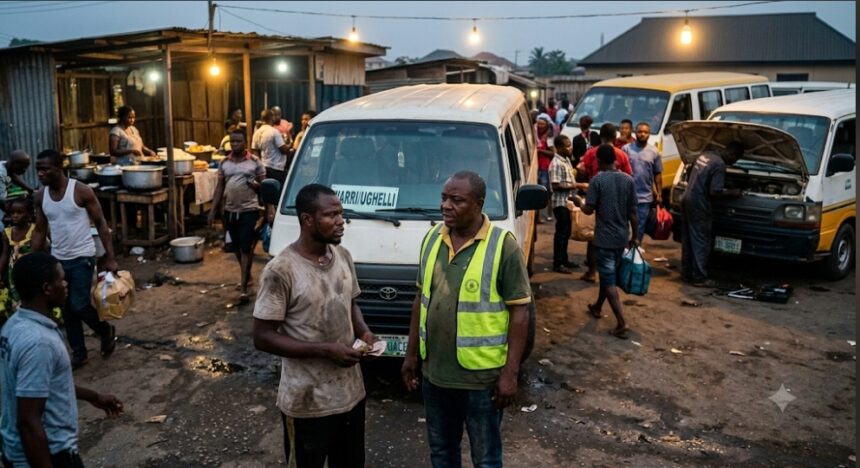
Long before daylight breaks over Asaba, Delta State, the city’s major motor parks are already in motion as drivers, conductors, mechanics, traders and passengers begin another day in an environment where economic pressures have become part of daily life.
At Summit and Koka motor parks, the sounds of revving engines, loading buses and destination calls create an atmosphere of activity, but beneath the routine lies a deeper struggle driven by rising living costs, expensive fuel, deteriorating roads and shrinking purchasing power.
For many of those who depend on the transport ecosystem for survival, the parks serve as more than departure points because they are workplaces, marketplaces and critical sources of income for thousands of households.
Food sellers prepare meals for early travellers while mechanics inspect vehicles before departure and passengers hurry to secure seats, creating a scene that reflects both movement and resilience.
Although the parks remain busy, many workers say the realities of the current economy have significantly altered how they earn a living.
As passengers move through Summit Motor Park, the Vice Chairman Of The Park, Comrade Anthony Okonkwo, oversees activities and monitors interactions between transport operators and commuters.
According to him, maintaining order remains essential to ensuring the safety and efficiency of operations within the facility.
“Our responsibility is to manage both passengers and drivers,” he said.
“We ensure vehicles load properly and passengers travel safely to their destinations
“Everything became more expensive almost overnight. Fuel prices increased. Spare parts became costly. Maintaining vehicles became difficult.”
He noted that transport operators now face a difficult decision whenever costs rise because increasing fares often attracts complaints from passengers who are also dealing with economic hardship.
For commercial driver Tony Ogaga Owhotemu, who operates routes between Asaba, Ughelli and Warri, every working day comes with uncertainty over passenger turnout and operating expenses.
“I resume whenever passengers begin to come,” he said.
“Sometimes I close late in the evening depending on business.”
He explained that fuel now consumes a substantial portion of daily earnings, leaving little room for profit.
“Most of the money we make now goes into buying fuel,” he noted.
Owhotemu observed that many travellers have reduced the frequency of their journeys because transport fares have increased significantly.
“People think carefully before making a journey because transport fares have increased,” he said.
He also cited delays caused by road officials as another challenge affecting productivity.
“Sometimes we are stopped several times on one journey. All these things affect our work,” he says.
Despite the difficulties, he continues to report to work because driving remains his primary source of livelihood.
“This is what feeds my family,” he says.
Another driver, Anthony Eze, believes road safety has become one of the biggest concerns facing transport operators.
He recalled surviving an accident caused by a failed tyre, an experience that continues to influence his approach to driving.
“I had an accident because one of my tyres failed,” he says.
Eze noted that the cost of replacing tyres and vehicle parts has risen sharply, forcing some operators to delay essential maintenance.
“Some people continue using tyres that should have been changed because they simply cannot afford new ones,” he concluded.
For many people passing through Asaba’s motor parks each day, the journey extends beyond transportation, reflecting a broader struggle for survival in an economy where resilience remains one of the few resources still widely available.