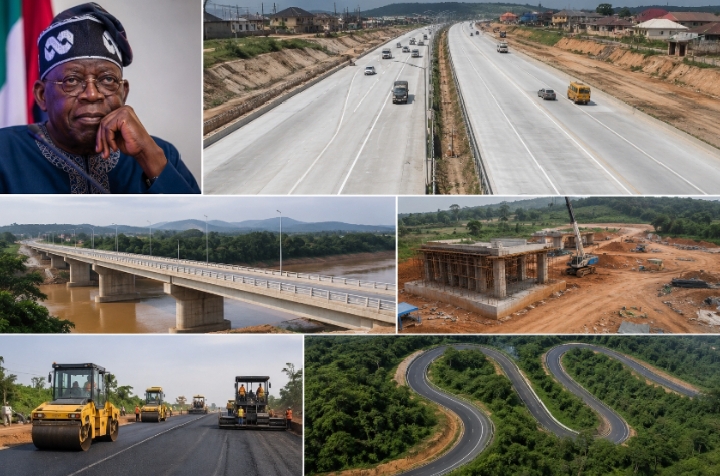
Every major road carries more than vehicles. It carries memories of journeys that took longer than expected, businesses that struggled because goods arrived late, families that endured dangerous trips, farmers who watched produce spoil before reaching markets, plus communities that waited year after year for promises to become reality. Across Nigeria, some highways have become symbols of economic strength while others have become reminders of how difficult it can be to turn ambitious plans into completed infrastructure.
Fresh approvals announced by President Bola Tinubu have once again placed some of Nigeria’s biggest transport projects at the center of national attention. Behind every approval lies a much longer story that stretches across different administrations, changing economic realities, rising construction costs, difficult engineering conditions, plus decades of public expectation. Each project carries its own history, yet together they reveal a larger picture of how Nigeria’s road network has evolved through years of progress, interruptions, renewed commitments, plus changing priorities.
Many of these projects did not begin with the present administration. Several have existed as proposals for decades while others have passed through multiple governments before reaching another important stage. Their histories are filled with major decisions, changing designs, funding challenges, technical obstacles, plus repeated efforts to keep construction moving despite difficult circumstances. Understanding where these projects began offers a clearer picture of why their latest approvals have attracted widespread attention across the country.
A journey stretching across decades
Road construction has always played a central role in Nigeria’s national development. Since independence, successive governments have viewed transport infrastructure as one of the strongest tools for expanding trade, improving security, connecting rural communities, plus encouraging investment. Every generation has inherited unfinished projects from the one before it, creating a long cycle of planning, construction, suspension, revival, plus eventual completion in some cases.
Economic conditions have often determined the pace of these developments. During periods of stronger government revenue, large infrastructure projects moved faster. Whenever national income declined or inflation increased sharply, construction slowed as available funds became more difficult to sustain. Several projects therefore became victims of circumstances rather than engineering limitations alone, leading to years of delays that stretched far beyond their original completion schedules.
Population growth also transformed many roads beyond what their original designers anticipated. Highways that once comfortably handled traffic gradually became overwhelmed as commercial activities expanded, cities grew larger, freight movement increased, plus millions of additional vehicles entered Nigeria’s roads. Infrastructure designed for one era eventually struggled to serve another, making reconstruction almost as important as entirely new construction.
President Bola Tinubu’s latest approvals therefore represent another chapter within this much longer national infrastructure story. Rather than beginning entirely new conversations, several approvals continue projects whose foundations were laid many years earlier, reflecting how large scale transport development often extends beyond a single administration.
Lagos Ibadan Expressway becomes Nigeria’s busiest highway
Among every project receiving renewed attention, none carries greater historical importance than the Lagos Ibadan Expressway. Commissioned in 1978 during General Olusegun Obasanjo’s military administration, the highway became Nigeria’s first modern expressway, establishing a direct connection between Lagos, Ibadan, plus the larger northern corridor. At the time of its construction, it represented one of the country’s most ambitious transport investments because it linked the nation’s commercial center with major economic destinations across several states.
Commercial activity expanded rapidly during the decades that followed. Lagos continued growing into one of Africa’s largest cities while the ports at Apapa plus Tin Can Island handled increasing volumes of imported goods. Heavy trucks transporting cargo across Nigeria relied almost entirely upon the expressway, creating constant pressure that gradually exceeded the road’s original design capacity. Interstate buses, petroleum tankers, private vehicles, plus commercial transport operators shared the same corridor every day, making it the busiest highway anywhere in the country.
Maintenance gradually became more difficult as traffic volumes continued rising. By the early 2000s, sections of the highway had developed deep potholes while failed portions of the pavement contributed to traffic congestion stretching for several kilometres. Motorists regularly spent long hours trapped in gridlock, accident rates increased, transport costs climbed higher, plus businesses experienced repeated delays moving goods between Lagos, Ibadan, plus other parts of Nigeria.
Calls for comprehensive reconstruction grew louder throughout the country. Businesses, transport unions, state governments, plus ordinary commuters all agreed that the highway required more than routine maintenance because decades of heavy use had weakened much of its original structure. Rather than isolated repairs, experts increasingly recommended complete reconstruction capable of supporting modern traffic demands.
Reconstruction enters a new chapter
President Goodluck Jonathan formally flagged off a major reconstruction programme in 2013, approving a project valued at ₦167 billion. Construction responsibilities were divided between Julius Berger Nigeria Plc plus Reynolds Construction Company, commonly known as RCC. The objective extended beyond repairing damaged sections because engineers intended to widen major portions of the expressway while improving drainage, interchanges, plus road safety infrastructure.
Progress continued under President Muhammadu Buhari after 2015, although construction experienced several interruptions linked to funding availability, changing contract schedules, plus the practical challenges of rebuilding one of Nigeria’s busiest highways while traffic continued using large sections of the road. Engineers frequently balanced active construction with continuous movement of thousands of vehicles every day, making the project considerably more complex than ordinary road expansion.
Large portions eventually reached completion after years of steady work. Motorists gradually experienced improved travel times across completed sections while commercial movement became more efficient. Despite those achievements, certain portions continued showing signs of distress because heavy truck traffic remained constant, placing enormous pressure upon sections exposed to some of the country’s highest freight volumes.
Fresh concerns emerged during 2026 when Minister of Works David Umahi disclosed that portions around the Ibadan corridor had begun showing structural failures. Rather than repeating earlier construction methods, President Tinubu approved reconstruction using reinforced concrete pavement, reflecting a significant engineering decision intended to improve durability under continuous heavy traffic.
Why reinforced concrete became the preferred option
Road construction materials have remained one of the most important technical decisions within highway engineering. Asphalt has traditionally served as Nigeria’s preferred pavement because it is generally faster to install, easier to repair, plus initially less expensive. Continuous exposure to overloaded trucks, however, gradually weakens asphalt surfaces, particularly where maintenance schedules become inconsistent over long periods.
Reinforced concrete offers different advantages despite requiring higher initial investment. Concrete roads generally withstand greater axle loads, resist deformation caused by heavy freight vehicles, plus often remain serviceable for several decades before requiring major rehabilitation. Engineers also argue that concrete performs better under constant pressure created by petroleum tankers, container trucks, plus other heavy commercial vehicles using major economic corridors every day.
Government officials have therefore presented the latest decision as a long term investment rather than a short term solution. Although construction costs may initially increase, reduced maintenance requirements could lower future expenditure while improving reliability for motorists, freight operators, plus businesses depending upon uninterrupted transport between Lagos, Ibadan, plus the rest of Nigeria.
This engineering transition also reflects broader efforts to strengthen infrastructure capable of supporting future economic expansion. Roads expected to carry increasing freight volumes over coming decades require construction methods designed for higher durability, making reinforced concrete an increasingly attractive option for heavily trafficked national highways.
Fourth Legacy Highway opens a fresh corridor
Unlike the Lagos Ibadan Expressway, the Fourth Legacy Highway does not represent reconstruction of existing infrastructure. Rather, it forms part of a broader vision aimed at creating entirely new transport corridors capable of supporting future national growth. President Tinubu’s administration introduced the Legacy Projects concept as part of wider plans to strengthen connectivity across multiple regions while opening new opportunities for investment, agriculture, commerce, plus industrial development.
Early plans placed the highway’s proposed length at approximately 700 kilometres. Following additional approvals during 2026, another 400 kilometres received approval, expanding the planned corridor to approximately 1,100 kilometres. The expansion reflects growing emphasis upon extending transport links beyond existing commercial centers toward communities that historically experienced limited road connectivity.
Strategic transport corridors often produce economic effects extending far beyond travel alone. Improved highways encourage businesses to establish new operations, reduce transportation costs for agricultural products, improve emergency response capabilities, attract private investment, plus increase access between rural communities plus urban markets. Roads frequently become catalysts for broader economic activity because they connect producers directly with consumers while reducing the time required to move goods across long distances.
Planning entirely new corridors also allows engineers greater flexibility than reconstruction projects. Rather than working around existing infrastructure, designers can incorporate modern standards from the beginning, including improved drainage systems, wider carriageways, better safety features, plus designs intended to accommodate future traffic growth without requiring immediate expansion.
Ibi Bridge carries decades of expectation
Residents of Ibi in Taraba State have long understood the importance of reliable river crossings. Located within an important riverine area, the community has depended heavily upon ferries plus boats for transportation across surrounding waterways, particularly during periods when water levels rise significantly. Seasonal changes often complicated movement, affecting access to schools, healthcare facilities, markets, plus government services.
Discussion surrounding construction of the Ibi Bridge has continued for many years across different administrations. Community leaders, traditional institutions, public officials, plus residents consistently highlighted the need for permanent road access capable of operating throughout every season. Despite widespread recognition of its importance, competing national priorities plus funding limitations repeatedly delayed progress toward full implementation.
River bridge construction presents engineering demands different from ordinary highways. Extensive geological surveys, foundation design, hydraulic studies, environmental assessments, plus specialised construction techniques are necessary before major bridge works begin. These technical requirements often increase overall project costs while extending planning timelines well beyond those associated with conventional road construction.
President Tinubu’s latest approval places renewed attention upon completing infrastructure capable of transforming daily life within surrounding communities. Reliable bridge access promises more consistent transportation regardless of seasonal river conditions while strengthening links between remote settlements plus larger commercial centers throughout Taraba State.
Lau Bridge strengthens regional access
Another major approval focuses upon construction of the 5.76 kilometre Lau Bridge across the Benue River. Like Ibi, surrounding communities have experienced transportation limitations caused by dependence upon river crossings that become increasingly difficult during periods of flooding or intense rainfall. Travel interruptions have affected commercial activities, emergency response, agricultural movement, plus ordinary daily transportation for many years.
Permanent bridge infrastructure changes far more than travel routes. Farmers gain more dependable access to markets, healthcare workers reach isolated communities more quickly, security agencies improve operational mobility, plus students experience more reliable transportation throughout the academic year. Stable road connections often encourage businesses to expand because year round accessibility reduces commercial uncertainty.
Construction across major rivers also strengthens regional integration by reducing physical barriers that previously separated neighbouring communities. Economic relationships become stronger when movement remains consistent throughout every season rather than depending upon changing weather conditions or limited ferry availability.
Approval of the Lau Bridge therefore represents another effort to close longstanding infrastructure gaps that have limited development despite the economic potential existing within surrounding areas. Reliable access frequently becomes the foundation upon which broader regional growth gradually develops over time.
East West Road remains nationally significant
Few highways carry greater economic importance than the East West Road. Connecting Delta, Bayelsa, Rivers, Akwa Ibom, plus Cross River states, the corridor serves as one of Nigeria’s most important transport routes through the Niger Delta. Oil production, petroleum distribution, commercial trade, passenger transportation, plus industrial activity all depend heavily upon reliable movement across this highway.
Construction began under previous administrations with ambitious expectations that the completed road would transform transportation throughout the region. Progress nevertheless became slower than originally anticipated because engineers encountered some of the country’s most difficult construction environments. Extensive wetlands, swampy terrain, unstable soil conditions, plus numerous water crossings required specialised engineering solutions that significantly increased both costs plus construction complexity.
Funding limitations created additional obstacles over several years. Large infrastructure projects require consistent financial support across extended periods, yet changing economic conditions often disrupted available funding. Contractor disputes, revised project schedules, inflation, plus rising material costs further complicated implementation, causing repeated delays before certain sections could progress toward completion.
Several completed portions have already improved travel across parts of the Niger Delta, although substantial work remains necessary before the wider vision becomes fully realised. President Tinubu’s approval covering an additional 400 kilometres of dualisation continues efforts already pursued over many years, reflecting another stage within one of Nigeria’s longest running transport infrastructure programmes.
Challenges shared across generations
Although each approved project possesses its own unique history, several common patterns appear throughout their development. Rising construction costs have repeatedly affected national infrastructure because prices of cement, steel, fuel, machinery, plus imported equipment rarely remain stable throughout lengthy project timelines. Budget estimates prepared during one period often require revision before completion because economic conditions change significantly.
Government transitions have also influenced project continuity across different administrations. Every incoming government reviews inherited infrastructure commitments before determining funding priorities. While many projects continue, revised policies, changing budget allocations, plus administrative reviews sometimes slow implementation before construction resumes.
Engineering conditions present another consistent challenge. River crossings require specialised bridge foundations while swampy environments demand advanced ground stabilisation techniques. Existing highways undergoing reconstruction must frequently remain open to traffic, creating additional logistical difficulties for contractors attempting to balance public safety with continuous construction activities.
Contract administration has likewise shaped project timelines across multiple decades. Changes in project scope, revised contract values, funding releases, plus technical modifications often require new approvals before construction advances further. These processes may appear administrative on paper, yet they frequently determine whether projects move steadily toward completion or experience lengthy interruptions.
Latest approvals become another milestone
Major infrastructure rarely reaches completion within a single political cycle because planning, financing, engineering, procurement, plus construction each require considerable time. Nigeria’s largest highways therefore reflect cumulative efforts extending across multiple administrations rather than belonging exclusively to one government. Every completed section often represents years of planning combined with decisions taken long before visible construction begins.
President Bola Tinubu’s latest approvals continue that long national journey by advancing projects whose origins stretch across different decades, different governments, plus changing economic circumstances. Reconstruction of the Lagos Ibadan Expressway using reinforced concrete introduces a new engineering approach for one of Nigeria’s busiest transport corridors, while approvals covering the Fourth Legacy Highway, Ibi Bridge, Lau Bridge, plus further dualisation of the East West Road extend infrastructure development into areas where improved connectivity could reshape economic activity for generations.
Each project stands as a reminder that roads are far more than concrete, steel, plus asphalt. They become pathways connecting businesses with markets, farmers with consumers, students with schools, patients with hospitals, plus communities with opportunities that might otherwise remain beyond reach. Their histories reveal decades of ambition, interruption, perseverance, plus renewed commitment, making the latest approvals not merely announcements of fresh construction but another important chapter within Nigeria’s continuing effort to build a stronger national transport network for the future.
Lasting impact beyond construction
Road infrastructure rarely changes a country the day construction begins. Its real value becomes clearer years after completion, when businesses begin expanding into new locations, transport operators reduce travel time, manufacturers receive raw materials more efficiently, plus farmers gain faster access to larger markets. Every kilometre completed creates opportunities that extend well beyond the road itself, gradually influencing economic activity across entire regions.
Nigeria’s experience has repeatedly shown that improved highways encourage population growth around transport corridors. New filling stations, hotels, warehouses, markets, logistics centres, plus small businesses often emerge wherever major roads create easier access. Communities that once depended on difficult routes gradually become commercial centres because reliable transportation attracts both private investment plus public services.
Education also benefits from stronger transport infrastructure. Students living in remote communities spend less time travelling to schools while teachers can reach rural areas more consistently throughout the academic year. Medical personnel face fewer transportation challenges when responding to emergencies, especially where bridges replace seasonal river crossings that previously delayed movement during periods of flooding.
Security operations equally become more effective once difficult terrain becomes accessible throughout the year. Law enforcement agencies, emergency responders, plus humanitarian organisations are better positioned to reach isolated communities quickly whenever assistance becomes necessary. Faster movement often translates directly into quicker response times during emergencies, reducing risks that previously existed because of poor accessibility.
Why many national projects require decades
Large infrastructure projects often appear straightforward from public announcements, yet construction usually begins long before physical work becomes visible. Engineers first conduct detailed feasibility studies, traffic projections, environmental assessments, geological investigations, plus route surveys before any contract reaches the execution stage. These technical exercises sometimes require years because each decision influences the safety plus durability of the finished structure.
Funding arrangements also play a decisive role. Governments rarely release the entire cost of massive highway projects at once, particularly when several national priorities compete for available resources. Annual budget allocations, supplementary appropriations, plus financing agreements frequently determine how much work contractors can complete within each construction season.
Weather conditions create another unavoidable reality. Heavy rainfall can interrupt earthworks, bridge foundations, pavement laying, plus drainage construction for extended periods. Riverine environments become even more challenging because fluctuating water levels influence construction schedules, equipment movement, plus worker safety. Delays caused by seasonal conditions are therefore often built into long term project planning.
Changing engineering standards sometimes extend construction timelines as well. Roads initially designed decades earlier may require redesign before completion because traffic forecasts increase, vehicle weights become heavier, or updated safety standards demand wider carriageways, stronger bridges, plus improved drainage systems. Such revisions increase costs but often improve the long term performance of completed infrastructure.
Lessons from previous administrations
Every administration that handled these projects contributed another layer to their development, whether through planning, funding, contract awards, construction, or technical redesign. Major infrastructure therefore reflects institutional continuity rather than isolated political achievements. Roads lasting several decades often require consistent commitment across changing governments before reaching completion.
The Lagos Ibadan Expressway provides one of the clearest examples of this pattern. Originally commissioned in 1978, its later reconstruction involved major interventions under President Goodluck Jonathan beginning in 2013, accelerated construction under President Muhammadu Buhari after 2015, plus another engineering phase approved by President Bola Tinubu during 2026. That sequence illustrates how nationally significant infrastructure frequently evolves across generations instead of within a single administration.
The East West Road follows a similar history. Initial construction created important transport links across the Niger Delta, yet expansion plus dualisation continued through several governments because financial requirements, engineering complexity, plus regional conditions demanded sustained long term commitment. Every completed section became another step toward a larger national objective rather than the conclusion of the project itself.
Bridge projects within Taraba State demonstrate another lesson. Communities continued advocating for permanent crossings despite years of delays because local economic needs never disappeared. Public demand remained constant while governments gradually returned to the projects whenever funding plus policy priorities allowed. Persistence therefore became one of the defining characteristics behind many of Nigeria’s largest infrastructure programmes.
Looking beyond today’s approvals
Every approval announced during 2026 represents more than another government decision recorded on paper. Each one continues a story that began years, sometimes decades, earlier through planning documents, engineering studies, public consultations, plus repeated efforts to overcome financial or technical obstacles. Roads that eventually transform national development often spend many years moving through different stages before reaching completion.
The Lagos Ibadan Expressway now enters another phase built around reinforced concrete technology, reflecting lessons learned from decades of heavy commercial traffic. The Fourth Legacy Highway expands an entirely new transport vision designed to support future economic growth across multiple regions. The Ibi Bridge plus Lau Bridge seek to replace seasonal transportation uncertainty with permanent connectivity, while additional dualisation of the East West Road strengthens one of Nigeria’s most economically significant corridors.
Viewed together, these projects tell a broader national story about patience, planning, plus persistence. Their histories show that infrastructure capable of serving millions of people cannot be measured only by the day approvals are announced or contracts are signed. Their true significance lies in the decades of preparation that came before, the years of construction that follow, plus the generations that eventually depend upon them long after the headlines have faded.