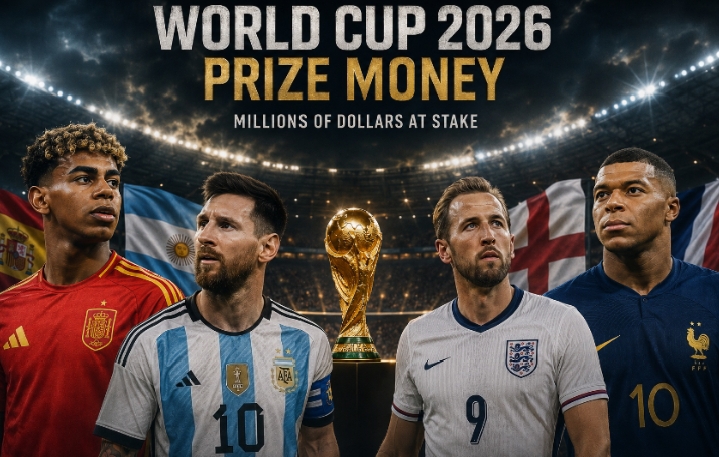
The FIFA World Cup 2026 has reached its conclusion, with every match ultimately carrying a financial value worth millions of dollars. While billions of football fans followed the race for the trophy, another contest unfolded behind the scenes, one measured in financial rewards, historic earnings and the value attached to every position on the final standings.
As Spain and Argentina completed their campaigns, the difference between victory, defeat and final placement carried a major financial impact. A World Cup title does not only deliver global recognition and football immortality, it also comes with the biggest share of FIFA’s record breaking financial distribution.
The FIFA Council approved a record breaking $727 million financial contribution connected to the FIFA World Cup 2026, creating one of the largest prize structures in the history of international football. The biggest share, $655 million, represents a 50% increase compared with the previous edition, reflecting the expanded tournament format and the growing commercial value of the competition.
For the teams that had already exited, the tournament journey still produced significant financial rewards. For the finalists, the last match determined which federation collected the biggest share of FIFA’s prize money. With Spain defeating Argentina in the final, the financial rankings are now complete, confirming the earnings attached to every finishing position.
FIFA World Cup 2026’s financial reward system
The 2026 World Cup introduced a larger financial structure designed to reward every participating nation while maintaining a strong connection between performance and earnings. With 48 teams competing across the United States, Canada and Mexico, FIFA expanded both the tournament format and the financial commitment attached to it.
The financial package combines guaranteed payments with performance based rewards. Every qualified nation receives preparation money before competing, while additional payments are determined by how far each team progresses in the tournament.
The preparation payment increased from $1.5 million to $2.5 million, giving all participating countries a guaranteed financial boost. The qualification or group stage payment also increased from $9 million to $10 million, meaning every nation began with a significant financial allocation before considering further progress.
The direct prize money structure remained focused on final tournament performance. The champion received $50 million, the runner up earned $33 million, the third placed team received $29 million, while the fourth placed nation collected $27 million.
When the preparation payment is added, the final earnings become higher for every position. This means the team lifting the trophy leaves with a combined financial package worth $52.5 million.
Spain’s World Cup 2026 triumph delivers the biggest payday
Spain’s victory over Argentina in the FIFA World Cup 2026 final secured not only the sport’s biggest prize but also the highest financial reward available at the tournament.
As world champions, Spain receive $50 million in FIFA prize money. Adding the $2.5 million preparation payment takes the country’s total earnings to $52.5 million, making Spain the highest earning nation at the tournament.
The triumph completes an outstanding World Cup campaign that rewarded Spain with football’s greatest honour alongside the largest financial payout approved by FIFA.
The difference between first and second place amounts to $17 million, highlighting the enormous financial value attached to lifting the World Cup trophy.
Argentina’s runner up finish still secures a major reward
Argentina’s journey ended with a second place finish after falling to Spain in the World Cup final. Although the defending champions missed out on retaining the trophy, they still secured the second highest financial reward of the competition.
The runner up receives $33 million in FIFA prize money. Combined with the $2.5 million preparation payment, Argentina’s total earnings amount to $35.5 million.
Reaching the final guaranteed Argentina one of the largest payouts available in international football. The campaign once again demonstrated the country’s consistency on football’s biggest stage while delivering a significant financial return to the Argentine Football Association.
England’s confirmed third place earnings
England finished the FIFA World Cup 2026 campaign in third place, securing one of the strongest financial outcomes of the tournament. The team’s final position earned the Football Association $29 million in FIFA prize money.
When the $2.5 million preparation payment is added, England’s total World Cup 2026 earnings stand at $31.5 million.
The third place finish places England among the highest earning teams of the tournament, behind only Spain and Argentina. The result represents a significant financial reward for reaching the final stages of the competition and completing the tournament among the world’s top 3 teams.
The payment gives the English football system additional resources that can support national team operations, youth development programmes, coaching structures and future football projects.
Although England fell short of reaching the final, the third place finish ensures the campaign remains one of the most financially valuable World Cup performances outside the championship match.
France’s confirmed fourth place earnings
France completed the FIFA World Cup 2026 tournament in fourth place, earning $27 million in direct FIFA prize money.
With the additional $2.5 million preparation payment included, France’s total earnings amount to $29.5 million.
The result places France among the top 4 teams of the competition and guarantees one of the largest financial returns available at the tournament. Reaching the semi finals already secured a significant reward, with the final position determining the additional value attached to their campaign.
France’s payment reflects the consistency required to reach the final stages of the World Cup. The team competed through several high pressure matches before securing a place among the four best nations in the tournament.
The $29.5 million received by France becomes another major financial contribution to the country’s football structure, supporting national team activities and long term development plans.
Quarter finalists’ completed World Cup 2026 earnings
The teams eliminated at the quarter final stage finished among the top 8 nations of the FIFA World Cup 2026 and secured a substantial financial return.
Each quarter finalist receives $19 million in FIFA prize money. Adding the $2.5 million preparation payment brings the total earnings for each team to $21.5 million.
These nations include Belgium, Morocco, Norway and Switzerland based on the final tournament breakdown.
Although they missed out on the final four positions, their quarter final appearances delivered one of the strongest financial outcomes available outside the semi finalists.
The payment rewards their progress through the tournament and provides additional funding opportunities for national football development, player preparation and future competitions.
Round of 16 teams’ completed World Cup 2026 earnings
Teams eliminated in the Round of 16 secured $15 million in FIFA prize money after progressing beyond the group stage and reaching the knockout phase.
The preparation payment increases their final tournament earnings to $17.5 million each.
Countries such as Brazil, Portugal, United States, Mexico, Colombia, Egypt, Canada and Paraguay fall into this category based on the tournament scenario.
For these nations, reaching the Round of 16 represents both a competitive achievement and a significant financial return. The expanded 48 team format created more opportunities for countries to progress into knockout football while receiving meaningful financial rewards.
Their earnings demonstrate that success at the World Cup is measured beyond winning the trophy. Every stage reached carries financial importance.
Round of 32 teams’ completed World Cup 2026 earnings
The introduction of the expanded FIFA World Cup 2026 format created a new competitive stage, giving more nations the opportunity to experience knockout football. Teams that reached the Round of 32 but were eliminated before the Round of 16 received a significant financial reward for their progress.
Each nation eliminated at this stage earned $11 million in FIFA prize money. Adding the $2.5 million preparation payment brought the total earnings to $13.5 million per team.
The payment represents the value attached to advancing beyond the group stage in a tournament featuring 48 teams. For many nations, reaching the knockout phase marks one of the strongest achievements in their football history and provides important financial support for future development.
The earnings can help national football associations strengthen their programmes, improve training structures, support youth development and prepare teams for future international competitions.
The expanded tournament format also ensured that more countries benefited financially from deeper participation, creating a wider distribution of World Cup revenue across global football.
Group stage teams’ completed World Cup 2026 earnings
The nations whose campaigns ended during the group stage still secured a major financial reward from FIFA’s record breaking World Cup distribution.
Each group stage team received $10 million as qualification payment, alongside the $2.5 million preparation money provided before the tournament. The combined amount means every team eliminated at this stage earned $12.5 million.
The payment guarantees that participation at the FIFA World Cup remains financially valuable even for teams that do not reach the knockout rounds. Qualification itself requires years of preparation, investment and competitive success, and FIFA’s structure ensures every participating federation receives meaningful financial support.
For developing football nations, the earnings can provide a foundation for future growth. National associations can use the funds to improve grassroots football, strengthen domestic competitions, develop young players and create better conditions for future national teams.
The group stage exits may have marked the end of their tournament journeys, but the financial contribution continues beyond the final whistle.
Complete FIFA World Cup 2026 earnings ranking
The final financial ranking of teams is determined by their finishing positions, combining FIFA prize money with the $2.5 million preparation payment allocated to every participating nation.
Spain, as champions, receive $52.5 million after combining the $50 million champion’s prize with the preparation payment.
Argentina, as runners up, receive $35.5 million after combining the $33 million runner up prize with the preparation payment.
England’s confirmed third place finish brings total earnings of $31.5 million after combining the $29 million third place prize with the preparation payment.
France’s fourth place finish delivers $29.5 million after adding the $2.5 million preparation payment to the $27 million fourth place prize.
Quarter finalists each earn $21.5 million after combining $19 million prize money with $2.5 million preparation support.
Round of 16 teams each earn $17.5 million after combining $15 million prize money with $2.5 million preparation support.
Round of 32 teams each earn $13.5 million after combining $11 million prize money with $2.5 million preparation support.
Group stage teams each earn $12.5 million after combining $10 million qualification payment with $2.5 million preparation support.
FIFA payments go to football associations, not players directly
The millions distributed after the FIFA World Cup 2026 do not go directly into the personal accounts of players. FIFA transfers the money to the national football associations representing each country.
The football federations then determine how the funds are used. Different associations may allocate portions of the money towards player bonuses, coaching staff payments, operational expenses, youth development projects, infrastructure improvement and other football related programmes.
Player rewards are usually determined through separate agreements between national teams and their football associations. The FIFA payment provides the financial foundation, while individual federations decide how much of the earnings are shared with players and staff.
This structure allows World Cup revenue to benefit the wider football system rather than serving only as a tournament bonus. A successful campaign can create opportunities that continue long after the competition ends.
For countries with established football structures, the money strengthens existing programmes. For developing football nations, the funds can become a major investment opportunity capable of shaping the next generation of players.
The financial legacy of the 2026 World Cup
The FIFA World Cup 2026 represents a new financial era for international football. With a record breaking $727 million contribution approved by FIFA, the tournament created one of the largest reward systems ever attached to the competition.
The increase from previous editions reflects the growth of football’s global audience, the expansion to 48 teams and FIFA’s commitment to distributing more resources among participating nations.
From Spain receiving $52.5 million as champions to the group stage teams securing $12.5 million, every nation involved leaves with a financial reward linked to its World Cup journey.
Spain, Argentina, England, France and the other participating teams have shown how every stage of the tournament carried both sporting and economic significance. The final positions determined the largest payouts, but every country that reached the world stage leaves with a valuable financial contribution.
The 2026 World Cup will ultimately be remembered for its goals, champions and unforgettable moments, while the financial figures reveal another historic chapter in the tournament’s legacy.