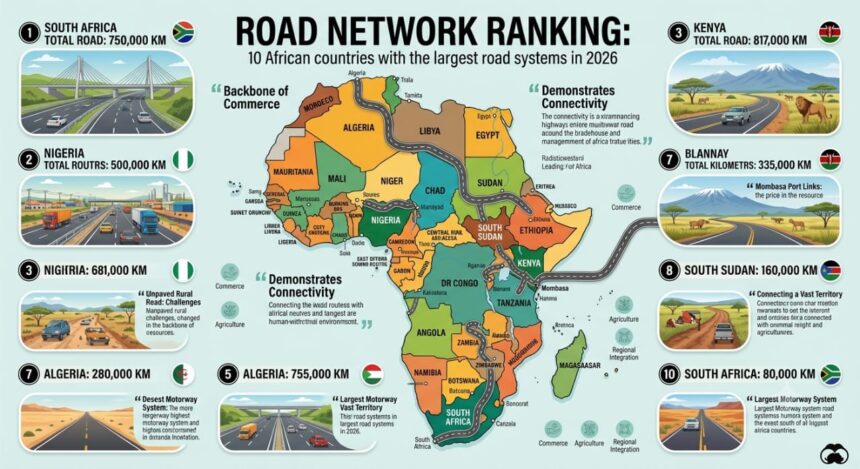
Road transport remains the backbone of commerce, agriculture and regional integration across Africa, making road infrastructure one of the most significant indicators of a country’s connectivity and economic potential.
Although the size of a road network does not necessarily reflect the quality of the roads, it demonstrates the extent of transport infrastructure available to connect cities, rural communities, industrial centres, seaports and neighbouring countries.
South Africa: Continent’s road infrastructure leader
South Africa leads the ranking with an estimated 750,000 kilometres of roads, supported by an extensive network of national highways, provincial roads and municipal routes that connect major cities, industrial hubs, ports and neighbouring countries.
Nigeria: West Africa’s largest road network
Nigeria occupies second position with an estimated 195,000 kilometres of roads that facilitate commercial activities, agricultural transportation and passenger movement across its 36 states and the Federal Capital Territory.
Kenya: East Africa’s expanding transport hub
Kenya ranks third with approximately 161,452 kilometres of roads following years of investment in highways and rural road projects that have strengthened links between Nairobi, the Port of Mombasa and neighbouring countries.
Democratic Republic of the Congo: Connecting a vast territory
The Democratic Republic of the Congo comes fourth with an estimated 152,373 kilometres of roads, although expanding and rehabilitating the network remains crucial to improving access to remote areas and stimulating economic activity.
Tanzania: Strengthening regional trade corridors
Tanzania is fifth with about 145,203 kilometres of roads connecting commercial centres, tourist destinations and neighbouring landlocked countries while supporting regional trade and economic integration.
Mali: A key transport network in West Africa
Mali occupies sixth place with approximately 139,107 kilometres of roads that play an important role in linking agricultural communities with urban markets despite existing infrastructure challenges.
Ethiopia: Investing in nationwide connectivity
Ethiopia ranks seventh with an estimated 120,171 kilometres of roads after years of expanding highways and rural transport infrastructure to improve mobility and support economic development.
Algeria: North Africa’s extensive motorway system
Algeria sits in eighth position with around 104,000 kilometres of roads, including one of Africa’s largest motorway networks that supports domestic transportation and regional commerce.
Zimbabwe: A strategic Southern African corridor
Zimbabwe places ninth with a road network measuring about 97,267 kilometres, providing vital transport links between its major cities and neighbouring countries.
South Sudan: Expanding connectivity despite challenges
South Sudan completes the top 10 with an estimated 90,200 kilometres of roads, although much of the network remains unpaved as the country continues efforts to improve transport infrastructure and economic mobility.