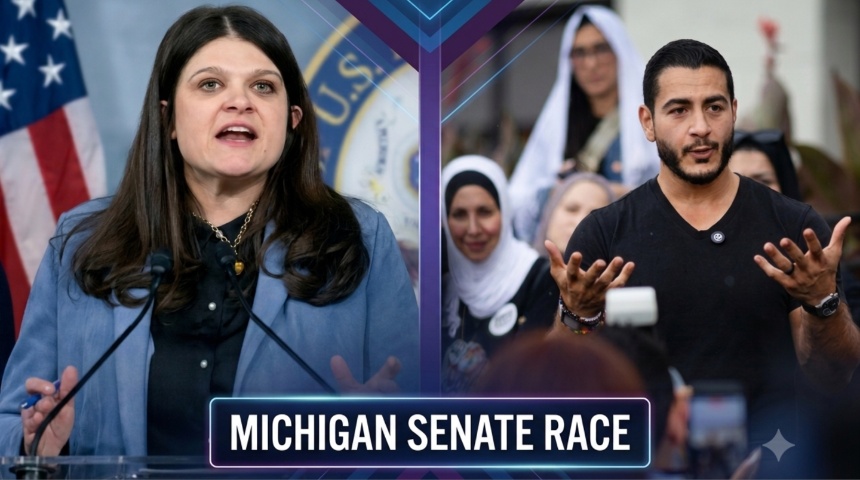
Michigan’s Democratic Senate primary lived up to every bit of its hype. After a night of see-sawing returns, shrinking leads, and a Wayne County vote count that had both campaigns’ watch parties holding their breath, NBC News has projected Dr. Abdul El-Sayed as the winner over Rep. Haley Stevens.
It was close. It was expensive. And it may end up being the clearest signal yet of where the Democratic Party is headed, or at least where its base wants it to go.
A Race That Came Down to the Wire
Polls closed across Michigan at 8 and 9 p.m. on Tuesday, August 4, but nobody was calling this one early. Early returns had El-Sayed at roughly 49% to Stevens’ 47%, with state Sen. Mallory McMorrow, who dropped out of the race back on July 5 but stayed on the ballot, pulling in about 4%.
From there, the count turned into a county-by-county tug of war. El-Sayed built early strength in Kent, Macomb, and Washtenaw counties, his home turf and the seat of the University of Michigan. Stevens held her own in Oakland, Wayne, Saginaw, and Genesee.
Wayne County, home to Detroit, ended up being the story of the night. Stevens started with a majority there, but her lead kept shrinking as Election Day votes from Detroit rolled in, along with results from Dearborn, a city with a large Arab-American population where El-Sayed reportedly won more than three-quarters of the vote. By 1:30 a.m., El-Sayed was holding a narrow but visibly shrinking lead, and both candidates addressed supporters in Detroit without either one claiming victory.
| County | Leading Candidate | Notes |
|---|---|---|
| Wayne | Stevens (early), narrowing | Detroit and Dearborn returns cut her lead sharply |
| Oakland | Stevens | Her home base; led by roughly 2 points with 76% counted |
| Kent | El-Sayed | Grand Rapids area |
| Macomb | El-Sayed | Suburban Detroit |
| Washtenaw | El-Sayed | His home county; includes Ann Arbor |
| Saginaw | Stevens | |
| Genesee | Stevens |
Figures reflect partial returns reported on primary night and are not final certified results.
Stevens told her crowd to “get some sleep, or some coffee,” and wait for the final numbers. El-Sayed, watching returns with family and advisers, thanked supporters for a fight he said proved something about grassroots momentum, especially given how heavily he was outspent by outside groups.
Who Are El-Sayed and Stevens?
Abdul El-Sayed is a physician from Ann Arbor who previously served as Detroit’s health director and later ran the Wayne County health department. This wasn’t his first statewide campaign either; he ran for Michigan governor in 2018 and lost the Democratic primary. This time, he ran well to the left, campaigning on Medicare for All and taking aim at billionaire influence in politics.
Haley Stevens is a four-term congresswoman from Birmingham representing a district in Oakland County. She built her campaign around manufacturing, blue-collar jobs, and a more traditional Democratic pitch, positioning herself as the candidate who could actually win in a state Donald Trump carried in 2024.
The two are backed by very different wings of the party. El-Sayed had Sen. Bernie Sanders and Rep. Alexandria Ocasio-Cortez in his corner. Stevens carried endorsements from outgoing Sen. Gary Peters, Senate Minority Leader Chuck Schumer, Gov. Gretchen Whitmer, and former Sen. Debbie Stabenow, essentially the entire Michigan Democratic establishment.
| Abdul El-Sayed | Haley Stevens | |
|---|---|---|
| Background | Physician; former Detroit health director; ex-Wayne County health director | Four-term U.S. Representative from Birmingham |
| Political lane | Progressive | Establishment moderate |
| Signature policy | Medicare for All; curbing billionaire influence in politics | Manufacturing and blue-collar jobs |
| Key endorsers | Bernie Sanders, Alexandria Ocasio-Cortez | Gary Peters, Chuck Schumer, Gretchen Whitmer, Debbie Stabenow |
| Stance on Israel | Critical of continued U.S. military support | Firmly pro-Israel |
| Prior statewide run | 2018 Michigan governor primary (lost) | First statewide run |
Israel Policy Became the Defining Fault Line
If one issue defined this primary, it was foreign policy, specifically, U.S. support for Israel amid the war in Gaza. El-Sayed made criticism of that support a central plank of his campaign, arguing the money would be better spent at home. “Rather than fund the genocide perpetrated by a foreign government, we’d better build schools right here in Grand Rapids,” he told a crowd at a recent campaign stop.
Stevens, by contrast, ran as the pro-Israel candidate in the race and cast El-Sayed as the choice Republicans were quietly rooting for. “You see the Republicans, they’re propping up my Democratic opponent,” she said on MS NOW, adding that she had no intention of making things easier for the GOP.
That divide showed up in the numbers too. In Oakland County, a suburban Detroit region with a significant Jewish population that Stevens represents in Congress, she was leading by around 2 points with three-quarters of the votes counted. Outside spending tied to the Israel debate, including reported backing from AIPAC-aligned groups, made this the most expensive Democratic Senate primary in U.S. history, according to reporting from the Detroit News.
Beyond Israel, the two candidates also split over how to regulate AI data centers, another flashpoint that separated El-Sayed’s more restrictive, consumer-protection approach from Stevens’ focus on economic growth and job creation.
What Happens Next
The winner inherits a seat that matters enormously to both parties. Sen. Gary Peters is retiring after two terms, and Democrats need to hold Michigan if they want any real shot at retaking the Senate. Republicans haven’t won a Senate race in the state since 1994, but this cycle feels different given how competitive statewide races have become.
Waiting in November is former Rep. Mike Rogers, who ran unopposed in the Republican primary. Rogers came close to beating Stevens in general election polling published before the primary and has already started framing the Democratic nominee, whoever it turned out to be, as too extreme for Michigan voters. A campaign spokesperson didn’t hold back on primary night, saying Rogers was “winning” while Democrats fought what they called a “bloody” internal battle.
Whoever heads into the fall as the Democratic nominee now has to do two things fast: unify a party that just spent months tearing itself apart over Israel policy, AI regulation, and what kind of Democrat can actually win in a purple state, and pivot immediately into a general election fight that both parties are treating as a must-win.
Michigan’s Senate race isn’t just a local story anymore. It’s a preview of the argument Democrats are having with themselves nationally, and in a few months, voters here will decide which side of that argument gets a shot at the general election.