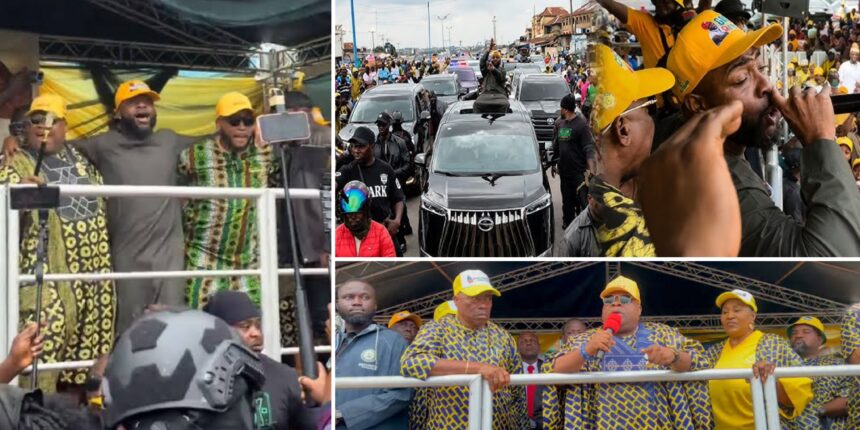
The final stretch of a political campaign often produces the images that remain long after the speeches have faded, and in Osun, one of those moments arrived with a familiar face whose presence was always likely to attract attention. The campaign ground was already charged with the pressure of an election only days away, supporters had gathered, party officials were moving through the crowd, and the atmosphere carried the unmistakable feeling of a contest entering its decisive stage. Then Davido stepped into the picture, bringing with him the kind of public attention that rarely remains confined to the campaign ground.
What followed quickly became more than another campaign appearance. The singer, who has spent months moving closer to the political project of his uncle, Governor Ademola Adeleke, was suddenly at the centre of the final phase of the Osun governorship contest. His appearance offered a striking mixture of family, music, politics, youth mobilisation and electioneering, creating scenes that were immediately suited to the fast moving world of social media. Yet beneath the excitement of the rally was a bigger political story that had been building quietly since late 2025.
The timing could hardly have been more significant. With the Osun governorship election scheduled for August 15, 2026, the campaign has entered the period when every rally, public appearance and mobilisation effort carries greater weight. Davido’s arrival therefore comes at a point when the question is no longer simply whether he supports Adeleke, but how visibly and directly he is prepared to campaign for him, and whether his enormous popularity among young Nigerians can be converted into meaningful political mobilisation across Osun.
Davido Arrives At The Rally
The first major moment from August 6 was Davido’s physical arrival at the Osun campaign rally alongside Governor Ademola Adeleke, a development that immediately changed the character of the gathering. For months, Davido had been publicly associated with his uncle’s political ambition, but seeing the singer physically take his place on the campaign platform offered a different level of involvement. The distinction matters because political endorsements can remain largely symbolic, while a campaign rally requires visibility, movement and direct contact with the people the candidate is trying to persuade.
Reports from the rally showed Davido joining Adeleke before a crowd of supporters, bringing together the two sides of his public identity in a single setting. He was not there simply as a member of the Adeleke family watching proceedings from the background. His presence was part of a campaign structure in which he had already been given a formal role focused on youth mobilisation, making the August 6 appearance a practical demonstration of an assignment that had been announced months earlier.
For Adeleke, the moment also carried obvious campaign value. The governor has built a public image around his energetic personality, his dancing and his close connection to popular culture, while Davido brings an entirely different kind of reach through music and entertainment. Placing the two together on a political stage created an image that required very little explanation. The governor was campaigning for another term, while his internationally recognised nephew was standing beside him in front of voters only days before they would decide the election.
The significance of the scene becomes clearer when the timeline is considered. Davido’s involvement did not begin with the August 6 rally, meaning his appearance was not a sudden decision made during the final week. It was the latest visible stage in a political journey that had already taken him from family support to formal party membership and eventually into the campaign’s youth mobilisation structure.
The Embrace That Set The Tone
One of the most striking moments came almost immediately after Davido reached the stage, when he embraced Adeleke before the crowd. It was a simple gesture, but political campaigns often depend on images that communicate a message faster than a long speech can. The embrace placed their family relationship directly at the centre of the rally while also reinforcing the public partnership that has developed around Adeleke’s second term campaign.

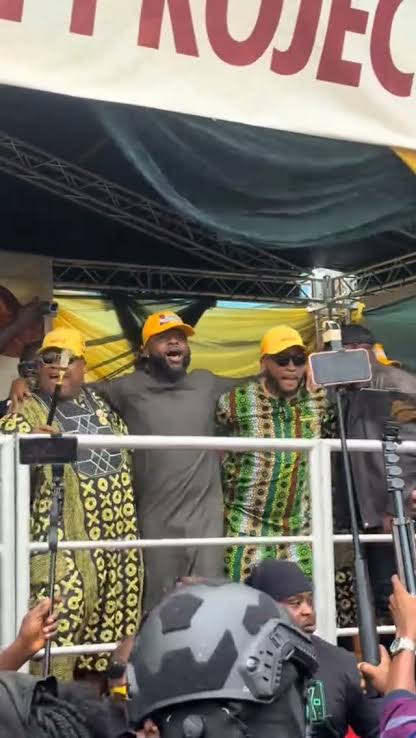
The image carried another layer because Davido has not hidden his affection for his uncle throughout the political season. His support has repeatedly been presented as both personal and political, creating a campaign narrative where the famous singer is not simply appearing for a candidate he happens to know, but actively backing a member of his family who is seeking another term as governor of Osun State.
That distinction has become increasingly important as the election has drawn closer. The campaign has moved beyond introductory rallies and general political messaging into the final period when parties are trying to strengthen their grassroots structures, maintain enthusiasm and push supporters towards election day. Against that backdrop, a public embrace between Adeleke and Davido was more than a family greeting. It became one of the clearest visual statements of their united campaign effort.
The crowd reaction added to the atmosphere. Supporters responded as the two men appeared together, turning the stage into a mixture of political rally and entertainment spectacle. Yet the underlying message remained straightforward. Davido had come to campaign with Adeleke, and he was doing so openly, publicly and at a critical point in the election calendar.
Adeleke Dances To Davido’s Feel
The next major scene came through music, an element that has long been closely connected to Adeleke’s public personality. During the rally, the governor was seen dancing and singing along to Davido’s Feel, a song from the singer’s Timeless album. The moment immediately connected Adeleke’s political persona with Davido’s musical identity, producing one of the most recognisable scenes from the campaign’s final days.
For Adeleke, dancing publicly is hardly a new feature of his political image. His energetic movements have become part of the way Nigerians recognise him, with the governor frequently attracting attention whenever campaign appearances turn musical. The August 7 rally therefore did not introduce a completely new side of Adeleke. Instead, it placed that familiar side of him directly beside one of the country’s biggest music stars.
The choice of Feel also gave the scene an unmistakable Davido connection. Rather than having the singer simply stand beside his uncle while campaign speeches dominated the stage, the music created a moment where both men were operating within Davido’s world while remaining firmly inside a political campaign. It was an unusual blend of entertainment and electioneering, but one that made sense given the role Davido has been assigned within the campaign.
The visual effect was powerful because it could be understood immediately without political explanation. Adeleke was dancing, Davido was beside him, supporters were cheering, and the election was only days away. For a campaign seeking youth attention, such a scene offers an obvious advantage because it naturally lends itself to photographs, videos and social media circulation.
More importantly, the moment showed that Adeleke’s campaign is not trying to hide the governor’s dancing image as the election enters its final stage. Instead, the campaign continues to use it as part of the personality surrounding his public identity, with Davido’s appearance adding another layer to the spectacle.
The Family Connection Becomes A Campaign Tool
The relationship between Davido and Adeleke has always made this political story unusual, but the campaign has gradually turned that family connection into something much more structured. Davido is not simply the governor’s nephew attending a rally because of family loyalty. His political involvement has developed through a series of identifiable steps that began months before the August 7 appearance.
The first major development came in December 2025, when Davido announced that he would formally join the Accord Party after Adeleke moved to the party. He travelled to Osogbo to collect his membership card, transforming his political support from a personal association into a formal party connection.
That decision mattered because Adeleke’s re election campaign was now connected to a globally recognised entertainer who had formally placed himself within the same political platform. Davido’s participation was therefore no longer limited to private conversations, social media messages or family appearances. He had entered the political structure of the party on which his uncle was seeking another term.
The next major step came on April 21, 2026, when Adeleke’s campaign announced Davido as head of youth mobilisation for the re election campaign. That appointment gave his involvement a defined purpose. Rather than merely appearing at selected events, Davido was now positioned as someone expected to help connect the campaign with younger voters.
That history gives the August 6 rally a deeper meaning. The singer was not arriving for the first time in a political capacity. He was appearing after months of increasingly formal involvement, making the rally another chapter in a political campaign that has gradually brought his celebrity status closer to Adeleke’s electoral machinery.
Davido Takes His Youth Mobilisation Role To The Streets
The youth mobilisation role is arguably one of the most important parts of Davido’s political involvement because it explains why his presence matters beyond the personal relationship with Adeleke. Young voters form an important part of Nigeria’s political population, and political campaigns have increasingly recognised the value of personalities capable of speaking directly to large youth audiences.
Davido already possesses a communication network that political organisations would normally spend enormous resources trying to build. His music career has given him a huge audience, particularly among younger Nigerians, while his social media platforms allow political messages to reach people far beyond the location of a physical rally. Turning that influence into political mobilisation is therefore the central ambition behind his campaign role.

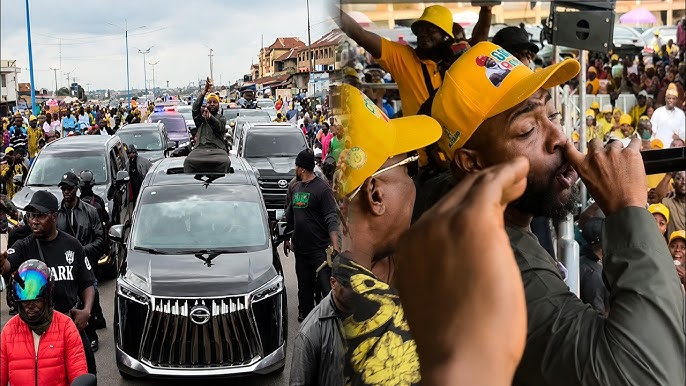
The challenge, however, is straightforward. A celebrity can generate attention without necessarily generating votes. Thousands of people can watch a campaign video, share a photograph or react to a famous personality without changing their voting decision. The real test comes when supporters move from online engagement to physical mobilisation, registration, attendance at campaign activities and ultimately participation at polling units.
The August 6 rally provided a visible example of that mobilisation strategy. Davido was not simply posting support for Adeleke from elsewhere. He physically entered the campaign environment and stood before supporters alongside the candidate. That movement from social media to the street is precisely what makes the appearance significant.
His message in recent campaign activity has also reflected that confidence. Reports quoted Davido telling Adeleke, “August 15: We no dey fear anything, we dey your back.” The statement captured the increasingly direct nature of his support as election day approaches, while also presenting the singer as someone willing to publicly identify himself with the governor’s political battle.
The campaign now has to convert that enthusiasm into electoral participation. That is where the youth mobilisation strategy will ultimately be judged.
The Rally Comes During A Fierce Final Week
Davido’s appearance also needs to be viewed against the wider political competition unfolding across Osun. Adeleke’s campaign is not operating without opposition, and the final days before the August 15 election have brought increased activity from rival political camps.
The APC candidate, Bola Oyebamiji, remains one of the major challengers in the contest, and the opposition has intensified its campaign activities as voting day approaches. On August 6, 2026, Edo State Governor Monday Okpebholo addressed an APC campaign rally in Osun, where he criticised Adeleke’s style of governance and the governor’s public dancing image.
That development made the timing of Davido’s appearance even more notable because it placed the governor’s most recognisable personal characteristics directly into the campaign conversation. While the opposition has used Adeleke’s dancing image as a point of criticism, Adeleke’s own campaign continues to present his personality as part of his appeal.
The August 6 rally therefore offered a very different visual response. Rather than distancing himself from the dancing image, Adeleke was seen embracing the atmosphere, singing along to Davido’s music and dancing with the singer before supporters. The campaign was effectively displaying the same characteristic that opponents had highlighted, but presenting it in a setting designed to generate excitement and enthusiasm.
That contrast is important because political campaigns are often about controlling the images voters remember. Speeches can be forgotten, policy promises can compete with one another and campaign slogans can become repetitive. A striking image, however, can travel quickly and remain in public memory.
Davido and Adeleke dancing together provided exactly that kind of image.
The August 6 Scene Raises The Bigger Election Question
The final and perhaps most important moment is not a single photograph or video. It is the question created by everything that happened around the rally. Can Davido’s enormous popularity help Adeleke strengthen his appeal among young voters before August 15?
That question cannot be answered by the size of a rally or the amount of attention a campaign video receives. Elections are ultimately decided by voters who participate in the voting process, and the impact of celebrity mobilisation becomes meaningful only when that attention translates into real electoral behaviour.
Davido has already demonstrated that he can attract enormous public attention. His music career has made him one of Africa’s most recognised entertainers, while his political involvement has ensured that his name is now directly connected to Adeleke’s second term campaign. His appearance on August 7 therefore gave the campaign something that ordinary political rallies do not always possess: an entertainment figure capable of instantly drawing national attention to a state level election.
The campaign’s task is now to channel that attention into the political process. The sequence is relatively simple. Davido attracts attention, the campaign uses that attention to reach young people, campaign structures attempt to turn that interest into grassroots mobilisation, supporters are encouraged to participate and voters ultimately make their decisions at polling units.
Whether that sequence succeeds is something that cannot be determined from a rally alone.
From December 2025 To August 7, 2026
Davido’s involvement with Adeleke’s political campaign becomes easier to understand when the events are placed in chronological order. The story began to take a more formal political shape in December 2025 when Davido announced his decision to join the Accord Party after his uncle’s move to the platform.
His trip to Osogbo to collect his membership card was an important early signal because it showed that the singer was prepared to associate himself with the political platform rather than merely offer personal encouragement to Adeleke.
The relationship became even more politically structured on April 21, 2026, when Adeleke’s campaign announced Davido as head of youth mobilisation. That appointment gave him an identifiable campaign responsibility and placed his celebrity influence within the wider machinery of the governor’s re election effort.
The months that followed saw Davido increasingly speak openly about the election and Adeleke’s second term bid. His language became more direct as the campaign moved closer to voting day, with his public messages showing that his role was not being treated as ceremonial.
Then came August 6, when the political contest entered another intense phase with APC activity in Osun and comments from Governor Monday Okpebholo directed at Adeleke’s administration and public image.
By August 7, Davido was physically on the campaign stage with Adeleke.
That sequence is important because it shows a gradual progression rather than a sudden celebrity intervention. The singer moved from family connection, to party membership, to formal youth mobilisation, to increasingly visible campaign participation and finally to a major public rally appearance during the final days before voting.
Why The Timing Of The Rally Matters
The calendar gives the August 6 appearance additional importance. Osun voters are scheduled to go to the polls on August 15, 2026, leaving the campaign with a very limited window to make its final push.
Political campaigns at this stage are generally focused on consolidation. Parties already know their core supporters, candidates have spent months travelling across communities and campaign structures are expected to be working at local levels. The final stretch is therefore about maintaining momentum, reaching undecided voters, strengthening turnout plans and ensuring that supporters remain engaged until election day.
Davido’s appearance fits directly into that final stage. His presence provides a high visibility event capable of attracting attention beyond the usual political audience, while his formal youth mobilisation role gives the campaign a reason to place him directly within the election effort.
The timing also means that every public image from the rally has greater potential to become part of the election narrative. A photograph from a campaign event several months before voting may attract attention, but a photograph taken 8 days before the election carries a different sense of urgency.
That is exactly where the August 6 scenes sit.
The Political Meaning Of Davido’s Presence
Davido’s presence also illustrates how Nigerian politics continues to blend traditional political structures with popular culture. Political campaigns have always relied on personalities capable of attracting crowds, but the growth of social media has changed the value of celebrity involvement.
A traditional campaign rally may reach thousands of people physically, while a single video from that rally can potentially reach millions online. Davido’s participation therefore creates two audiences at the same time. There are the people standing before the stage in Osun and there are millions of people who may encounter the images and videos through social media platforms.
That dual reach is part of the reason celebrity politics has become increasingly visible in Nigeria. Public figures can take political messages beyond conventional campaign spaces, while political candidates can use their popularity to connect with audiences who may not normally follow political speeches or party events.
Adeleke’s campaign appears to have recognised this value by placing Davido within its youth mobilisation structure. The August 6 rally then became an opportunity to demonstrate that relationship publicly.
Yet the electoral value remains dependent on participation. Popularity can create attention, but attention is not the ballot.
The Security Question Around Election Day
The excitement surrounding the rally exists alongside a more serious electoral environment. The Independent Corrupt Practices and Other Related Offences Commission has announced plans to deploy operatives across all 30 local government areas during the August 15 election as part of efforts to combat vote buying.
That development places the celebratory campaign scenes within the broader reality of election administration. Political rallies can be energetic and entertaining, but election day itself involves a much more structured process involving voters, polling officials, security agencies, party agents and electoral regulations.
Davido has also previously called for political differences to be settled through ballots rather than violence following an attack on an Accord Party official in Osogbo. That position is particularly relevant as the election approaches because the excitement generated by political competition must ultimately give way to peaceful participation at polling units.
The contrast is striking. On August 6, the campaign stage was filled with music, dancing, cheering supporters and the unmistakable energy created by Davido’s presence. On August 15, the focus will shift from campaign spectacle to voting.
That is where the real political test begins.
What The August 6 Rally Changes
Before August 6, the Davido and Adeleke political story could still be described largely through appointments, party membership and public endorsements. After the rally, there is a much more visible picture of the relationship.
Davido has now physically campaigned with Adeleke during the decisive final phase of the election. He has appeared before supporters, embraced his uncle and shared the stage with him during a moment that combined music, dancing and political mobilisation.

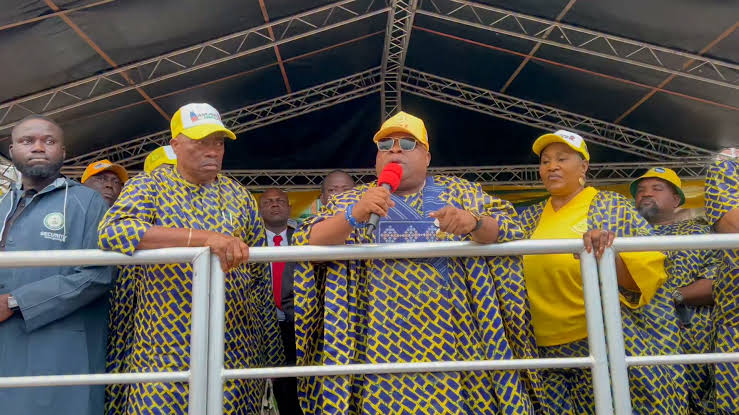
The development also makes the April youth mobilisation appointment easier to understand. The role is no longer simply a title announced by a campaign team. The singer is visibly participating in the field campaign at the exact moment when the election is entering its final days.
For Adeleke, the rally provides another opportunity to reinforce the image of a governor comfortable with popular culture and youth engagement. For Davido, it represents one of the clearest public demonstrations yet of his commitment to his uncle’s political campaign.
For the election itself, it adds another dramatic chapter to a contest already attracting significant attention.
8 Days To Go
The calendar is now unforgiving. August 7 has passed into the final stretch, and August 15 is the date that matters most.
Every campaign appearance between now and election day will be measured against the same question: can the momentum created on the campaign trail survive until voters reach the polling units?
Davido has played his part in creating attention. His arrival at the rally generated a highly visible moment, his relationship with Adeleke added a family dimension, the music and dancing produced memorable footage and his formal youth mobilisation position gave the appearance a clear political purpose.
The remaining work belongs to the wider campaign structure.
Supporters have to remain engaged. Grassroots organisers have to maintain contact with voters. Political messages have to reach communities across the state. Election day participation has to follow campaign day excitement.
That is the gap between a viral campaign moment and an electoral result.
The Final Picture Before August 15
The image from August 7 is difficult to miss. Davido and Governor Ademola Adeleke were together on stage, the crowd was responding, music was playing and the governor was dancing alongside one of Nigeria’s biggest music stars.
But the image is only one part of a much larger sequence.
December 2025 brought Davido’s formal entry into the Accord Party. April 21, 2026 brought his appointment as head of youth mobilisation. The months that followed saw increasingly direct public support for Adeleke’s second term campaign. August 6 brought another major opposition campaign appearance. August 7 brought Davido directly into the final campaign push. August 15 will bring the voters.
That is why the rally matters beyond the entertainment value of the footage. It represents the point where months of political association have become a highly visible campaign operation, with Davido standing beside his uncle at a time when the election is only days away.
The singer can generate attention, create excitement and bring younger audiences closer to the campaign. Adeleke can use his position as the incumbent governor to present his record and make the case for another term. The Accord Party can organise its structures across the state. Rival parties can intensify their own campaigns.
Ultimately, however, the decisive scene will not be the stage, the music or the dancing. It will be the polling unit.
For now, the August 7 rally has given Adeleke’s campaign one of the most memorable images of its final stretch, with Davido moving from formal political association into the heart of the campaign ground and standing beside his uncle as the countdown to August 15 continues.
The question hanging over the remaining days is no longer whether Davido is involved. He clearly is.
The bigger question is how far that involvement can carry the campaign before Osun voters make the final call on August 15, 2026.