At about 7:24am on Sunday, the final stage of the 2026 Osun State governorship election took place at the state collation centre, where a university professor formally announced the result that returned Ademola Adeleke for another term.
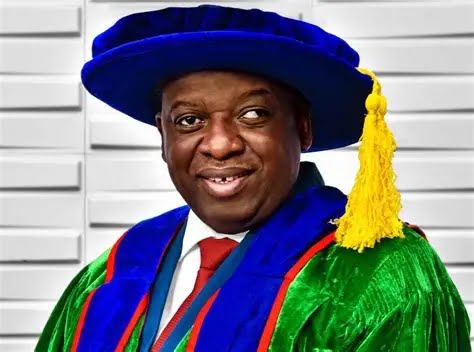
The official entrusted with that responsibility was Professor Joshua Olalekan Ogunwole, Vice-Chancellor of the Federal University Oye-Ekiti, who served as the State Returning Officer for the election.
By the time Ogunwole took the microphone, the figures from the state’s 30 local government areas had been collated, presented and signed by agents representing the participating political parties.
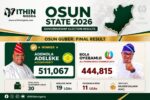
Adeleke, who contested on the platform of the Accord Party, emerged with 511,067 votes, placing him ahead of his closest challenger, the All Progressives Congress candidate, Bola Oyebamiji, who secured 444,815 votes.
The result showed Adeleke winning 19 local government areas, while Oyebamiji carried the remaining 11, with the African Democratic Congress candidate, Najeem Salaam, finishing third.
Having established that the winning candidate had satisfied the requirements of the law, Ogunwole declared Adeleke elected for another four-year term.
“That Ademola Nurudeen-Jackson Adeleke, having satisfied the requirements of the law, is hereby declared the winner of the August 15 Governorship Election and returned elected,” he announced.
For a man whose public career has largely been associated with lecture halls, laboratories, research and university administration, the moment represented a departure from his usual academic responsibilities.
But the professor at the centre of the declaration has spent decades building a career that stretches well beyond the Osun collation hall.
From Ibadan to the university system
Ogunwole was born on July 23, 1967, in Ibadan, Oyo State, and is originally from Ogbomoso.
Within academic circles, he is also known by the informal name “Coach”, a name used by students, colleagues and mentees.
His early education began at St Anne’s Primary Boarding School in Kakuri, Kaduna, after which he proceeded to Tafawa Balewa Memorial College, Samaru-Zonkwa.
He later enrolled at the School of Basic Studies of Ahmadu Bello University, Zaria, beginning a connection with the institution that would eventually shape much of his academic career.
Ogunwole studied Agriculture at undergraduate level, earning a BSc, before obtaining both an MSc and a PhD in Soil Science from Ahmadu Bello University, Zaria.
His professional journey subsequently took him through several universities, including Ahmadu Bello University, Adamawa State University, Federal University Dutsin-Ma, Bowen University and the Federal University Oye-Ekiti.
His career has combined teaching, research and university leadership, eventually taking him into senior management positions within the institutions where he worked.
From soil science to university leadership
Before assuming the position of Vice-Chancellor at FUOYE, Ogunwole served as the institution’s Deputy Vice-Chancellor responsible for Strategic Partnerships, Research, Innovation and Linkages.
The position followed another major leadership assignment at Bowen University, where he served as Vice-Chancellor from 2018 to 2023.
His academic profile, however, has remained closely connected to soil science and the wider question of sustainable environmental management.
His areas of research include soil science, environmental management, carbon sequestration, sustainable agriculture and climate adaptation.
Over the years, those interests have taken him beyond Nigeria, giving him an international academic profile alongside his university responsibilities.
A career that crossed continents
Between 2009 and 2010, Ogunwole was a Fulbright Scholar at Pennsylvania State University in the United States.
His international academic experience also includes a TWAS Postdoctoral Fellowship in India and an Alexander von Humboldt Fellowship at the University of Hannover in Germany.
His academic and research engagements have further taken him to Sri Lanka, Ethiopia, Italy, Ghana, Mali, Kenya and Tunisia.
The international exposure has complemented his work in research and postgraduate education, particularly in areas connected to agriculture, soil and environmental sustainability.
Ogunwole has published studies in Nigerian and international journals and has supervised postgraduate students in his field.
His professional affiliations include fellowships of the African Scientific Institute and the Soil Science Society of Nigeria.
He is also associated with international professional organisations, including the Agronomy Society of America, the Soil Science Society of America and the International Union of Soil Science.
Beyond academic publishing and professional memberships, his work has included research and development initiatives dealing with agriculture, soil and water conservation, irrigation and sustainable environmental management.
A different assignment in Osun
The role he performed in Osun on Sunday was markedly different from his usual work in academia.
As the State Returning Officer, Ogunwole was responsible for receiving the collated figures, declaring the aggregate result and formally returning the candidate who met the legal requirements as the winner of the governorship election.
The assignment placed the university administrator at the centre of one of the most consequential moments in the state’s electoral process.
Once the results from all 30 local government areas had been presented and the necessary signatures obtained from party agents, the process moved towards the formal declaration.
The figures left Adeleke ahead of Oyebamiji, with the Accord candidate securing 511,067 votes compared with the APC candidate’s 444,815.
Adeleke’s victory across 19 local government areas gave him the numerical advantage needed to retain the governorship, while Oyebamiji won 11 local government areas.
Najeem Salaam of the African Democratic Congress placed third in the overall contest.
Ogunwole’s declaration therefore provided the formal conclusion to the state-level collation, turning the accumulated figures into an official electoral outcome.
For the professor, it was a brief but significant appearance outside the world of soil science, research and university administration.
His name became attached to the official moment when the 2026 Osun governorship election moved from a collection of local government results to a declared winner.
And behind that declaration was a career that had travelled from early schooling in Kaduna and higher education in Zaria to university leadership, international research fellowships and, eventually, the Osun election collation centre.