This week a family visit to Japan’s most famous mountain became a subject of national discussion after a father left his seven-year-old son alone at a point along the trail so that he could continue on to the summit.
The child, a first-grader from Nagoya, was hiking on the Fujinomiya route with his 48-year-old father and his older brother, who was a middle-school student, when he started to say that he was too tired to go on. Instead of slowing down, turning back, or waiting for the boy, the father told him to “wait there” and continued on towards the top with his older son.
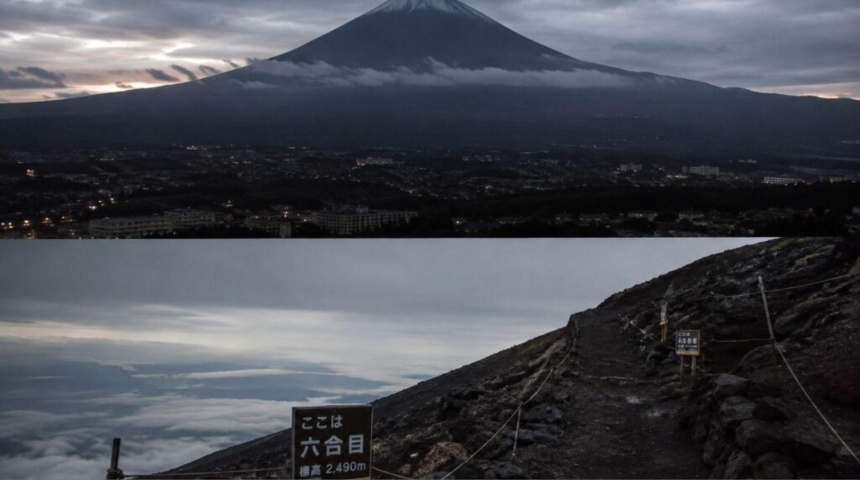
As a result, a young child was left sitting all hour by himself on one of the most unpredictable mountains in the country at an altitude of about 2,490 metres above sea level.
What Actually Happened on the Trail
The family began their journey early in order to climb the Fujinomiya Trail, one of the four official paths to the top of Mount Fuji and a popular yet difficult option even for experienced climbers. When they reached the sixth of the ten stations on the route to the 3,776-metre summit, the youngest boy became unpleasant and stated that he couldn’t go on any further.
Rather than stopping to climb, the father made a call which has since attracted severe criticism in Japan; he told his son to stay where he was and continued on with his older child, clearly intending to reach the summit and come back down before going back for him. Taking into account the usual hiking times for that section of the mountain, the round trip he had planned would have left the seven-year-old alone for about seven and a half hours.
People noticed him rather quickly.
A Mountain Hut Worker Raises the Alarm
A staff member at a mountain hut situated along the route saw the boy sitting all by himself on a bench at about 7:30 in the morning. At that time, rain had already begun to fall and fog was coming in conditions which can change rapidly and become dangerous on Mount Fuji, even at lower elevations. The worker took the child inside, away from the weather, and then phoned the police.
The officers tracked the father’s movements and discovered that he had already reached the eighth station, going well beyond the point where he had left his son; they then contacted him directly and told him to turn around at once and come back down to get the boy.
When the father and son were reunited, the child was cold and trembling though he had not been physically injured. The police issued the father a formal warning, making it clear that it is unacceptable to leave a young child alone on a mountain, even if that means having to give up the cli
A Father’s Explanation, and a Country’s Reaction
The father subsequently said to the police that he had not meant on purpose to place his son in danger and that he had expected to be back for him rather quickly. However, this explanation has had little effect in calming the online criticism, where Japanese social media users have been direct in condemning what they regard as a serious failure in judgment and basic parental responsibility.
The discussion has also involved Japan’s general cultural attitude towards bringing up children who are resilient and independent a principle which many Japanese parents take seriously from a young age. However, commentators have promptly drawn a distinction between encouraging independence in safe and controlled circumstances and leaving a first-grader alone on an active volcano in changing weather, miles from any help.
Even though Mount Fuji has the appearance of a easy hike, it is not an easy walk. It is an active stratovolcano situated about 60 miles to the southwest of Tokyo, and the higher parts of the mountain are famous for sudden falls in temperature, thick fog and rain which can come with no warning. Each year climbers fail to appreciate how quickly the conditions can change, and as a result mountain rescue teams have to deal with the aftermath.
Police Issue a Wider Warning to Climbers
In addition to reprimanding the father, the police took the opportunity to tell hiking groups and families about basic mountain safety. The advice given was simple in that the pace of a group should always be determined by its slowest or weakest member rather than by its strongest one, and the members of a climbing party should remain in constant contact instead of separating when someone is having difficulty.
The advice is not only relevant to this one family but extends to many other cases as well; every year during its brief official climbing season Mount Fuji attracts hundreds of thousands of climbers, most of them being casual hikers or tourists rather than experienced mountaineers, and children can often be seen on the lower and mid-level trails.
At the moment, the story has a fairly happy ending since the boy was found quickly, kept warm and dry, and was handed back to his father a few hours later. No permanent harm was mentioned.
The incident has once again brought up in Japan a well-known debate as to where the boundary lies between fostering independence in children and merely putting them at risk. For a seven-year-old child sitting by himself on a bench in the rain, with the fog growing thicker around him at a height of nearly 2,500 metres, that boundary had already been passed.