Four days after a wall of water, ice and mud tore through the Nepal-Tibet border, rescuers are still counting bodies. As of Sunday, August 30, the confirmed death toll from the flash floods and mudslides stands at 750, with more than 3,000 people still unaccounted for across Nepal and China’s Tibet Autonomous Region.
Those numbers have moved almost by the hour since Wednesday, August 26, when a glacier collapse near Gyirong, on the Tibetan side of the border, sent an ice avalanche crashing into a mountain lake. What followed was a flood that authorities are now calling one of the worst natural disasters to hit the Himalayan region in years.
What Triggered the Nepal Floods
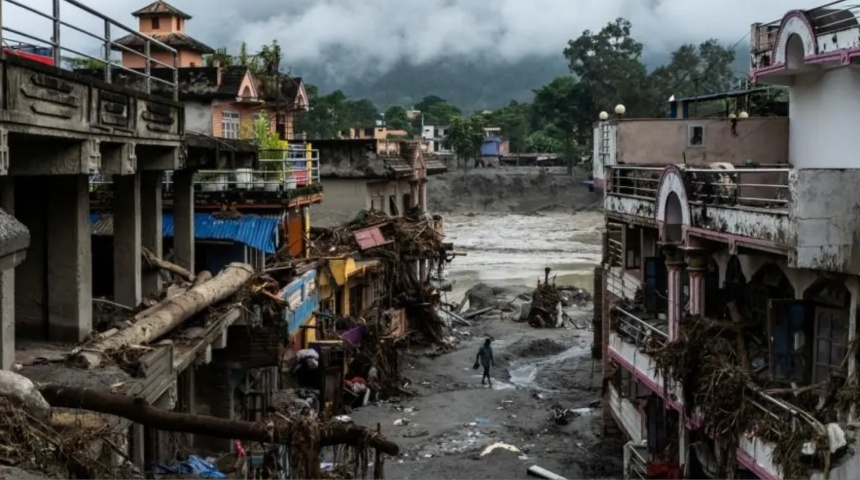
The disaster began with an ice avalanche that broke off a glacier and slammed into a body of water near Gyirong County in Tibet. The resulting surge sent a torrent of ice, rock, mud and debris hurtling down the Bhotekoshi and Trishuli river systems into Nepal’s Nuwakot district and beyond.
Entire settlements along the riverbanks didn’t stand a chance. In Devighat, in Nuwakot’s Bidur Municipality, drone footage shows houses buried under thick grey sludge, roofs poking out of what used to be riverside streets. The Sino-Nepal Friendship Bridge at Rasuwagadhi, a key trade crossing between the two countries, was among the infrastructure swept away. Roads, hydropower plants and entire village blocks along the Trishuli and Narayani rivers were flattened within hours.
Making matters worse, geologists say the mudslide that triggered the flood also dammed part of a river, forming a new lake across the Nepal-China border. That lake has since begun overflowing, and the threat of a second, follow-on flood is exactly why search efforts have been suspended and resumed multiple times since Friday, August 28.

How the Death Toll Has Climbed
The scale of this disaster has become clearer with every passing day, and honestly, it’s been hard to keep up with the number:
- August 26 (day of the flood): Around 160 people confirmed dead.
- August 27: The toll nears 392, with over 1,400 reported missing.
- August 28: Death toll climbs past 469.
- August 29: Nepal’s figures alone rise to 626, then later that day to 682, with over 3,000 missing across the region.
- August 30 (Sunday): Combined Nepal-Tibet toll reaches 750, with 3,044 people still missing, according to disaster management authorities.
On the Chinese side of the border, in Tibet’s Gyirong County, officials have confirmed 16 deaths, with more than 500 people still missing there as of the weekend, including a significant number of foreign nationals who were in the area for cross-border trade or trekking.
It’s worth being upfront about something: these numbers will likely keep changing, in both directions. Search teams have already reclassified some of the missing as rescued once phone networks came back up in remote valleys. But given how many riverside communities were essentially erased, nobody expects the final death toll to stop where it is now.
Missing Persons: Hundreds of Foreigners Among Them
Of everything about this disaster, the missing-persons numbers are the most gutting to read. Nepal’s National Disaster Management Authority says at least 700 foreign nationals were unaccounted for in the early days of the search, a figure that has fluctuated as embassies confirm the safety of their citizens one by one.
The United States alone reported around 90 Americans missing as of Friday, August 29. By Saturday, the State Department confirmed five had been evacuated, up from three the day before. Many of the missing were tourists and trekkers who’d been in the region ahead of the autumn hiking season, drawn by the same Himalayan trails that make this part of Nepal famous.
There’s a detail that’s stuck with a lot of people following this story: several families have described relatives who’d sent excited voice notes and photos just days before the flood, describing local sightseeing around Kathmandu before heading into the mountains. Those messages are now the last anyone has heard from them.
Rescue Operations: Tunnels, Rivers and a Race Against the Weather
Nepal’s National Disaster Risk Reduction and Management Authority (NDRRMA) says it has deployed more than 18,700 rescuers to the affected districts. As of Saturday, authorities reported that 7,514 people had been pulled to safety, including 227 foreign nationals, with 219 injured people treated or discharged from hospitals.
Much of the current search effort is focused on hydropower plant tunnels along the Trishuli and Bhotekoshi rivers, where hundreds of workers are believed to have been trapped when the flood hit. Soldiers have also been combing the riverbanks for bodies, with recoveries along the Trishuli and Narayani rivers being brought to Pokhara for identification.
Rescue conditions have been brutal. Damaged roads, power outages, and repeated flood warnings tied to that newly formed border lake have forced crews to pull back from the worst-hit zones more than once since Friday. Rescue teams have reported finding almost nothing left standing in some areas near the border checkpoint at Gyirong Port, no walls, no outlines of buildings, just mud.
Notably, Nepal’s Ministry of Foreign Affairs initially turned down offers of international search-and-rescue teams, citing coordination problems experienced during the 2015 earthquake response. That position has since softened. The government has allowed in specialists from India, China, Australia and South Korea to help with tunnel rescues, DNA testing and forensic identification, and it has requested heavy-lift cargo drones from international partners to reach isolated mountain communities that roads can no longer serve.
International Aid and Relief Efforts
The response from the international community has picked up pace through the week.
China has sent over 2,100 rescue workers to its side of the border and pledged roughly 220 million yuan (about $32.7 million) toward relief operations, alongside satellite and hydrological data to help predict further flooding. Chinese President Xi Jinping has publicly called for continued search efforts and improvements to the region’s disaster early-warning systems.
The United States has more than tripled its committed aid, from an initial $500,000 to $3.6 million, which the State Department says will fund up to three months of emergency food assistance for as many as 10,000 flood-affected households. President Trump, asked about the disaster in the Oval Office, called it “a terrible thing” and said Washington is willing to send “any help” Nepal needs.
According to the UN’s resident coordinator in Nepal, Lila Pieters Yahia, the government has established a formal relief fund, with the World Bank, India, China and the US together pledging around $229 million to support recovery.
On the ground, Nepal has also set up an Emergency Control Room under its Ministry of Foreign Affairs, dedicated specifically to search, rescue, information verification, and consular support for foreign nationals caught up in the disaster.
For now, the emphasis has shifted in a lot of the hardest-hit areas from rescue to recovery. Officials are watching that newly formed glacial lake closely, worried that further overflow could trigger a second wave of flooding before cleanup even properly begins. Monsoon rain hasn’t let up either, and rising river levels have already forced rescue teams onto higher ground more than once this week.
Nepal loses lives to flooding and landslides most monsoon seasons. What’s different this time is the scale, and the fact that a glacial event on foreign soil, in Tibet, triggered a disaster that has devastated communities on both sides of the border. It’s the kind of event climate scientists have been warning about for years as Himalayan glaciers keep retreating and the lakes they leave behind keep growing more unstable.
This is a developing story, and the numbers above reflect the latest confirmed figures as of Sunday, August 30. Expect both the death toll and the missing count to keep shifting as search teams reach communities that are still, days later, cut off from the outside world.