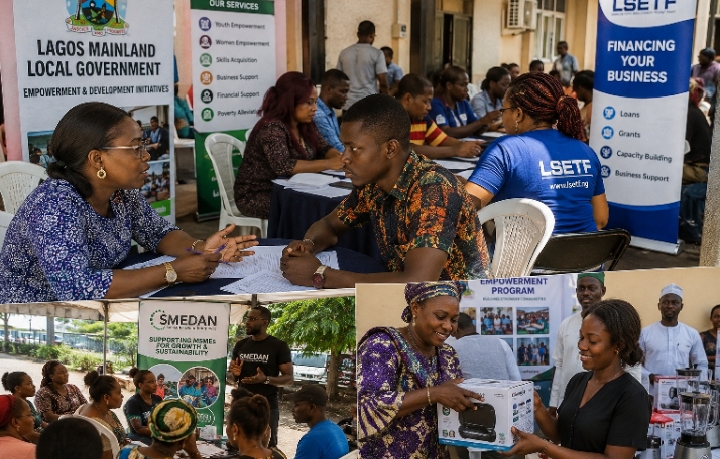
For many people living around Lagos Mainland, the search for financial support has become a daily exercise in separating genuine opportunities from attractive promises that disappear the moment an applicant tries to verify them. A flyer may mention hundreds of thousands of naira, a business empowerment programme may promise equipment, while another announcement may point toward a government intervention that sounds exactly like the opportunity someone has been waiting for. Yet, behind those different claims is a more complicated picture, because not every programme is open, not every intervention is a cash grant, and not every opportunity requires an online application.
The interesting part is that Lagos Mainland is not left out of the wider network of government empowerment programmes, business financing schemes, skills interventions and enterprise support initiatives operating across Lagos and Nigeria. Some opportunities are rooted directly in the local government area, others come through Lagos State agencies, while federal programmes can reach residents through constituency projects, MSME interventions or targeted business support. The real question is not whether opportunities exist, but where they are, who qualifies, what form the support takes, and which ones are actually worth pursuing from August 31, 2026 onward.
The Lagos Mainland Opportunity Picture
Lagos Mainland occupies an interesting position because residents can potentially benefit from several layers of government support without every programme carrying the words Lagos Mainland in its name. The local government remains the most direct starting point because grassroots empowerment can involve young people, women, traders, artisans, small business owners and other residents who need assistance to improve their economic activities. At the same time, Lagos State institutions such as the Lagos State Employment Trust Fund create a much wider financing channel for people operating businesses within the state.
Federal interventions add another layer because Lagos Mainland is also represented within federal constituency structures where empowerment projects can include training, equipment, business materials and support for young people or women. This means that someone searching for funding should not assume that a programme must advertise itself as a Lagos Mainland grant before it becomes relevant. The source of the programme, the location of implementation, the eligibility requirements and the method of selecting beneficiaries are often more important than the headline used on a social media flyer.
Lagos Mainland Local Government Support
The local government remains one of the most important places to investigate because its mandate is closest to residents who need grassroots economic assistance. Lagos Mainland Local Government is located at 2 Ondo Street, Ebute Metta West, and its published departmental structure includes areas connected to women affairs, poverty alleviation, agriculture, social and rural development, information technology and education. Those departments are significant because empowerment does not always arrive in the form of money paid directly into a beneficiary’s bank account.
Previous grassroots interventions have included forms of cash support, business assistance, empowerment materials and other measures designed to help residents improve their livelihoods. For a trader, that support could take a different form from what an artisan receives, while a young person entering a skilled trade could receive training or equipment rather than cash. This is why the local government route deserves attention even when there is no confirmed public announcement carrying a simple promise such as Lagos Mainland residents should apply now to receive ₦500,000.
The absence of a verified current online application window is particularly important for anyone who comes across such a claim. At the time covered by this report, there is no confirmed official online application window establishing a universal Lagos Mainland ₦500,000 grant for residents. That does not mean the council cannot introduce another empowerment exercise, but it means applicants should avoid treating unofficial forms, WhatsApp links or social media graphics as proof that a programme is open.
What Residents Should Ask For
Anyone visiting or contacting the local government should be specific about the type of support being sought because empowerment programmes can be handled through different departments or implementation structures. Rather than simply asking whether there is free money, a resident can ask whether there is an ongoing youth empowerment exercise, women empowerment programme, trader intervention, artisan support scheme, cash grant, equipment distribution, starter pack programme, skills acquisition exercise or upcoming beneficiary registration.
That approach can make the search more productive because government support is often described using different names at different stages. A programme may begin as a skills acquisition exercise and later involve starter equipment, while another intervention may focus on established traders who need business support. Someone with an existing business should therefore explain the nature of the business, how long it has operated and the type of assistance required rather than approaching every opportunity as though it were a general cash giveaway.
Federal Support Within Lagos Mainland
The federal angle makes the search more interesting because Lagos Mainland has appeared in government empowerment projects connected to youth and women. The Federal Government’s Youth Initiative Database contains projects involving computer training and empowerment for young graduates and youths in Lagos Mainland, along with empowerment materials for youths and women across Lagos Mainland Federal Constituency.
These projects are important because they demonstrate that federal empowerment can reach the area without necessarily creating a public website where every resident fills out a form and waits for an automatic payment. Constituency based interventions can involve implementing agencies, community structures, beneficiary identification processes, training providers or other designated channels. Consequently, the existence of a federal empowerment project should not automatically be interpreted as an open grant application.
For residents, the practical lesson is simple. Federal opportunities connected to Lagos Mainland deserve to be monitored because they can provide training, equipment or business materials, but applicants should verify the implementing organisation, eligibility conditions and beneficiary selection process before submitting personal information. A legitimate programme should have a traceable government connection rather than relying entirely on an anonymous social media administrator.
LSETF Remains a Major Route
The Lagos State Employment Trust Fund remains one of the strongest places to look when the objective is business financing rather than employment. Its importance comes from the range of financing products available to Lagos business owners, covering micro businesses, startups and established SMEs. The figures are also significant enough to make LSETF relevant to people whose businesses require more than a small starter package.
The Micro Enterprise Loan provides between ₦50,000 and ₦500,000, with the published terms stating a 9% annual interest rate and a 12 month tenor. Requirements include a LASSRA ID, LIRS Tax ID, government issued identification, BVN, 2 passport photographs, a 6 month bank statement and evidence that the business has operated for at least 1 year.
This is where applicants need to understand the difference between financing and a grant. The LSETF Micro Enterprise Loan is repayable, meaning the money should not be treated as free government cash. Its attraction is instead the possibility of accessing formal business financing under published terms that can be more structured than borrowing informally from friends, family or unregulated lenders.
LSETF Startup Financing
People who are still building their businesses may find the Startup Loan more relevant than the larger SME facility. LSETF lists the Startup Loan at a maximum of ₦250,000, with a 12 month tenor and a published annual interest rate of 9%.
The requirements include LASSRA, LIRS Tax ID, government issued identification, BVN, passport photograph and a vocational training certificate from a Lagos recognised body. That vocational training requirement is particularly relevant because it signals the type of applicant the product is designed to support. Someone with a practical skill and a realistic business idea may therefore have a stronger fit than someone simply looking for personal spending money.
A resident considering this route should prepare the documentation before the application window becomes active. Government financing opportunities can attract large numbers of applicants when applications reopen, and people who begin looking for documents after the announcement can easily lose valuable time. Having identification, business information, bank records and relevant training documents ready can make the process much smoother.
LSETF SME Financing
Established businesses have access to a larger LSETF financing category that can reach ₦5 million per business. The published SME Loan range is ₦500,000 to ₦5 million, with a stated interest rate of 9% per annum and a tenor of between 24 and 36 months.
The requirements are more extensive because the facility targets established businesses. They include LASSRA, LIRS Tax ID, government issued identification, CAC documents, BVN, passport photographs, a 6 month corporate bank statement, evidence of CAC registration and at least 1 year of business operation.
The ₦5 million figure has understandably attracted attention, but it needs to be placed in its proper context. This is not evidence that Lagos State is distributing ₦5 million free to every resident who registers. It is a business financing facility with eligibility requirements and repayment obligations. Anyone advertising it as a universal ₦5 million grant is changing the meaning of the programme.
The LSETF Portal Situation
The status of the LSETF application portal is another detail applicants should take seriously. The official portal currently states that the application portal is closed and will reopen soon. That message changes how residents should approach the opportunity because there is little value in paying an individual who claims to have a secret activation link for a programme whose official portal has not reopened.
The better approach is preparation. A prospective applicant can use the waiting period to organise LASSRA details, LIRS Tax ID, BVN, government identification, bank statements, CAC documents where applicable and certificates required for specific financing categories. Business owners can also ensure that their financial records are in order so that an application does not become difficult when the official window returns.
This is also where caution becomes important. Whenever a popular government programme closes, unofficial agents sometimes create urgency around supposed registration slots. Applicants should therefore rely on the official LSETF channel for confirmation rather than handing over money because someone claims that applications close within hours.
Lagos CARES Funding
Lagos CARES deserves separate attention because it combines different forms of support rather than operating as one simple cash grant. The programme has included categories such as Credit Grant, Operations Grant and IT Enhancement Grant, with different conditions attached to each category.
The Credit Grant has provisions reaching up to ₦1 million for micro enterprises and up to ₦1 million for SMEs under the described programme structure. Its connection with qualifying existing loans is important because it means the support should not be interpreted as an unconditional payment available to every resident who completes a form.
The Operations Grant is designed around business operating expenses and has covered areas such as salaries, utilities, rent, security and alternative power. However, the official FAQ states that the Operations Grant is closed, while the Credit Grant and IT Grant are available. This distinction matters because old articles can make a programme appear completely open even when individual categories have different statuses.
IT Support Beyond Cash
The IT Enhancement Grant is particularly interesting for business owners who do not necessarily need money deposited into their accounts but require tools that can improve the way they operate. The programme documentation describes support that can cover items such as laptops, internet services, e commerce tools, productivity software and other digital infrastructure.
The listed support limits include up to ₦400,000 for micro enterprises and up to ₦1.5 million for SMEs. For a small business trying to move from manual operations to digital systems, this type of intervention can be more useful than receiving the same amount as unrestricted cash.
The distinction also explains why the phrase funding opportunity should be broader than grant opportunity. Equipment, technology, training, working capital support and structured financing can all change the capacity of a small business. Someone searching exclusively for cash may overlook a programme that could provide an expensive piece of equipment needed to increase production.
SMEDAN Conditional Grant Scheme
The Small and Medium Enterprises Development Agency of Nigeria remains another major institution worth monitoring. Its Conditional Grant Scheme is designed around nano businesses at local government level and is much closer to the type of intervention many small traders and micro business owners are looking for.
The scheme has been described as supporting nano businesses through grants for areas including workforce support, equipment procurement and business development. That structure makes it particularly relevant to people whose businesses are too small for conventional SME financing but still require resources to become more productive.
There is, however, an important date related limitation. There was no verified fresh nationwide application deadline for a new August 31, September, October, November or December 2026 CGS round within the information available for this article. Consequently, applicants should not treat an old registration announcement as proof that a new application cycle is currently active.
SMEDAN Business Registration
One practical step for people interested in future government opportunities is formalising their business information with SMEDAN. Registration does not mean that a person automatically receives a grant, but it can place a business within the broader MSME support ecosystem.
SMEDAN Select is another programme worth watching because its stated areas include capacity building, market access, networking, funding and business resources. The value of such programmes can extend beyond a single payment because business owners may gain access to knowledge, markets, connections and resources that can support growth over a longer period.
For residents of Lagos Mainland, the advantage is that these programmes do not necessarily depend on living in a particular local government area. A qualifying Lagos based business can potentially pursue relevant national MSME opportunities when application windows open.
Agriculture Based Opportunities
Agriculture can also create a separate route for people searching for support outside traditional trading or services. SMEDAN’s Agri business Development and Empowerment Programme is aimed at people and organisations involved in agricultural production, processing and marketing.
That makes the programme potentially relevant even to an urban resident whose business sits somewhere along the agricultural value chain. Food processing, agricultural distribution, packaging and related value added activities can fall within the broader business environment connected to agriculture.
The opportunity is therefore not limited to someone physically operating a farm. Entrepreneurs who process food, distribute agricultural products or build businesses around agricultural value chains can monitor programmes in this category as part of a wider funding strategy.
The Presidential Conditional Grant
The Federal Government’s Presidential Conditional Grant Scheme is another name that continues to circulate widely whenever Nigerians search for government grants. The Bank of Industry described the scheme as providing non repayable grants to eligible nano businesses, with target sectors including trading, food services, ICT, transportation, creative businesses and artisans.
The programme also targeted categories such as women, youths, people with disabilities and senior citizens. Those details explain why old PCGS announcements remain attractive to applicants looking for small business funding.
The problem is timing. The major rollout of the programme began in 2024, and there was no verified fresh 2026 application window in the information available for this report. An old government page can remain online for years without meaning that the same application process has reopened.
Tony Elumelu Foundation
The Tony Elumelu Foundation remains one of the strongest private entrepreneurship funding programmes Nigerian business owners should know about, but it is not an August 2026 opportunity. The foundation’s official 2026 Entrepreneurship Programme application period ran from January 1 to March 1, 2026.
That date is important because it immediately separates the genuine annual programme from websites or social media accounts claiming that TEF 2026 applications are still open. Anyone who missed the March 1 deadline should think ahead to the next application cycle rather than paying someone to create a supposedly late application.
The programme is still worth monitoring because it has become a major entrepreneurship pipeline, particularly for people developing businesses with the potential to grow beyond a small informal operation. For someone preparing for 2027, the period before the next application window can be used to strengthen the business idea, records, financial projections and evidence of market activity.
Larger BOI Financing
People searching for ₦10 million, ₦20 million or ₦50 million opportunities should also understand that larger amounts are generally found within enterprise financing rather than universal personal grants. The Bank of Industry has supported youth owned businesses and other enterprise categories through substantial financing programmes.
The GLOW programme is another example, providing women focused financing of up to ₦50 million per beneficiary under its stated structure. A figure of ₦50 million can easily become sensationalised online, but the actual nature of the opportunity is important because large business financing involves eligibility, assessment and financing conditions.
The difference between a ₦50 million financing facility and a ₦50 million free grant is enormous. Applicants who understand that distinction are less likely to fall for advertisements promising instant approval in exchange for registration fees.
The Documents Worth Preparing
Preparation can make a significant difference when an official opportunity opens with a short application period. Lagos based applicants should pay particular attention to LASSRA information, LIRS Tax ID, BVN, valid government identification and recent bank statements because these appear repeatedly among the requirements for LSETF financing.
Business owners seeking larger facilities should also keep CAC documents, corporate bank statements, evidence of business operation and relevant training certificates available. The purpose is not to submit documents randomly but to ensure that everything required can be produced quickly once an official application window is confirmed.
A business owner should also make sure the information across documents is consistent. Differences in names, business details or identification information can create avoidable problems during verification. Proper preparation does not guarantee approval, but it can prevent an otherwise eligible applicant from losing an opportunity because basic paperwork was not ready.
The Programmes To Approach Carefully
The most obvious warning sign is a promise that combines a large amount of money with almost no eligibility requirements. Claims such as every Lagos Mainland resident will receive ₦500,000, registration is closing tonight, pay a small activation fee or send your BVN to secure your slot should be treated with caution until independently verified.
The same caution applies to old programme links. A page can carry the name of a genuine government scheme while the application window attached to it has already closed. The existence of an official programme therefore does not automatically mean that applications are open today.
LSETF’s closed portal status, the March 1, 2026 TEF deadline and the absence of a verified new 2026 PCGS application window are all examples of why dates matter. The safest applicant is not necessarily the person who registers first. It is the person who knows whether the programme is genuinely open, what it provides and who is responsible for administering it.
The Strongest Route For Lagos Mainland Residents
For someone living around Lagos Mainland and specifically seeking cash, equipment, business support, grants or starter resources rather than employment, the search can be organised into a clear sequence. Lagos Mainland Local Government should come first for grassroots empowerment and local beneficiary registration. Lagos State agencies should follow, particularly LSETF and relevant ministries or intervention programmes.
Federal constituency projects should then be monitored because Lagos Mainland has appeared in federal empowerment initiatives involving youths and women. SMEDAN provides another important national channel for nano businesses, MSMEs and specialised programmes, while BOI becomes more relevant when the business requires larger structured financing.
This sequence is more realistic than waiting for one perfect advert promising free cash. Government support is spread across institutions, programmes and categories, and the form of assistance can change depending on the applicant’s circumstances. One person may qualify for a grant, another for equipment, another for training and another for a repayable business facility.
The Real Opportunity Ahead
The funding landscape around Lagos Mainland in 2026 is therefore broader than the phrase Lagos Mainland grant suggests. There is genuine grassroots empowerment activity, federal intervention connected to the constituency, Lagos State financing through LSETF, targeted Lagos CARES support, SMEDAN programmes and larger business financing routes through institutions such as BOI.
At the same time, the current picture does not support the claim that every Lagos Mainland resident can simply apply online for a universal ₦500,000 cash grant. The LSETF application portal is currently closed and expected to reopen, TEF 2026 closed on March 1, 2026, the older PCGS should not be treated as a fresh 2026 application, and several other programmes have specific categories rather than blanket eligibility.
That leaves residents with a much clearer path going into the final months of 2026. The immediate focus should be on verified local empowerment channels, the reopening of relevant LSETF applications, Lagos CARES categories that remain available, new SMEDAN announcements, federal constituency interventions and legitimate business financing programmes. Anyone prepared with the right documents, a functioning business record and a clear understanding of whether an opportunity is a grant, equipment support or a loan will be in a much stronger position when the next genuine window appears.
The search for funding around Lagos Mainland does not end with finding a flyer that promises money. It begins when the promise survives verification, the programme has a traceable source, the application window is genuinely active and the terms match what the applicant actually needs. For residents watching the period from August 31 through December 2026, that distinction could be the difference between spending time chasing recycled promises and finding a real opportunity capable of moving a business forward.