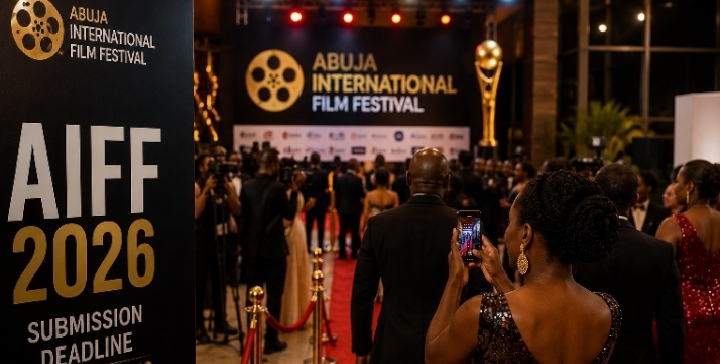
A film can spend months in development, pass through countless rewrites, survive production pressures, editing rooms and sleepless nights, yet still face its most important test when it finally meets the people who decide where it belongs. For filmmakers watching the calendar in September 2026, one particular date is beginning to matter because it marks the final opportunity to place a completed film before one of Nigeria’s established international film festivals. Behind that date are categories, fees, technical requirements, awards, screenings, masterclasses and industry opportunities that can determine whether a submission becomes part of the festival conversation in Abuja.
The real question is not simply whether a filmmaker can submit before the deadline, but what exactly happens after the submission button is pressed, what the rules actually promise, what they do not promise, and what selected filmmakers may gain from being part of the 2026 edition.
The September 18 Deadline
September 18, 2026 is the final submission deadline listed for the Abuja International Film Festival, widely known as AIFF, and this is one of the clearest dates filmmakers need to keep in view. The deadline is not the opening date of the festival itself, which is an important distinction for anyone seeing September 18 mentioned in opportunity listings. The festival’s submission calendar shows an early bird deadline of July 3, 2026, a regular deadline of August 15, 2026, followed by the final or late deadline of September 18, 2026. Anyone intending to enter a film after the regular period therefore needs to work around the final date rather than assuming the September date refers to the physical festival.
The deadline also matters because a late submission does not appear to carry the same pricing advantage as the earlier stages. The published submission information shows different fee periods for several categories, meaning the timing of the application can affect what a filmmaker pays. September 18 is therefore not simply another date on the calendar, but the final point within the published 2026 submission window. Filmmakers who already have their films, screeners, posters, still photographs and other required materials ready have a much shorter checklist to complete than filmmakers who are still putting their submission package together.
When AIFF 2026 Takes Place
The festival itself is scheduled for October 20 to October 24, 2026, according to the current official AIFF programme information. That puts the physical festival just over a month after the September 18 submission deadline, creating a clear sequence from final submission to selection and then festival activities. Abuja will become the meeting point for screenings, industry conversations, masterclasses, networking sessions and the awards programme during those five days.
The published programme gives October 20 as the opening day, with activities including the opening ceremony and film, a masterclass, a panel discussion, the unveiling of the AIFF Academy and networking. October 21 moves into red carpet activities, a keynote, an opening film and selected screenings, while October 22 focuses on the AIFF Academy and industry sessions. October 23 continues with screenings, panels, question and answer sessions and networking before October 24 brings the festival towards its climax with the closing ceremony, jury presentation, AIFF Awards and special recognition awards.
There is one date discrepancy that prospective attendees should know about before making travel arrangements. Festhome currently displays October 27 to October 31, 2026, while the festival’s own current website and FilmFreeway information point to October 20 to October 24, 2026. For a publication focused on the official 2026 schedule, October 20 to October 24 is the stronger date to use because it is the schedule currently presented by AIFF itself. Anyone selected or planning to attend should still check directly with the festival before booking flights or accommodation.
Who Can Submit a Film
AIFF is not presented as a competition reserved exclusively for Nigerian filmmakers. The published FilmFreeway rules state that the 23rd edition is open to filmmakers from all countries, giving the submission process an international character. That matters because a Nigerian filmmaker submitting from Lagos, Abuja, Enugu, Port Harcourt or elsewhere is entering the same broader festival environment as filmmakers submitting from outside the country.
The categories cover different forms of screen storytelling, giving filmmakers with different types of completed projects a possible route into the festival. The published materials refer to feature films, short films, documentaries, animation, experimental films and student films, while other platform information also references television or online content and music videos. The official AIFF submission page currently places particular emphasis on narrative, documentary and short films, so applicants should check the exact category available on the submission platform before completing payment.
Feature Films Take Their Place
Feature films form one of the major categories within the festival’s competition structure, with both international and Nigerian feature categories referenced in the published information. For filmmakers who have invested heavily in a full length production, festival selection can provide a route into an audience and industry environment beyond the film’s initial release strategy.
A feature submission also needs to be treated as a professional festival entry rather than simply sending a video file and waiting for a response. The submission package requires information about the production, including the film title, runtime, country of production, synopsis, director’s biography, director’s photograph, still images, poster and an online screener or uploaded film. The strength and completeness of those materials can therefore matter alongside the film itself because the programming process needs enough information to assess and present each entry.
Short Films Remain Part of the Competition
Short filmmakers are also directly catered for within the published AIFF structure, with international and Nigerian short film categories listed among the competition areas. This gives emerging directors and producers with shorter productions an opportunity to submit without needing to have produced a feature length project.
The short film category can be particularly relevant to student filmmakers and emerging directors who are still building their festival records. A well made short can serve as both a standalone piece of cinema and a calling card for the filmmaker behind it. AIFF’s inclusion of screenings, networking, masterclasses and industry discussions means a selected short can potentially place its creator in a wider professional setting where the film becomes part of a larger introduction to the filmmaker’s work.
Documentary, Animation, Experimental Work
Documentary filmmakers are also included in the published categories, giving factual and non fiction storytelling a place within the festival’s programme. Animation is listed as another category, while experimental film is recognised within the festival’s wider competition structure. This broadens the opportunity beyond conventional narrative cinema and creates room for filmmakers working with different visual and storytelling approaches.
Student films are also recognised, which gives film students a possible route into an established festival environment before they have built long professional careers. For a student filmmaker, festival selection can become an important part of a developing portfolio because it provides an opportunity to have the work screened alongside productions submitted from other filmmakers. The important point is that the applicant needs to identify the correct category and satisfy its requirements rather than assuming every film is automatically considered under one general competition.
What Filmmakers Need Before Submission
The submission process requires more than having a completed film sitting on a laptop or hard drive. The published requirements call for a film title, runtime, country of production and a synopsis of up to 250 words, alongside a director’s biography and photograph. Applicants are also expected to provide 2 to 5 high resolution still photographs, a film poster and an online screener or uploaded version of the film.
That list is worth taking seriously because a rushed submission can create avoidable problems. A filmmaker who waits until September 18 to start looking for high resolution stills, prepare a poster or upload a secure screener could end up spending the final hours fixing materials instead of reviewing the actual application. Vimeo and YouTube links are among the secure screener options referenced in the rules, while uploaded files are also accepted.
The Technical Requirements
Technical quality is another part of the submission that cannot be pushed aside. The published requirements state that final exhibition copies should be HD 1080p or higher, with 4K preferred. Accepted formats include MP4, MOV and MKV, while films produced in languages other than English must carry English subtitles.
That requirement is particularly important for filmmakers who may have completed a film in another language or whose production contains substantial dialogue outside English. Subtitles are not merely an optional convenience in that situation because the festival rules specifically refer to English subtitles. The published rules also warn that poor audio or video quality can lead to disqualification, making the technical preparation of the final screener part of the filmmaker’s responsibility.
How Much Does Submission Cost
AIFF is not a completely free film submission opportunity. The published Festhome information gives category specific fees, with the amount depending on the type of production and the submission period. Feature films are listed at $30 for early submissions, $35 for standard submissions and $35 for late submissions.
Short films are listed at $15 for early submissions, $20 for standard submissions and $20 for late submissions. Television series are listed at $20 for early submissions, $20 for standard submissions and $25 for late submissions. The platform also shows discounted rates for certain members, while submission fees are stated to be non refundable.
Nigerian filmmakers should pay attention to the submission route because the AIFF website also provides a Submit Now NGN option. That means applicants should not automatically assume the dollar denominated Festhome amount is the only route available to them. The safest approach is to open the relevant submission category and confirm the amount displayed before making payment because fees can vary according to the platform and category being used.
What Happens After the Film Is Submitted
Sending the film does not mean the film has automatically entered the festival programme. According to the published rules, submissions go through a selection process, with the final selection determined by the AIFF Programming Committee. Selected filmmakers are then notified by email.
There is a small but important problem within the currently published rules because the notification clause refers to September 20, 2025, even though the surrounding material concerns the 2026 edition. That date should therefore not be presented as the confirmed notification date for the 2026 festival. The safer fact based position is that selection is made by the festival’s programming process and selected filmmakers are notified by email, while applicants should await an updated official notification schedule if AIFF corrects the outdated date.
The Awards Question
This is where the title of the opportunity becomes particularly interesting because AIFF is not simply organising screenings. The festival has an awards structure that recognises different aspects of filmmaking and performance, creating another potential reward for films that make the official selection.
The published awards structure references the Golden Jury, Audience Choice, Cinematography, Music Score, Special Mention, Outstanding Actor and Outstanding Actress among its areas of recognition. Awards can include trophies and certificates, with partner sponsored prizes where applicable. That means the trophy and recognition element is established within the festival structure, while the precise value and form of any partner sponsored prize can depend on what is available for the particular edition.
Cash Prizes, Trophies, Awards: The Money Question
Abuja International Film Festival has a history of attaching cash rewards to some of its competition prizes. Previous AIFF promotional material has cited cash awards of ₦750,000 for 1st place, ₦500,000 for 2nd place and ₦250,000 for 3rd place. However, those figures should not be presented as the confirmed 2026 prize structure because the published 2026 rules do not state that the same amounts will be paid this year.
For the 2026 edition, the official rules confirm that winning filmmakers can receive trophies and certificates, alongside partner sponsored prizes where applicable. The rules therefore leave room for sponsored or cash rewards, but they do not establish a guaranteed ₦750,000, ₦500,000 or ₦250,000 payout for every edition. That makes the prize package an important part of the festival’s attraction, while the exact 2026 cash component remains subject to official confirmation.
The bigger opportunity extends beyond the money. A filmmaker whose work makes the final selection is entering a festival platform that combines screenings, awards consideration, industry conversations, masterclasses, networking, professional development and international exposure. For emerging filmmakers especially, the trophy may be valuable, but the relationships and visibility created around the screening can become the more consequential reward.
The Screening Opportunity
For a selected filmmaker, one of the clearest benefits is the opportunity to have the film screened as part of the festival programme. Screening a film at an established festival places it in a setting where audiences, filmmakers, industry professionals and other creative practitioners are gathered around cinema.
That opportunity can matter even when there is no guaranteed cash reward attached to the selection. Festival screenings can become part of a filmmaker’s professional history, giving the production another platform beyond its original release or online distribution. AIFF’s programme also combines screenings with discussions, question and answer sessions and networking, creating a wider environment around the films rather than treating them as isolated pieces of content.
Masterclasses Move Beyond the Screening Room
The AIFF Academy is another significant part of the 2026 programme. The festival describes the Academy as a talent development platform intended to support emerging filmmakers with craft development, filmmaking business knowledge and industry connections. This gives the 2026 event an educational dimension that goes beyond competition and awards.
The programme lists areas including directing, writing, producing, acting, cinematography, editing and post production, film business and entrepreneurship, industry panels, global co production and filmmaking for impact. For someone trying to build a sustainable career in film, those sessions can be just as relevant as the screening schedule because filmmaking involves much more than getting a camera and completing a project.
Networking Becomes Part of the Opportunity
Networking is repeatedly built into the 2026 programme, including dedicated sessions involving filmmakers, emerging creatives and industry professionals. This gives selected filmmakers and festival participants opportunities to meet people working in different parts of the screen industry.
Directors, producers, screenwriters, actors, cinematographers, editors and film entrepreneurs can all find reasons to pay attention to the programme. A filmmaker does not necessarily need to approach the festival solely as a competition for trophies because the wider programme creates opportunities for conversations about projects, careers, collaboration and the business of film.
The International Reach
AIFF presents itself as an international film platform, and its published figures point to a broad global reach. The festival website refers to representation from more than 120 nations, while its FilmFreeway profile lists historical figures including 35,000 audience attendance, 10,076 estimated submissions, 100 projects selected and 352 awards presented.
Those figures are festival and platform figures rather than independently audited statistics, so they should be treated as figures listed by AIFF rather than independent measurements. Even with that qualification, the numbers provide context for the scale the festival claims across its history and platform presence.
The previous edition also gives a more recent picture. AIFF reported that its 2025 edition received more than 1,500 films from 80 countries, with 70 films selected for screening. That level of international submission shows that filmmakers entering the 2026 edition should not approach the application as an automatic route to selection.
What Happened at the 2025 Edition
The 22nd edition of the Abuja International Film Festival took place from November 6 to November 10, 2025. Reports surrounding the edition said the festival received more than 1,592 entries from 80 countries and selected 70 films for screening.
The 2025 programme included film screenings, panels, workshops and capacity building activities, while the festival also recognised actors and other industry figures. Discussions around investment, infrastructure and the development of Nigeria’s creative economy formed part of the wider festival environment, showing that AIFF has positioned itself as more than a simple film screening event.
Where the 2026 Festival Will Hold
The 2026 festival is centred in Abuja, with venues listed across the city. Silverbird Cinemas Abuja and Transcorp Hilton Abuja are among the venues referenced in the festival information, while the University of Abuja Mini Campus is also listed among the locations connected with the programme.
The spread of venues means the event is not simply a single cinema screening. The programme combines ceremonies, screenings, masterclasses, panels, Academy activities and networking, with different activities taking place across the festival schedule. Selected filmmakers travelling to Abuja should therefore pay attention to the specific location of their scheduled activity rather than assuming every event will happen at one venue.
Who Founded AIFF
The Abuja International Film Festival was founded by Fidelis Duker, while Temitope Duker is listed as Festival Director. The festival dates back to 2004, according to Fidelis Duker’s account of its history, when the platform was created to give filmmakers a place to screen their work, network and exchange ideas.
The 2025 edition was the 22nd edition, making the 2026 edition the 23rd. That history is relevant when considering what the festival represents because the current submission opportunity is part of a longer running festival rather than a newly created competition appearing for the first time in 2026.
Travel Costs Are Not Automatically Covered
Being selected should not be confused with receiving an all expenses paid trip to Abuja. The published rules state that attendance is encouraged but not mandatory, while selected filmmakers who attend are responsible for their travel, accommodation and visa arrangements unless the festival states otherwise.
That point is especially important for international filmmakers because selection does not appear to automatically include flights, hotel accommodation or visa expenses. Nigerian filmmakers travelling from outside Abuja should also factor transport and accommodation into their plans rather than assuming the festival will cover those costs.
What Filmmakers Can Realistically Gain
The most realistic way to understand the opportunity is to look at the benefits as a package. A filmmaker who submits a qualifying production has the possibility of being selected for screening, considered for awards, participating in networking activities and accessing professional development through masterclasses and Academy sessions.
The international nature of the festival adds another layer because selected work enters a programme involving filmmakers and productions from different countries. There is also the possibility of recognition through trophies, certificates and partner sponsored prizes where applicable. What should not be added to that list without an official announcement is a guaranteed cash grant or guaranteed production funding.
The September 18 Checklist
With September 18, 2026 serving as the final submission deadline, filmmakers should treat the remaining period as a preparation window rather than waiting until the final hours. The first step is confirming the correct category for the film, whether it is a feature, short, documentary, animation, student production, experimental film or another eligible format listed by the relevant platform.
The next step is assembling the submission materials. The filmmaker should have the film title, runtime, country of production, synopsis of no more than 250 words, director biography, director photograph, 2 to 5 high resolution stills, film poster and working screener ready. Technical checks should follow, including resolution, file format, audio quality and English subtitles where required.
The Dates Worth Remembering
September 18, 2026 is the date that matters most for filmmakers who have not yet submitted because it is the published final deadline. October 20 to October 24, 2026 is the current official festival schedule, covering the opening, screenings, Academy activities, panels, networking, closing ceremony and awards.
The earlier submission dates also help explain how the application window has been structured. July 3, 2026 was the early bird deadline, while August 15, 2026 was the regular deadline. September 18, 2026 is therefore the final stage, with late category fees applying where stated.
The Bottom Line for Filmmakers
AIFF 2026 presents a clear proposition for filmmakers with completed projects who want more than simply uploading a film online and waiting for an audience. The 23rd Abuja International Film Festival brings together film submissions, screenings, awards, professional development, industry discussions and networking, with the current festival programme scheduled for October 20 to October 24, 2026.
The September 18 deadline is the immediate date to remember. The opportunity does involve submission fees, and selection is not guaranteed. Travel and accommodation are also not automatically covered for selected filmmakers. At the same time, the festival’s published structure provides a genuine route toward screening, recognition, professional development and industry connections, while its previous edition demonstrates that the competition can attract submissions from filmmakers across many countries.
For anyone preparing to submit, the smartest approach is straightforward. Confirm the category, prepare the required materials, check the technical specifications, verify the current submission fee, complete the online entry and make sure everything is submitted before September 18, 2026. The festival itself follows in October, when selected filmmakers will have the chance to see whether their work moves from a private screener into a public festival programme in Abuja.