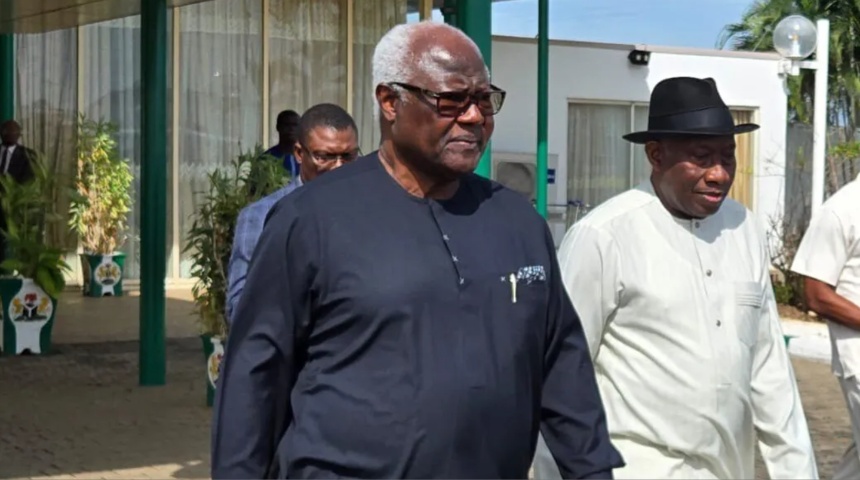
Ernest Bai Koroma is home.
On Sunday, after having been away for over two years, the former president of Sierra Leone landed at Freetown’s international airport, alighting from a flight coming in from Abuja onto a welcoming party which consisted of a former head of state from Nigeria, the present foreign minister of Nigeria, and members of his own political party who had been waiting for a long time to see him again in Sierra Leone.
“I’ve returned home today and I’m pleased,” Koroma told the reporters at the airport, smiling as the cameras moved in. Although it was just a simple statement, it contained the significance of a story which had lasted for over two years and had involved everything from a violent uprising to a contested election to a subtle diplomatic initiative involving three former African presidents.
From medical trip to two-year exile
The origins of the story date from January 2024. Koroma, who was Head of Government in Sierra Leone from 2007 to 2018, had just been accused of treason and other offences linked to a violent uprising that had taken place two months earlier. With the approval of Sierra Leone’s High Court, he was allowed to go to Nigeria for medical treatment, a journey which was intended to take three months but ultimately lasted over two years.
The revolt in November 2023 was serious enough to send shockwaves through the entire country, when armed attackers carried out a coordinated attack on a military armoury, two barracks, two prisons, and two police stations; the authorities subsequently referred to this as an attempted coup. About 21 people were killed during the fighting and nearly 2,000 prisoners escaped before the security forces were able to bring order back. The incident occurred five months after a heavily contested election in which President Julius Maada Bio won a second term by a narrow margin, a result that Koroma’s opposition party, the All People’s Congress, refused to accept.
Dozens of people were eventually connected with the plot. A military court imposed sentences between 50 and 100 years on twenty-two soldiers as well as on Koroma’s former bodyguard. In 2024 eleven civilians and 24 soldiers were found guilty for their part in the mutiny. Although Koroma has always and firmly denied having taken any part in planning or supporting the attack, he was charged with treason.
How the charges disappeared
What makes the situation interesting and where Nigeria’s influence is most clearly seen is the difference between January 2024 and this weekend.
Accounts from the area indicate that an agreement was arranged secretly via the Economic Community of West African States, enabling Koroma to stay in Nigeria while the case against him was handled behind closed doors instead of in an open court. Although the Sierra Leone government has never officially confirmed that such an arrangement existed, the timeline does fit: Koroma remained in Nigeria for a lot longer than his medical visit had required, and the case against him just never progressed.
It was then in July 2026 that the case came to an end. The justice ministry in Sierra Leone withdrew the charges. Chernor Bah, who was information minister, stated to the BBC that the case had been discontinued due to health reasons, and the attorney general then completed the official documents to close it. No further explanation was provided, and indeed none was really to be expected, since in West African politics some settlements are reached through negotiation rather than through litigation.
Koroma in fact went back to Sierra Leone for a short time that same month, attending an ECOWAS summit in Freetown at the invitation of President Bio. This visit was a quiet indication of things to come. Several days before the event took place, Sierra Leone’s Vice President, Mohamed Jukdeh Jalloh, made Koroma’s full return official by posting a video on Facebook from Makeni, his political base in the northern part of the country, and stated that the former president would be returning “in the spirit of peace and national cohesion.”
Nigeria’s quiet diplomacy, front and centre
What is clear from Koroma’s return on Sunday is the fact that people came with him. He did not go back to Nigeria by himself or in silence; instead, he left accompanied by former President Olusegun Obasanjo and Nigeria’s foreign affairs minister, Bianca Odumegwu-Ojukwu. Former President Goodluck Jonathan, who saw Koroma off from the Nigerian side, later wrote on X that Nigeria had, over the past two years and more, effectively become Koroma’s ‘second home’ and that he and others had worked to establish a dialogue with the authorities in Sierra Leone in order to make a safe and dignified return possible.
The fact that three men who had previously been in charge of Africa’s most populous country, Obasanjo and Jonathan, both of them presidents—and together with a foreign minister currently in office, have placed their names and themselves behind one man’s return home shows that this was never simply a matter of arranging the travel arrangements. It was an example of Nigerian diplomacy, carefully carried out over a period of two years, aimed at bringing a fellow West African leader back from exile without having to go to court.
On the Sierra Leonean side, Mohamed Rahman Swarray, who is the foreign minister, met Koroma at the airport, together with senior members of the All People’s Congress who had spent two years observing their party’s most prominent figure governing from a distance while in exile and not being able to enter the country that he had once led.
Why the timing matters
This is not taking place in isolation. With presidential elections due in Sierra Leone in 2028, Koroma’s return, having had all criminal charges against him dropped, being welcomed back by his party, and the move being approved by a government which he had once opposed strongly, once again establishes him as a political figure no matter what personal decisions he ends up making. Whether or not he decides to stand as a candidate, whether he chooses to mentor a successor in the APC, or merely lives out the rest of his life at home, his being back in Makeni has an effect on the political atmosphere in a nation that is still recovering from a coup attempt which almost brought it down.
For the government of Bio, deciding to drop the case and officially welcoming Koroma back is in itself a statement; it sends a signal, whether deliberately or not, of a desire to reduce political tensions before the next election cycle, rather than allowing an unresolved treason case to loom over the country for years to come.
For Nigeria, this incident adds yet another item to its lengthy record of acting as an informal mediator in political crises in West Africa, in this instance mainly relying on personal relationships between senior statesmen who have known one another for decades.
Koroma is home. The charges are gone. And a chapter that began with gunfire at a Freetown armoury in November 2023 has closed, for now, with a handshake at the airport instead of a verdict in court.