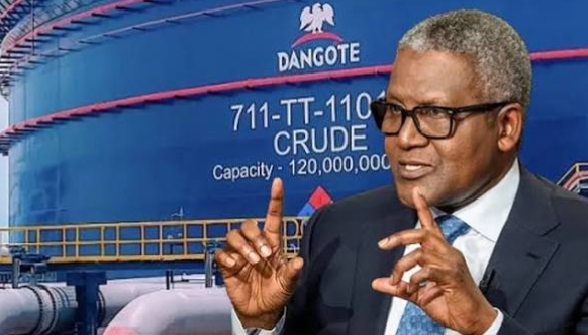
On Monday Lagos witnessed a historic moment when, at the Eko Hotels under the scrutiny of cameras and the watching eyes of investment bankers, Aliko Dangote signed the documents that will finally allow ordinary Nigerians to own his $50 billion refinery.
It has finally arrived. Since the facility in Lekki, with a capacity of 650,000 barrels a day, started pumping petrol, diesel and jet fuel in 2024, Nigerians have seen it transform the country’s fuel market, reduce reliance on imports, and have made Dangote a name associated with industrial ambition. However, up until now they have not been able to obtain a share in it.
On September 14 the Dangote Petroleum Refinery and Petrochemicals FZE will officially launch its Initial Public Offering, a share offering of ₦2.15 trillion which could become the largest in the history of Nigeria’s capital market and possibly the biggest IPO that Africa has ever seen.
The Numbers Behind the “IPO for the People”
This is the section that everybody has been looking forward to: the price.
The refinery is issuing 4.1 billion ordinary shares at a price of ₦525 each. If you do the calculation, the company’s value comes to nearly $50 billion, an extraordinary amount for an asset which is located on about 2,635 hectares of reclaimed land in the Lekki Free Trade Zone and is already the largest single-train refinery in the world.
The figure which matters most to the typical Nigerian isn’t the one in the headline amounting to a trillion naira; it’s ₦5,250. This is the minimum amount that an average investor has to spend in order to get started, enough to buy ten shares, since that is the smallest subscription the company will take. Once that has been done, people who wish to invest more can do so by purchasing further blocks of ten shares at a time.
Dangote was not reluctant when explaining why the entry point had been set so low. At the ceremony when the shares were signed, he referred to it as “the IPO for the people” and stressed that there would be no gatekeeping regarding who could take part. “There will be no segregation as to who can own the shares,” he said. “We would like every human being who is living on the continent to be part of this initiative.”
That line works well and in fact matches the structure of the deal. The offer has been intentionally constructed on the basis of a digital subscription model with the aim of increasing retail access, a feature which, at least on paper, could make refinery shares accessible to market women, university graduates, and salary earners who had never opened a brokerage account.
Why Now, and Why It’s Such a Big Deal
If you want to understand why this IPO is being discussed as it is, then you need to consider where the money is being directed and what has already taken place before the IPO.
The amount in question, expected to come in at about $1.6 billion, is to be used for the refinery’s next stage of expansion, which involves increasing its capacity from the current level of 650,000 to 700,000 barrels per day to around 1.4 million barrels per day. That is no small improvement; it is an attempt to transform a refinery which already holds a dominant position in the supply of fuel in West Africa into one of the largest single industrial establishments in the world.
For months now, investor interest has been growing and not in a quiet manner. In July the Dangote Refinery raised $2.5 billion via a private placement directed at institutional investors and high-net-worth individuals, this offering being 270 per cent oversubscribed. The company then, in August, entered into a $1 billion underwriting deal which included a $600 million funded placement and a $400 million commitment. By the time the public offering came around, there was already a long queue of unsatisfied demand ready to move into it.
The demand became so great that, in June, Nigeria’s Securities and Exchange Commission was forced to intervene and halt all marketing associated with the IPO following reports that ordinary people, some of whom had no previous experience in trading shares, were rushing to open trading accounts simply because of the rumours surrounding the offer. That fact is significant: before the prospectus had even been signed, Nigerians had already been trying to buy shares.
There is also the wider situation concerning the Nigerian Exchange itself. The analysts who are keeping an eye on the listing expect the NGX’s total market capitalisation to increase by more than a third when the shares are officially listed on the Main Board, a development which would be among the most important single events in the exchange’s history. Outside Lagos, Dangote’s team is also having discussions about a secondary listing on the Johannesburg Stock Exchange, and it is reportedly still being discussed in relation to Egypt and Kenya, showing that its ambitions reach well beyond Nigeria’s borders.
How the Offer Actually Works
The subscription period will begin on 14 September 2026 and, according to the offer documents published together with the signing ceremony, is expected to last approximately four weeks before ending in mid-October.
Retail investors have two primary ways of getting in: they can do so via a stockbroker who is licensed and registered with the NGX, or they can apply electronically through approved digital investment platforms together with participating banks, this reflects the “digital-first” access that Dangote’s team has been stressing. As for institutional investors, they will mostly use receiving agents and fill out formal application forms.
Full payment must be made at the time applications are made, which means this is not a pay-in-full later arrangement, you have to have the funds available before you submit them. Vetiva Advisory Services Limited is overseeing the fundraising, in cooperation with Stanbic IBTC Capital and FirstCap as the lead issuing houses.
If you’re planning to take part, there are a few practical boxes to tick before the window even opens:
- Open a CSCS account. The Central Securities Clearing System is where Nigerian share ownership actually gets recorded. No CSCS account means no way to legally hold the shares once allotted, so this has to be sorted first.
- Set up or confirm your brokerage account. Whether it’s a traditional stockbroking firm or one of the newer investment apps operating on the NGX, you’ll need an active, funded account through which to submit your application.
- Complete your KYC. Identity verification and know-your-customer checks are non-negotiable for any Nigerian IPO, and processing can take time, best handled well before the rush.
- Have your funds ready. Given the scale of interest already seen in the private placement rounds, delays in funding your account could mean missing out entirely if the offer is heavily oversubscribed.
- Read the actual prospectus. Every material detail, share pricing, subscription multiples, offer timelines, the company’s financials, is spelled out there, and it’s worth reading rather than relying on secondhand summaries.
Another point worth knowing is that, in the event that the offer is oversubscribed, Dangote Refinery will be able to take on 30 percent more than its original target, provided that the SEC approves it. There’s also a incentive included for smaller investors, retail applicants who are eligible and keep their minimum shareholding for a specified period of time may be entitled to up to two bonus shares without having to pay any extra cost, although this too is subject to regulatory approval.
A Word of Caution Amid the Excitement
It’s simple to be overwhelmed by the magnitude of the situation, by the trillions involved, the record-breaking assertions, and the idea that ordinary Nigerians will get to own a share of the continent’s largest industrial project. And there is real merit to the excitement. This is a refinery that is actually operating, making a profit, and generating revenue, not just a speculative startup proposal. In May alone it was stated to be supplying an average of 41.5 million litres of petrol each day, which amounts to just over 101 per cent of its named capacity. The refinery has also taken over the lead from the United States to become the biggest single external supplier of jet fuel to Europe, a position it held during June and July.
Yet, whenever you purchase shares in a company, whether it’s a refinery or not, there is risk involved and no return can be guaranteed. The oil and fuel markets can experience sharp fluctuations due to global events which are beyond anyone’s control. All of the factors that deserve consideration before you spend money you cannot afford to lose include possible changes in regulation, movements in the currency, and the execution risk associated with the planned expansion to 1.4 million barrels a day.
There is also another important warning that deserves to be repeated: as growing interest in this IPO has developed, so too has the amount of noise surrounding it. Officials and financial websites have on numerous occasions warned Nigerians not to send money in response to advertisements on WhatsApp, unofficial ‘early access’ deals, or to anyone who says they can secure a spot before the official period. The sole legitimate ways are through licensed stockbrokers, digital platforms approved by the NGX, and the banks and agents explicitly listed in the prospectus. All other methods should be regarded with suspicion.
At the moment, the countdown is underway. For the first time since Africa’s richest man began construction on his refinery many years ago, Nigerians will not only be filling their tanks with fuel that has been refined by Dangote but will also have the opportunity, should they wish to, to own a share in the company responsible for it.