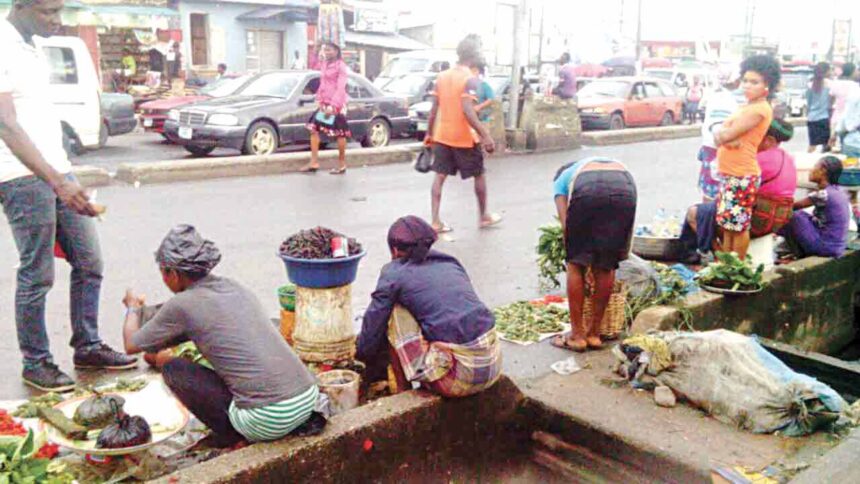
For many Lagos residents, buying something by the roadside is hardly a decision that requires much thought. A driver sees oranges arranged beside a busy road and pulls over, a passenger notices a seller with drinks and reaches out, a commuter spots clothes, shoes or household items displayed close to a walkway and decides to make a quick purchase before continuing the journey. It has become part of the rhythm of everyday life in a city where convenience often matters just as much as price, especially when traffic is heavy and stopping at a recognised market can turn a simple purchase into a much longer trip.
That familiar routine has now come under a different kind of attention following a warning issued by the Lagos Waste Management Authority on September 8, 2026. The warning goes beyond the traders who occupy roads, medians, walkways and other unauthorised public spaces, because the authority says the people who patronise such traders can also face arrest and prosecution. For residents who have always viewed themselves as customers rather than participants in illegal street trading, that detail changes the situation considerably and raises a question that is far more serious than the price of whatever is being bought.
The issue becomes even more interesting when the relevant Lagos law is examined closely, because the legal provision being relied upon is not a rule created suddenly in September 2026. The buyer offence already appears in the Lagos State Environmental Management and Protection Law 2017. What has changed is the renewed enforcement warning and the stated intention to begin targeting buyers from the following week, bringing an old legal provision into the centre of everyday activity on Lagos streets.
September 8, 2026 Begins A New Enforcement Conversation
The latest warning came on September 8, 2026, when LAWMA Managing Director and Chief Executive Officer Muyiwa Gbadegesin announced a renewed enforcement strategy concerning illegal roadside and median markets across Lagos. The authority made it clear that its concern is not restricted to traders who occupy prohibited locations, because customers patronising those traders are also being brought into the enforcement picture. According to the announcement, enforcement is expected to begin the following week, meaning the warning is not simply a general reminder about environmental cleanliness but a signal of a more active enforcement phase.


The locations mentioned are particularly important because the policy is not framed as a ban on buying from every informal seller found somewhere close to a road. The focus is on trading carried out in prohibited or unauthorised public spaces, including roads, roadside areas, road medians, walkways and setbacks. Other public spaces that have not been authorised for trading can also fall within the wider concern. That distinction matters because the legal question is connected to where the goods are being offered for sale and whether that location is covered by the relevant prohibition.
For the ordinary Lagos resident, this means the location of the transaction can become just as important as the transaction itself. A person buying an item from a recognised market is in a different position from someone deliberately stopping at an unauthorised roadside stall occupying a prohibited public space. The presence of a seller alone does not tell the entire legal story, and the existence of a purchase alone does not establish the complete offence without considering the circumstances covered by the law.
The Buyer Is Not Outside The Law
The most significant part of the situation is found in Section 151(2) of the Lagos State Environmental Management and Protection Law 2017. That provision specifically addresses a person who buys goods exposed or offered for sale from a place or street specified in the First Schedule. The wording is important because it places the buyer within the scope of the offence rather than treating the customer as someone completely separate from the prohibited trading activity.
Under that provision, a person convicted of the buyer offence may face a fine of ₦90,000, imprisonment for 6 months, or both. This is where the widely discussed 6 month prison figure comes from, and it is also why the issue cannot accurately be dismissed as a warning with no legal foundation. The penalty is written into the legislation itself, although the wording of the law must be read carefully before drawing conclusions about how every individual roadside purchase will be treated.
The critical point is that the punishment follows conviction. That means the existence of a penalty in the law does not mean every person stopped while buying an item will automatically spend 6 months in prison. Arrest, investigation, prosecution and conviction are separate stages, and each stage carries its own legal significance. A headline can create the impression of an immediate journey from a roadside purchase to a prison cell, but the actual legal process is more structured than that.
Where The Law Draws The Line
The First Schedule becomes particularly important because it provides the framework for the places covered by the street trading restrictions. The published law describes the relevant streets and places in broad terms, while also recognising that exemptions may be specified by the Commissioner. This means the location of the trading activity cannot simply be ignored when considering whether the buyer provision applies.
That detail changes the way residents should understand the September 2026 warning. It would be misleading to reduce the entire matter to the statement that anyone who buys something beside a road in Lagos has committed an offence. The legal provision is concerned with goods exposed or offered for sale from places or streets falling within the applicable prohibition. The surrounding circumstances therefore matter, particularly whether the seller is operating in a location where the law prohibits that activity.
A person walking past a road and entering a lawful shopping centre is not facing the same legal situation as a person buying from a makeshift stall occupying a prohibited road median. Likewise, an authorised market cannot simply be treated as an illegal roadside market because both involve physical selling of goods. The law contains provisions that preserve sales in recognised legal markets, shopping centres, authorised traditional markets, fairs and bazaars that meet the applicable requirements.
The Trader Faces A Separate Legal Problem
The law does not begin with the customer. Section 151 also contains provisions directed at the person who sells, hawks or exposes goods for sale in prohibited locations. That creates the first layer of the enforcement structure, because the trader may already be committing an offence by using a location where such trading is prohibited. The buyer provision then creates another legal layer by addressing the person who purchases the goods from that prohibited setting.
This is why the latest LAWMA strategy is significant. Traditional enforcement against illegal street trading is often understood as an exercise focused on removing traders from roads and public spaces. The renewed approach goes further by attempting to address the demand that keeps those roadside markets alive. When customers continue to buy, traders have a reason to return even after previous enforcement operations have cleared an area.
LAWMA’s position is that illegal roadside and median markets can contribute to environmental problems because waste generated around those trading points can end up on roads, in drains and across other public spaces. The authority also links illegal trading activity with obstruction, traffic problems, environmental pollution and public health concerns. Targeting the buyer is therefore presented as a way of weakening the commercial demand that supports the continued return of illegal roadside markets.
The Six Month Penalty Needs To Be Read Carefully
The phrase 6 months in prison naturally attracts attention, but the precise wording of Section 151(2) is more important than the dramatic headline. The law provides a ₦90,000 fine, imprisonment for 6 months, or both for the buyer offence upon conviction. It does not say that every buyer arrested under the provision must automatically receive a 6 month prison sentence.
The difference becomes even clearer when Section 151(1) is considered. That subsection contains a separate graduated penalty structure for other contraventions, with a first offender facing ₦20,000 or 3 months imprisonment, a second offender facing ₦50,000 and 6 months imprisonment, and a third offender facing ₦90,000 or 1 year imprisonment. Section 151(2), however, separately addresses buyers and provides its own penalty.
That distinction matters because it prevents the buyer penalty from being incorrectly described as simply a third offence punishment. The ₦90,000 fine and 6 month imprisonment provision applicable to the buyer is specifically contained in Section 151(2). Anyone discussing the matter therefore needs to distinguish between the general offences under Section 151(1) and the buyer offence under Section 151(2).
Arrest Is Not The Same As Conviction
This is perhaps the most important legal distinction for anyone trying to understand what could happen during enforcement. LAWMA has said buyers can be arrested and prosecuted, but an arrest is not a conviction. A person can be arrested because enforcement authorities believe an offence has occurred, but the eventual outcome depends on the legal process that follows.
The sequence can therefore be understood in stages. A buyer is identified at a prohibited trading location, enforcement action may follow, the circumstances surrounding the transaction are considered, a charge may be brought where the authorities believe an offence has been established, prosecution can follow, and the court then determines the matter according to the applicable legal process. Only after conviction can the statutory punishment under Section 151(2) become relevant.
That is why the statement that every roadside buyer will be jailed for 6 months would go too far. The law establishes an offence and a penalty, while the actual outcome in an individual case depends on the circumstances and the legal process. The presence of a statutory prison term creates a genuine legal risk, but it does not remove the need for due process.
The On The Spot Fine Provision Changes The Picture
Section 152 introduces another part of the legal framework that deserves attention. The law provides for an on the spot fine mechanism for offences covered by the relevant provisions, with payment accompanied by the issuance of a receipt. That does not mean enforcement officials can simply invent an amount and demand cash from anyone they stop, because the payment mechanism exists within the legal framework governing the offence.
The provision becomes particularly important when the person cannot pay the applicable on the spot fine. The law provides for a criminal summons requiring the person to appear before the nearest Magistrate Court on the next day after the offence. The matter can then proceed before the court under the applicable summary procedure for criminal charges under that part of the law.
That means the legal journey does not necessarily end at the roadside. A person who cannot settle the applicable fine through the mechanism provided by law can find the matter moving into the court system. This is one reason residents should not assume that an enforcement encounter is merely a matter of paying money immediately and walking away, because the legislation contains a procedure for situations where payment does not take place.
The Court Stage Matters
The involvement of the court is central because the statutory penalty is connected to conviction. The legal system is not structured around an enforcement officer simply declaring that a person is guilty and imposing imprisonment on the spot. Where a prosecution proceeds, the court becomes responsible for determining the case according to the law.
Section 153 deals with prosecution and provides for a duly authorised person to prosecute an offender brought before an Environmental Court in the State. The wording is important because it means the authority and status of the particular enforcement officer matter. It would be inaccurate to suggest that every person wearing an enforcement uniform automatically possesses unlimited powers to arrest, charge and prosecute anyone under every provision of the environmental law.
Residents therefore need to distinguish between enforcement action, arrest, charging and prosecution. These terms are sometimes used interchangeably in everyday conversation, but legally they describe different steps. The exact authority of the officer involved, the circumstances of the alleged offence and the court process all matter when determining what happens after a person is apprehended.
What Counts As A Prohibited Location
The question of location could become one of the most important issues once enforcement begins. Roads, roadside areas, medians, walkways and setbacks have been specifically mentioned in the September 8, 2026 warning, but the legal framework is broader because it works through specified streets and places under the relevant legislation.
That means residents should not assume that every seller operating close to a road is automatically committing exactly the same offence. The circumstances of the location, the nature of the trading activity and whether the place is covered by the applicable prohibition can all matter. A stall that looks informal to a passerby may still require closer examination before anyone can confidently determine the precise legal position.
The safest practical approach is therefore straightforward. Where a trader is visibly occupying a road, median, walkway, setback or another clearly unauthorised public space, residents should avoid patronising the stall. The risk becomes particularly unnecessary when the same goods can be obtained from a recognised market, shopping centre or other lawful trading location.
Recognised Markets Are Different
The law also contains a saving provision for sales in legal markets. Section 154 makes it clear that the street trading provisions do not affect certain sales and offers for sale carried out in legally recognised markets, shopping centres and authorised traditional markets, as well as legally organised fairs and bazaars covered by the provision.
This is another reason the September 2026 warning should not be interpreted as a ban on informal shopping in every part of Lagos. The central issue is not simply whether a person is buying from another person rather than from a large shop. The important consideration is whether the trading activity is taking place in a location and under circumstances covered by the prohibition.
For residents, the practical difference is therefore significant. Walking into a recognised market to buy food does not become an offence simply because the market contains small traders. The concern arises when trading is taking place in a prohibited public space and the buyer deliberately patronises that activity. The legal distinction is about the circumstances surrounding the sale rather than the mere existence of a customer and seller.
Why The Customer Has Become Important
Illegal roadside trading can be difficult to eliminate when traders know that customers will continue to buy. Clearing a median may remove the physical stalls for a short period, but if customers keep returning and sales remain profitable, the economic incentive for traders to come back remains strong.
That is the logic behind targeting both sides of the transaction. The trader faces the consequences of operating in the prohibited location, while the customer faces a separate legal risk for purchasing goods from a place covered by the buyer provision. The approach therefore attempts to make the illegal market less attractive from both directions.
LAWMA’s September 8 announcement places this strategy directly into the public conversation. The authority says enforcement is expected to begin the following week, making the warning particularly relevant to anyone who routinely buys from roadside sellers. What previously looked like an ordinary convenience could now become an activity residents need to consider more carefully.
The Environmental Reason Behind The Crackdown
The environmental argument behind the policy is also directly connected to the way roadside markets operate. Traders selling food, drinks, fruits, vegetables and other goods often generate waste around the areas where customers gather. Packaging, food remnants and other discarded materials can remain on roads or enter drainage channels when there is no organised waste collection structure around the trading point.
LAWMA has linked illegal roadside markets with blocked drains, road obstruction, traffic congestion and environmental pollution. The authority’s position is that repeated clearance without addressing the demand for the markets can create a cycle in which traders return after enforcement has ended.
That is why the latest policy is not being presented solely as a physical removal exercise. LAWMA has also said it is strengthening waste collection in inner streets and communities around previously cleared dumping hotspots while addressing identified service gaps. The broader approach combines improved waste services with enforcement against deliberate dumping, re dumping and patronage of illegal markets.
What Residents Should Watch From Next Week
The first practical issue is the location of the seller. Residents should pay attention to whether the trader is operating on a road, median, walkway, setback or another public space that is clearly being used without the required authorisation. The closer the activity is to a prohibited trading location, the greater the reason to avoid becoming part of the transaction.
The second issue is the nature of the transaction. The buyer provision is concerned with goods exposed or offered for sale from locations covered by the law. A person should therefore avoid assuming that the mere presence of a seller makes the buyer offence applicable, just as the person should not assume that being a customer automatically provides protection from enforcement.
The third issue is the possibility of enforcement. LAWMA has announced that buyers can be targeted alongside traders, so residents who knowingly patronise illegal roadside and median markets should understand that they are no longer dealing with a situation where enforcement is directed exclusively at the seller. The legal provision already exists, and the September 8, 2026 announcement indicates an intention to use it more actively.
The Legal Journey Can Be Broken Down
The process begins with the alleged prohibited trading activity. A trader operates from a location covered by the relevant restriction and displays or offers goods for sale. A customer then purchases goods from that location, creating the circumstance addressed by Section 151(2).
The next stage is enforcement. Officers may identify the transaction and take action where they believe the legal requirements for an offence have been met. Arrest or another enforcement measure does not itself establish guilt, because the legal process still has to determine whether the offence occurred and whether the person can properly be prosecuted.
The following stage is prosecution. Where an offence is established for prosecution, the matter can proceed through the applicable court process. Section 153 provides a prosecution framework involving duly authorised persons, while Section 152 provides a mechanism dealing with fines and summonses.
The final stage is the court’s determination. If the person is convicted under Section 151(2), the statutory punishment can include a ₦90,000 fine, 6 months imprisonment, or both. If there is no conviction, the statutory penalty does not simply become automatic because an arrest or allegation occurred.
Why The Date September 8, 2026 Matters
The date is important because it separates the existing law from the renewed enforcement announcement. The buyer offence was not created on September 8, 2026. Section 151(2) was already part of the Lagos State Environmental Management and Protection Law 2017.
September 8, 2026 is significant because LAWMA publicly announced its renewed intention to enforce against buyers who patronise illegal roadside and median markets. That means the development is better understood as a renewed enforcement move based on an existing legal provision rather than a new law suddenly passed against Lagos residents.
The reference to enforcement beginning the following week also gives the warning a practical timeline. Residents who previously ignored roadside trading restrictions because they believed only traders were exposed to enforcement now have a different reason to pay attention. The authority has specifically brought customers into the enforcement picture.
The Biggest Misunderstanding To Avoid
The biggest mistake would be turning the law into a blanket statement that every person who buys something near a road will be imprisoned. That is not what the legal provision says. Section 151(2) identifies a specific buyer offence connected to goods exposed or offered for sale from a place or street specified under the relevant legal framework.
The second mistake would be assuming that an arrest means 6 months imprisonment. It does not. The prison term is part of the punishment that may follow conviction under the buyer provision. Between an allegation and a conviction lies the legal process involving enforcement, investigation, charging and court proceedings.
The third mistake would be ignoring recognised markets. The law expressly preserves certain lawful markets and organised sales environments through its saving provision. The September 2026 warning therefore does not transform every market purchase into a potential environmental offence.
The Practical Message For Lagos Residents
For someone who wants to avoid unnecessary trouble, the safest option is simple. If a trader is operating directly on a road, median, walkway, setback or another clearly unauthorised public space, there is little reason to take the risk when the same purchase can be made from a recognised market or lawful commercial location.
The issue is particularly relevant for quick purchases made during traffic, on the way home or while walking through busy areas. Those transactions may seem too ordinary to attract legal attention, but LAWMA’s latest warning shows that enforcement is now being framed around both the seller and the customer.
Residents should also remember that the legal position depends on the facts of the particular situation. The location, the nature of the trading activity and whether the place falls within the relevant prohibition can all matter. The safest response is not panic, but awareness of where one chooses to shop.
The Bigger Meaning Of The New Warning
The September 8, 2026 announcement represents a notable change in the way the public may experience enforcement against illegal roadside markets. The legal provision targeting buyers has existed since the 2017 law, but many residents may never have considered that a customer could fall within its reach.
That makes the enforcement announcement more significant than the ₦90,000 figure or the 6 month imprisonment provision alone. The real development is that the customer is being placed directly into the enforcement equation. The person buying the goods is no longer being treated as completely separate from the prohibited market simply because the person did not set up the stall.
The message from LAWMA is therefore straightforward. Illegal roadside markets depend on traders to sell and customers to buy. If enforcement reaches both sides, the authority is attempting to weaken the entire cycle rather than repeatedly removing stalls while allowing demand to bring them back.
What Could Happen During Enforcement
Once enforcement begins, the crucial issue will be how officers identify prohibited trading locations and how the buyer provision is applied in individual cases. The law provides the framework, but the circumstances of each enforcement encounter will determine whether the legal requirements for an offence are actually present.
A buyer who is approached by enforcement officers should understand the difference between an allegation and a conviction. The existence of a statutory penalty does not mean the person has already been found guilty. Where a matter proceeds into the legal system, the person is entitled to the process provided by law.
The same principle applies to the payment of fines. Section 152 provides an on the spot fine mechanism, but it also provides a route involving a criminal summons where the offender cannot pay. That means the legal consequences can extend beyond the immediate roadside encounter and potentially reach the Magistrate Court.
The Roadside Purchase That Suddenly Looks Different
For years, stopping briefly to buy something from a roadside seller has been one of those everyday Lagos habits that rarely feels like a legal decision. The seller wants to make a sale, the customer wants convenience and the transaction takes place in seconds. Yet the September 2026 enforcement warning places a legal question around that familiar routine.
The question is not whether every roadside seller is illegal or whether every customer is destined for court. The real issue is whether the trader is operating in a place covered by the prohibition and whether the buyer’s transaction falls within the buyer offence created by Section 151(2).
That distinction is the key to understanding the entire development. Lagos residents are not being told that ordinary shopping has suddenly become a criminal activity. They are being warned that knowingly patronising traders operating in prohibited public spaces can carry legal consequences under an existing environmental law.
The Bottom Line
LAWMA’s warning of September 8, 2026 is built around an existing legal provision rather than a brand new offence. Section 151(2) of the Lagos State Environmental Management and Protection Law 2017 specifically provides for a buyer offence where goods are purchased from a place or street covered by the relevant prohibition.
The penalty upon conviction is ₦90,000, 6 months imprisonment, or both. That does not mean every person who buys from a roadside trader will automatically be imprisoned for 6 months, because the law requires the offence to be established through the applicable legal process before the punishment becomes relevant.
The immediate practical lesson is therefore clear. Residents who see traders occupying roads, medians, walkways, setbacks or other clearly unauthorised public spaces should think twice before making a purchase. The warning is no longer directed solely at the person behind the stall, because the person standing in front of it with money in hand can also fall within the enforcement picture.
What makes the development particularly striking is that the legal provision has been sitting inside Lagos environmental legislation since 2017. The September 8, 2026 announcement has now placed that provision under a much brighter spotlight, with LAWMA signalling that enforcement against buyers is expected to begin the following week.
For Lagos residents, the roadside purchase may still take only a few seconds, but the law now gives residents a reason to look more carefully at where that purchase is being made.