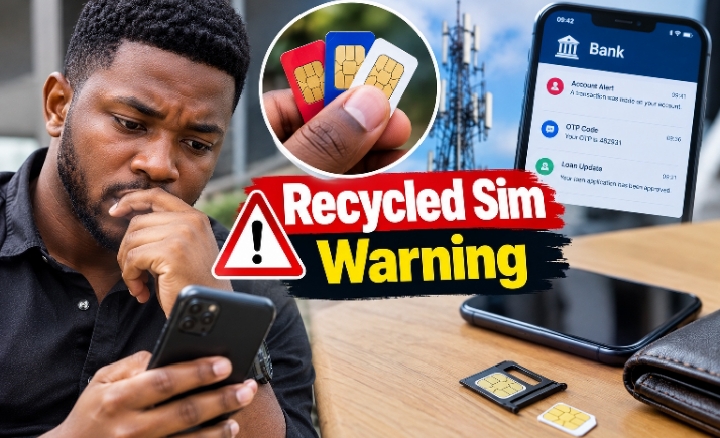
For many Nigerians, changing a phone number can feel like a simple decision. A new line may come with a new network, better service, a fresh start after losing a SIM card, or simply a desire to stop using an old number. The number itself can eventually disappear from daily life, but that does not necessarily mean its digital connections disappear with it. A number that once received bank alerts, OTPs, password reset messages, loan notifications and account verification codes can continue to exist within different systems long after its former owner has stopped using it.
That is where the growing concern over recycled SIM numbers becomes important. The Nigerian Communications Commission is preparing a system that goes beyond simply knowing whether a mobile number is active. The Telecommunications Identity Risk Management System, known as TIRMS, is designed to help authorised organisations identify the status and potential risk attached to mobile numbers, including numbers that have been swapped, churned, reassigned or blacklisted.
The development is becoming more significant because the NCC has now scheduled the TIRMS system to go live in October 2026. That means the issue is no longer simply about an old phone number sitting unused in a drawer or remaining forgotten in the contact list of a former owner. It is increasingly becoming part of a wider telecommunications identity system designed to help banks, fintech companies, insurers and other approved organisations establish whether the number connected to a customer still presents a reliable identity link.
For the ordinary Nigerian, the real concern begins with a number that has been abandoned. Once that number passes through the telecom operator’s processes and is eventually allocated to another person, the new subscriber may receive communications intended for the previous owner. At the same time, the former owner may still have the old number attached to accounts that were never properly updated. The result can create a security problem involving 2 different people who may have no connection with each other.
How an Old Number Can Become Relevant Again
A mobile number can remain connected to a person’s digital life long after the person stops actively using it. Nigerians commonly use their numbers when opening bank accounts, registering fintech wallets, creating social media accounts, recovering email accounts, receiving OTPs, accessing government services, applying for loans and confirming transactions. The number therefore becomes more than a communication channel because different organisations may use it as one of the ways to recognise or authenticate the customer.
The problem starts when the owner stops using that number without updating every important account linked to it. A person may remove the SIM card from a phone and assume the matter is finished, while a bank, fintech company, email provider or social media platform still has the old number stored on its system. If the telecom operator eventually treats the number as inactive and it goes through the churn process, the number can later become available for another subscriber.
The new subscriber has no knowledge of the previous owner’s accounts, yet the number may still be recognised by different platforms as belonging to the former customer. This is where an ordinary change of telephone number can turn into an identity and privacy issue. The new owner may begin receiving messages, alerts or calls intended for someone they have never met.
The NCC’s explanation of TIRMS highlights this problem because mobile numbers have become deeply connected to financial and digital services. The issue is not simply that another person has obtained an old telephone number. The bigger concern is the digital history that may still be attached to that number in systems operated by organisations that have not yet received the updated information.
What Churned Means for a Mobile Number
The word churned can sound technical to an ordinary subscriber, but it has an important meaning within the TIRMS framework. A churned number refers to a number that has been permanently disconnected and can eventually go through a process that makes it available for allocation again. This is different from simply changing a handset or removing a SIM card from a phone.
A subscriber may stop using a number for months and eventually assume it has disappeared completely. The telecom operator, however, has its own processes for inactive numbers. Once the required conditions are met, the number can move through the operator’s systems before potentially becoming available to another user. This means that an old number can effectively return to circulation.
The distinction becomes particularly important when the former owner has not updated every service connected to the number. A bank account could still have the old number. A fintech wallet could still have it. A social media account could still use it for recovery. An email account could still recognise it as a recovery option. A loan platform could still have it in its records.
That creates 2 separate risks. The former owner may remain exposed because the old number is still attached to important accounts, while the new owner may suddenly receive private communications that were intended for somebody else. The TIRMS system is being designed to give authorised organisations more information about the status of numbers so that these situations can be identified more effectively.
Reassigned Numbers Create Another Layer of Risk
A reassigned number is a number that has subsequently been allocated to another user after leaving the previous subscriber’s control. This is where the recycled SIM issue becomes particularly relevant to ordinary Nigerians because the new owner can legitimately possess the number while still receiving communications associated with its previous user.
Imagine someone who stopped using a number several months ago. The person may have changed their WhatsApp number, but forgotten to update a banking profile. They may have changed their SIM but left the old number inside an online account. Eventually, another Nigerian receives that old number as a newly allocated line and begins using it normally.
The new subscriber could receive a bank alert that does not belong to them. They could receive a loan message addressed to another person. They could receive an authentication message or a call from a company trying to reach the former subscriber. None of this necessarily means the new owner has done anything wrong. The problem is that the old number has entered the hands of a new person while records elsewhere may still contain the previous owner’s details.
The NCC has specifically warned about this kind of situation and advises people who receive another person’s sensitive financial communications after obtaining a new number not to attempt to access or use the information. The appropriate step is to contact the relevant institution and explain that the number has been reassigned.
Why SIM Swap Fraud Remains Dangerous
SIM swapping is another part of the TIRMS picture, although it should not be confused with number reassignment. A legitimate SIM swap can happen when a subscriber loses a SIM card, damages it or needs a replacement. The mobile number remains the same while the service moves to another SIM card.
The danger comes when that process happens without the genuine subscriber’s permission. An unauthorised SIM swap can give another person control of a mobile number and potentially allow them to receive SMS messages or other communications that would normally reach the legitimate customer.
This becomes particularly serious where financial services still rely on mobile numbers for authentication. If the number is connected to banking services, fintech accounts or other sensitive platforms, control of the number can become an important part of controlling access to communications associated with those accounts.
The NCC’s TIRMS framework is designed to help authorised organisations identify whether a number has recently undergone a SIM swap. That does not mean every SIM swap is fraudulent. It means the status of the number can provide an additional signal that an organisation can consider when carrying out sensitive transactions, authentication or account checks.
A recent SIM swap could therefore become relevant when a customer attempts a transaction that requires additional security. A bank or fintech provider with approved access to the system could potentially identify the status of the number and decide whether further verification is appropriate.
How TIRMS Is Designed to Work
The Telecommunications Identity Risk Management System is not being presented as a public website where anyone can enter a phone number and obtain another person’s identity or banking information. Its structure is designed around controlled access for registered and approved organisations.
The NCC’s technical documentation describes a system through which authorised telecom operators can update information relating to mobile numbers, while approved service providers can verify numbers. The system includes functions for phone number verification, status updates, bulk verification, API key generation, webhooks, access controls and different endpoints for telecom operators and service providers.
The system can recognise several statuses associated with a number. These include NORMAL, SWAPPED, CHURNED, BLACKLISTED and REASSIGNED, while the documentation also provides for a NULL result in certain verification situations. Information returned through verification can include the current status of the number, whether it has been reassigned, the reassignment date where applicable, the date connected to a relevant status event, the mobile network, the verification timestamp and the MSISDN.
This gives authorised institutions another layer of information when checking a customer’s mobile number. A bank could potentially verify a number during customer onboarding. A fintech company could use the system when performing sensitive transactions. A service provider could conduct a check during authentication or password recovery. Periodic checks of stored customer numbers are also part of the technical framework.
The October 2026 Launch Becomes the Key Date
The timeline surrounding TIRMS has now become clearer. The NCC has been developing the framework while explaining the risks associated with mobile number identity, SIM swaps, churn and reassignment. The Commission published a consumer explanation of the system on August 31, 2026, giving Nigerians a clearer picture of the problem it intends to address.
The major update came on September 9, 2026, when the NCC Board held its 110th Board Meeting. The Commission stated that TIRMS, together with its associated business rules, is scheduled to go live in October 2026. This puts the system on a defined deployment timeline rather than leaving it as a distant regulatory concept.
The development is significant because the system has already moved into the technical preparation stage. The NCC has published documentation covering organisational onboarding, verification procedures, API access, status updates, bulk verification and webhook notifications. Organisations are expected to be registered and approved before integrating with the platform.
A September 15, 2026 industry report further highlighted the October launch and described the system around phone number tracking, identification of risky SIMs and real time verification. The combination of the NCC’s technical documentation and the Board’s September 9 announcement shows that the system is being prepared for practical institutional use.
What a Bank Could See From a Number Check
The TIRMS API structure gives an indication of how the system could be used by financial institutions. An approved organisation can submit a phone number for verification and receive information about its status. The purpose is not to expose the private contents of a person’s account but to help establish whether the number itself presents a recognised identity risk.
For example, a number connected to a customer account could return a NORMAL status. Another number could show that it has recently been SWAPPED. Another could be identified as CHURNED, REASSIGNED or BLACKLISTED. The organisation can then use that information as part of its own security processes.
The importance of this becomes clearer during sensitive activities. If a customer attempts a transaction and the number associated with the account has recently undergone a SIM swap, the financial institution may have additional information that can support further authentication. The TIRMS status does not automatically establish that fraud has occurred, but it provides another signal that may be relevant to a security decision.
This is why the system is better understood as a mobile number risk verification framework rather than a replacement for existing Nigerian identity systems. It does not replace NIN or BVN. Instead, it addresses the status and integrity of the mobile number itself, which can sit between a customer and multiple digital services.
The Former Owner Faces One Set of Problems
For someone who has abandoned an old number, the first step is understanding how many services may still be connected to it. The number could remain inside a bank profile even if the person has not used it for years. It could remain connected to a fintech account, email account, social media account, loan service or other online platform.
The danger is not necessarily that the new owner will immediately gain access to those accounts. The risk is that the number may still function as a recovery or communication channel. If a platform sends a verification code to the old number, the person now holding that number could receive the message.
The former owner therefore needs to treat an old phone number as an important digital credential rather than something that simply becomes irrelevant after a new SIM is purchased. Changing a number should be followed by updating banks, fintech services, email accounts, social platforms and other important services that used the previous number.
This becomes especially important where the old number was used for password recovery or transaction authentication. A forgotten number can remain part of an account’s security structure even when the owner has physically discarded the SIM card.
The New Owner Faces a Different Problem
The person who receives the reassigned number can also become part of the problem without doing anything wrong. A newly purchased SIM may begin receiving messages that clearly belong to another person. These could include banking notifications, loan messages, account reminders or calls from organisations trying to reach the previous subscriber.
The NCC’s consumer guidance makes the expected response clear. A new subscriber should not attempt to use, investigate or exploit another person’s financial information simply because it arrived on their new number. The safer approach is to contact the relevant service provider and explain that the number has been reassigned.
This distinction is important because receiving another person’s information does not automatically give the new subscriber any legitimate authority over that information. The message may have arrived because a company has not yet updated its records.
The problem can also become frustrating for the new subscriber. Repeated calls from debt collectors, banks or other service providers can continue if the previous owner’s details remain connected to the number. TIRMS is intended to help organisations identify the status of numbers and reduce the possibility of such outdated links creating wider identity risks.
The 14 Day Churn Notification Proposal
Another part of the broader framework concerns what happens before a number is churned. Earlier in 2026, proposed regulatory changes around TIRMS included a requirement for operators to notify subscribers at least 14 days before a line is churned.
The proposal also included a requirement for operators to submit information about churned numbers to TIRMS within 7 days. Measures addressing fraudulently registered or misused mobile numbers were also part of the proposed regulatory framework.
There is an important distinction between these proposals and the October 2026 launch announcement. The 14 day notification requirement was reported as part of proposed regulatory changes, while the NCC Board subsequently stated on September 9, 2026 that TIRMS and its associated business rules were scheduled to go live in October 2026.
For Nigerians, the practical lesson remains straightforward. A phone number that has become inactive should not simply be forgotten, particularly when it has been used for important financial or digital services. The longer an old number remains connected to those accounts, the more complicated a future reassignment can become.
Why Banking Is Central to the Conversation
The banking connection is one reason the TIRMS development deserves attention beyond the telecommunications sector. Nigerian customers use mobile numbers across banking, fintech, payment and other digital services, making the telephone number one of the recurring links between a person and different online platforms.
NIBSS reported that digital payment fraud losses fell from ₦52.26 billion in 2024 to ₦25.85 billion in 2025, representing a 51 percent reduction. Even after that decline, the 2025 figure shows the scale of financial exposure within the digital payment environment.
TIRMS is not designed to solve every form of electronic fraud. It targets a particular layer of the identity chain by helping approved organisations understand the status of the mobile numbers connected to customers.
That distinction matters because a fraudulent transaction can involve several different points of failure. The customer’s identity, device, SIM card, account, authentication method and transaction channel can all play different roles. TIRMS focuses on the mobile number and whether its current status presents information that a participating organisation should consider.
Privacy Remains Part of the Framework
The introduction of a central system capable of handling telecommunications identity information also creates legitimate privacy considerations. The NCC Board has stated that the deployment should remain consistent with applicable legal, privacy and data protection requirements.
The issue has added relevance because the NCC and the Nigeria Data Protection Commission signed a Memorandum of Understanding in February 2026 aimed at strengthening data and privacy protection within Nigeria’s telecommunications sector.
The wider Nigerian data protection framework requires personal data to be handled lawfully, used for specified purposes, kept accurate where necessary and protected against unauthorised access, loss or unlawful processing. TIRMS therefore has to operate within that broader environment.
The controlled access structure described in the technical documentation is relevant here. The system is not intended to operate as an open public directory of Nigerians and their mobile numbers. Organisations are expected to be registered and approved before accessing the relevant functions.
That controlled structure is one of the most important points for Nigerians to understand because TIRMS is about institutional verification rather than public access to personal records.
TIRMS Does Not Mean Your Phone Number Becomes Public
There is already a possibility of misunderstanding the system because of the amount of information attached to modern mobile numbers. TIRMS does not mean that anyone will be able to enter a Nigerian phone number into an NCC website and instantly obtain the person’s bank accounts, identity information or private records.
The technical framework describes an authorised system where telecom operators and approved service providers have defined responsibilities. A telecom operator can update relevant number information, while an approved organisation can perform verification according to its authorised access.
This means the system is designed to operate behind institutional controls rather than as a public reverse phone lookup service. A person receiving a new number will not suddenly have access to a database containing the previous owner’s financial history simply because the number once belonged to somebody else.
The focus is instead on giving participating organisations more reliable information about the status of a number. That can help them make better informed security decisions when dealing with authentication, onboarding, sensitive transactions and other activities where the integrity of a mobile number is important.
What Nigerians Should Do Before Changing Numbers
Anyone planning to abandon a mobile number should first identify every important account connected to it. The process should include banks, fintech applications, email services, social media accounts, loan platforms, government services and other online platforms where the number was used for registration or account recovery.
The number should be updated before the old SIM is permanently abandoned. Where a bank or fintech provider requires additional verification, the customer should complete that process rather than assuming that simply inserting a new SIM into the phone has changed the number attached to the account.
Lost or stolen SIM cards should also be reported immediately. A person should not wait for unusual transactions before informing the relevant network operator or financial institution. The same caution applies when a subscriber notices unexpected changes involving their mobile service or receives unusual messages connected to financial activity.
OTP codes, PINs and passwords should never be shared with another person. Customers should also monitor their bank accounts and transaction notifications so that suspicious activity can be identified quickly.
What Nigerians Should Do With Someone Else’s Alerts
A reassigned number can sometimes place a new subscriber in an uncomfortable position. Imagine buying a new Sim and receiving a bank alert containing another person’s name, transaction amount or account information. The fact that the message arrived on the new owner’s phone does not make the information theirs.
The correct response is to avoid attempting to use the information and contact the relevant institution. The subscriber can explain that the number has been newly assigned to them and that the financial communications appear to belong to a previous user.
This can help the institution update its records and reduce the possibility of further messages being sent to the wrong person. The same approach applies to loan notifications, authentication messages and other sensitive communications connected to the previous subscriber.
The new owner should also be careful not to respond to unfamiliar links or requests contained in messages. A message arriving on a reassigned number can create confusion, and scammers can exploit that confusion by pretending to be banks, fintech companies or other service providers.
The Bigger Issue Is Digital Identity
The rise of TIRMS reflects a wider reality about how Nigerians now use mobile numbers. The number is no longer simply the place where someone receives a call. It can function as a recurring identity link across banking, payments, communication, social media, email, government services and other digital platforms.
That creates a difficult situation when control of the number changes but the digital records do not change at the same speed. The former subscriber may think the number is finished, while another person is already using it. A financial institution may still have the old number stored. A digital platform may still send recovery messages to it.
TIRMS is being developed around that gap. By giving authorised organisations information about whether a number is normal, swapped, churned, reassigned or blacklisted, the system is intended to make the mobile number itself more visible as a security factor.
The October 2026 launch therefore represents an important point in Nigeria’s attempt to manage the risks created by the growing connection between telecommunications identities and digital services.
October 2026 Will Put the System to the Test
The NCC’s September 9, 2026 announcement provides the clearest current timeline for TIRMS, with the system and associated business rules scheduled to go live in October 2026. The months leading up to that deployment have included technical documentation, consumer information and regulatory preparations.
The real significance will become clearer as banks, fintech companies, insurers and other approved organisations begin integrating the system into their own processes. The technology is designed to provide information about mobile number status, but the value of that information will depend on how participating institutions use it during onboarding, authentication, sensitive transactions and account management.
For ordinary Nigerians, the immediate lesson does not require waiting until October. A number that is no longer being used should be removed from important accounts before it eventually returns to circulation. A new subscriber who receives another person’s financial messages should report the problem rather than interact with the information.
The old number sitting inside an abandoned phone may look harmless today, but its digital connections can continue long after the owner has moved on. With TIRMS scheduled for October 2026, the NCC is putting greater attention on that overlooked part of digital security and on the risks that can emerge when a mobile number changes hands while the accounts connected to it remain behind.