
“It is now common,” says Akinlade Olalekan, a 32-year-old secondary school teacher. Speaking to WITHIN NIGERIA on Monday, September 21, 2026, he disclosed that some girls in his school use contraceptives.
His revelation offers a glimpse into an emerging reality in many secondary schools across the country: teenage girls turning to birth control to avoid unwanted pregnancies, a practice increasingly encouraged at home — especially by mothers.
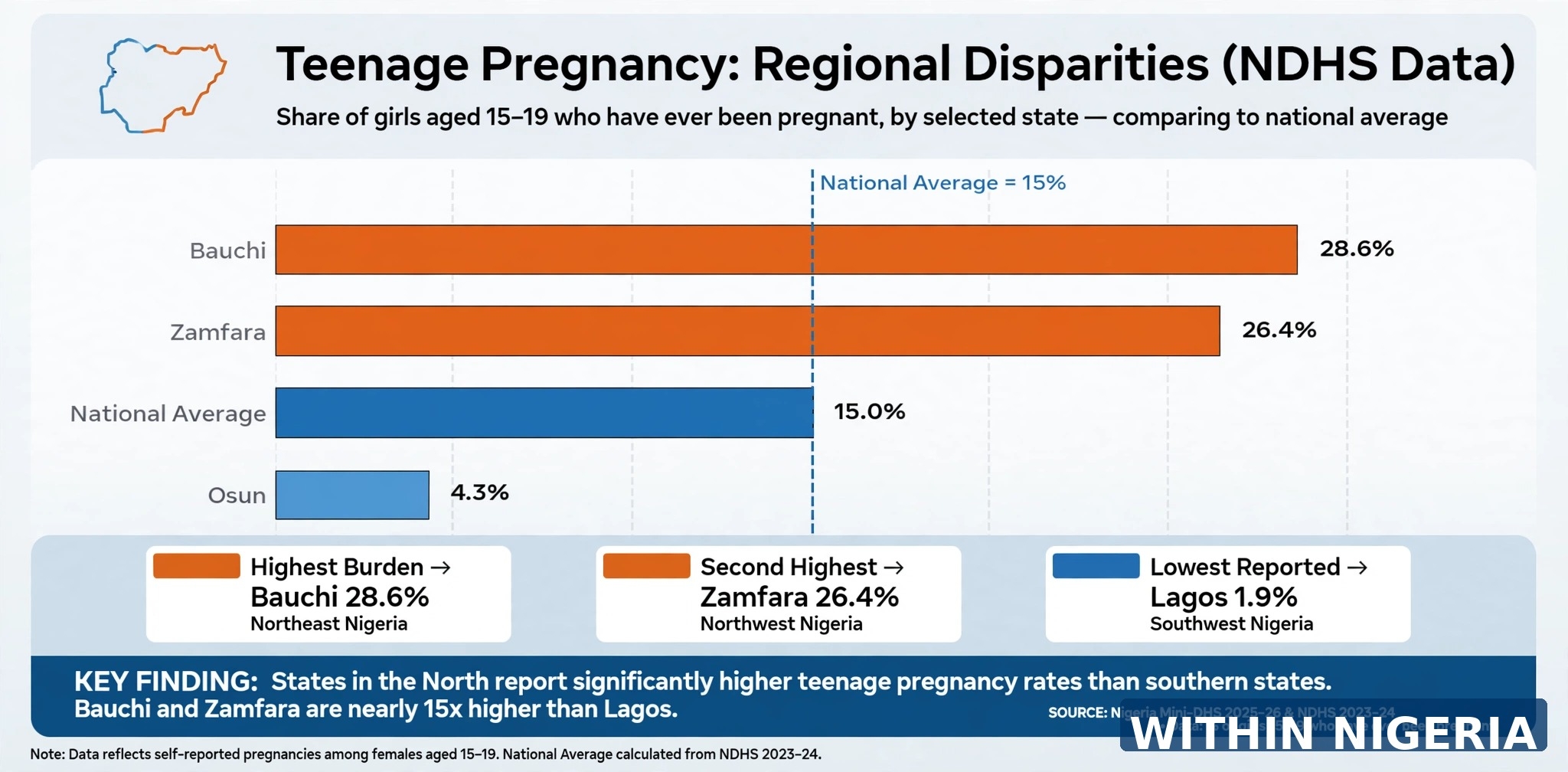
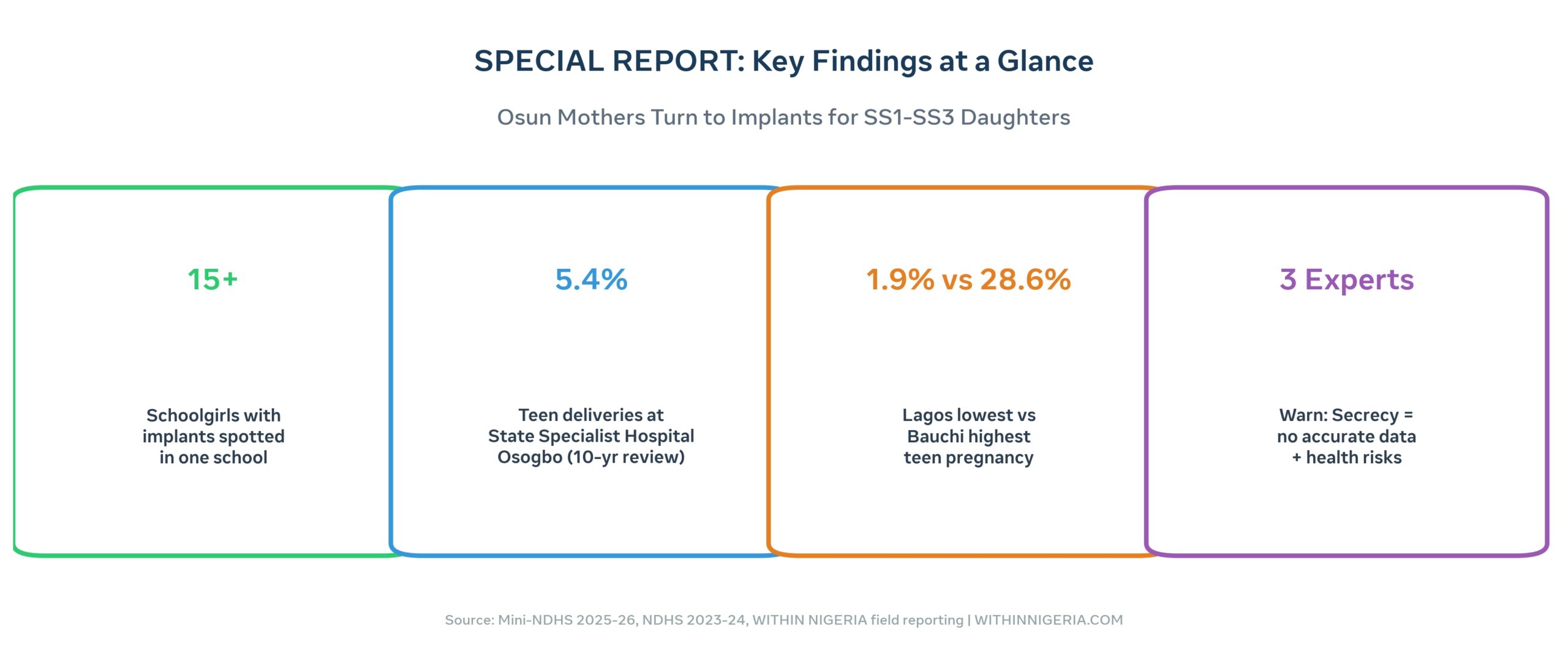
Official data shows the South-West has the lowest teenage pregnancy burden nationally. According to the Nigeria Mini Demographic and Health Survey (Mini-NDHS) 2025-26, 4.3% of girls aged 15-19 in Osun State and 1.9% in Lagos State have ever been pregnant, compared with 26.4% in Zamfara and 28.6% in Bauchi. 15% of Nigerian girls (15-19) have experienced pregnancy, according to NDHS 2023-2024 reports.

While official surveys show a low burden in the South-West, hospital records suggest hidden trends may persist.
According to records obtained from antenatal and delivery records at the State Specialist Hospital, Osogbo covering 2016-2026, 5.4% of pregnancies managed at the facility were among teenagers aged 13 to 19, an indication that contraceptive use among in-school adolescents may be under-reported in community surveys.
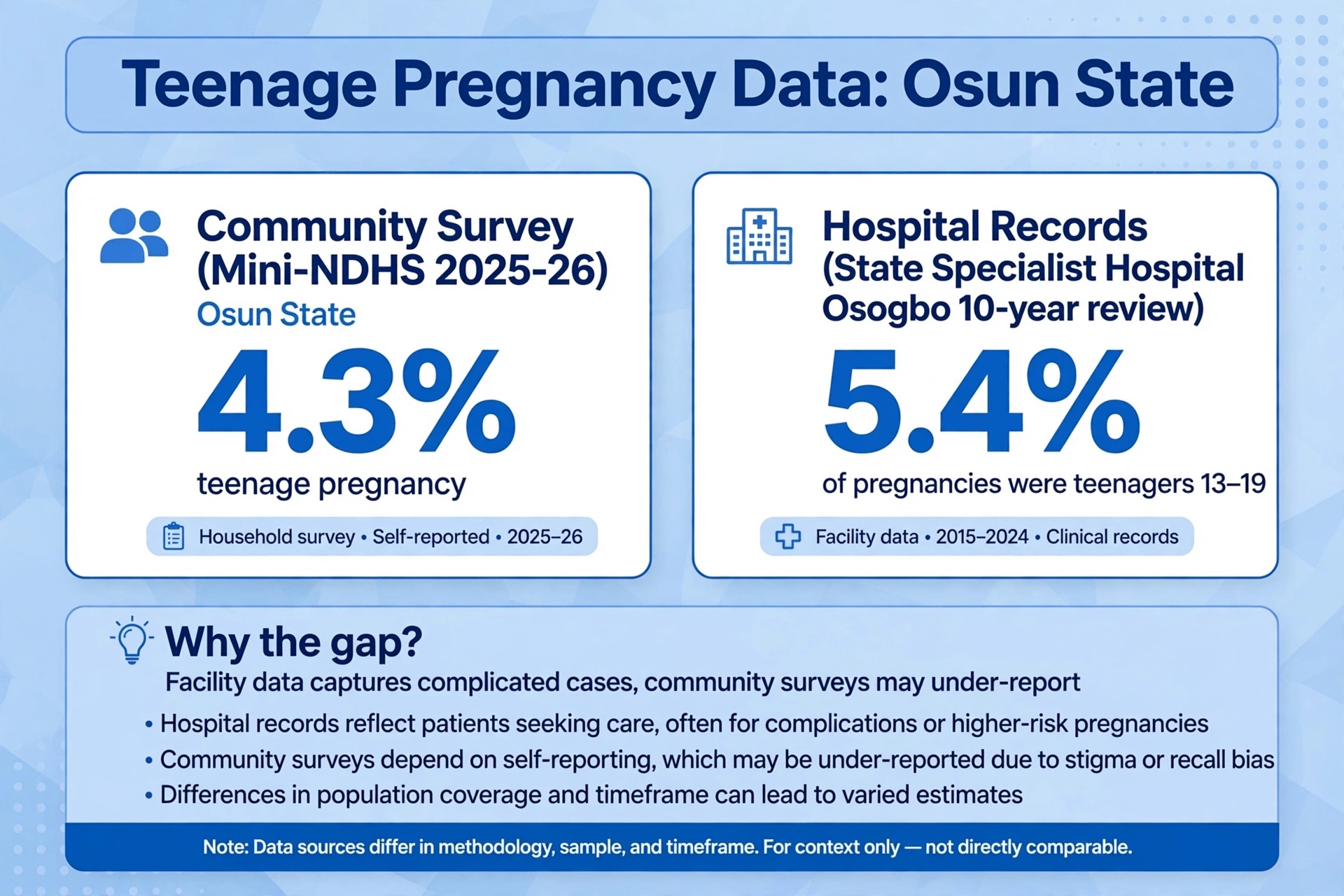

Experts say facility data often show higher teenage pregnancy rates than community surveys because hospitals receive more complicated cases.
WITHIN NIGERIA visited 3 public secondary schools in Osogbo and Ilesa between September 15-21.
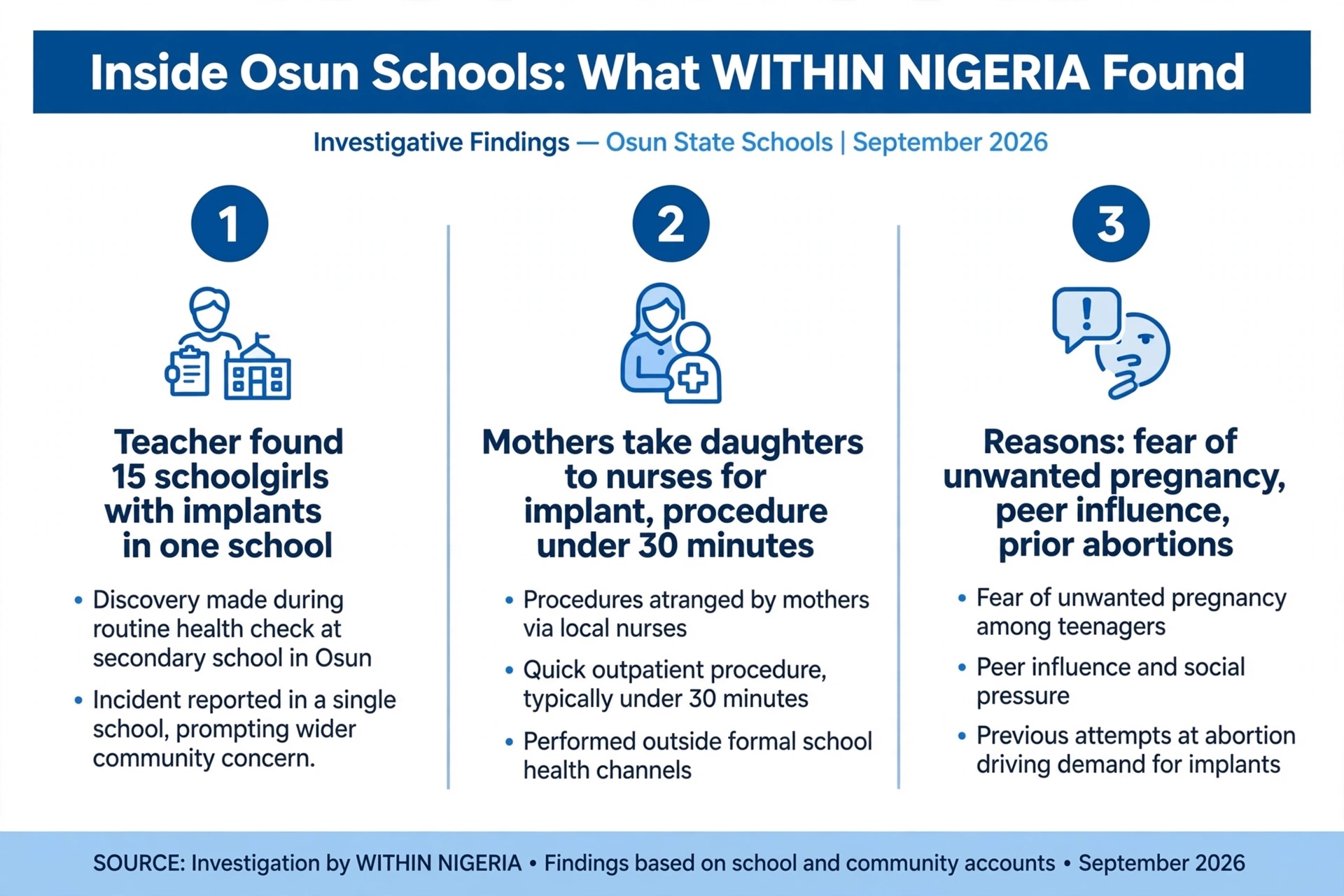
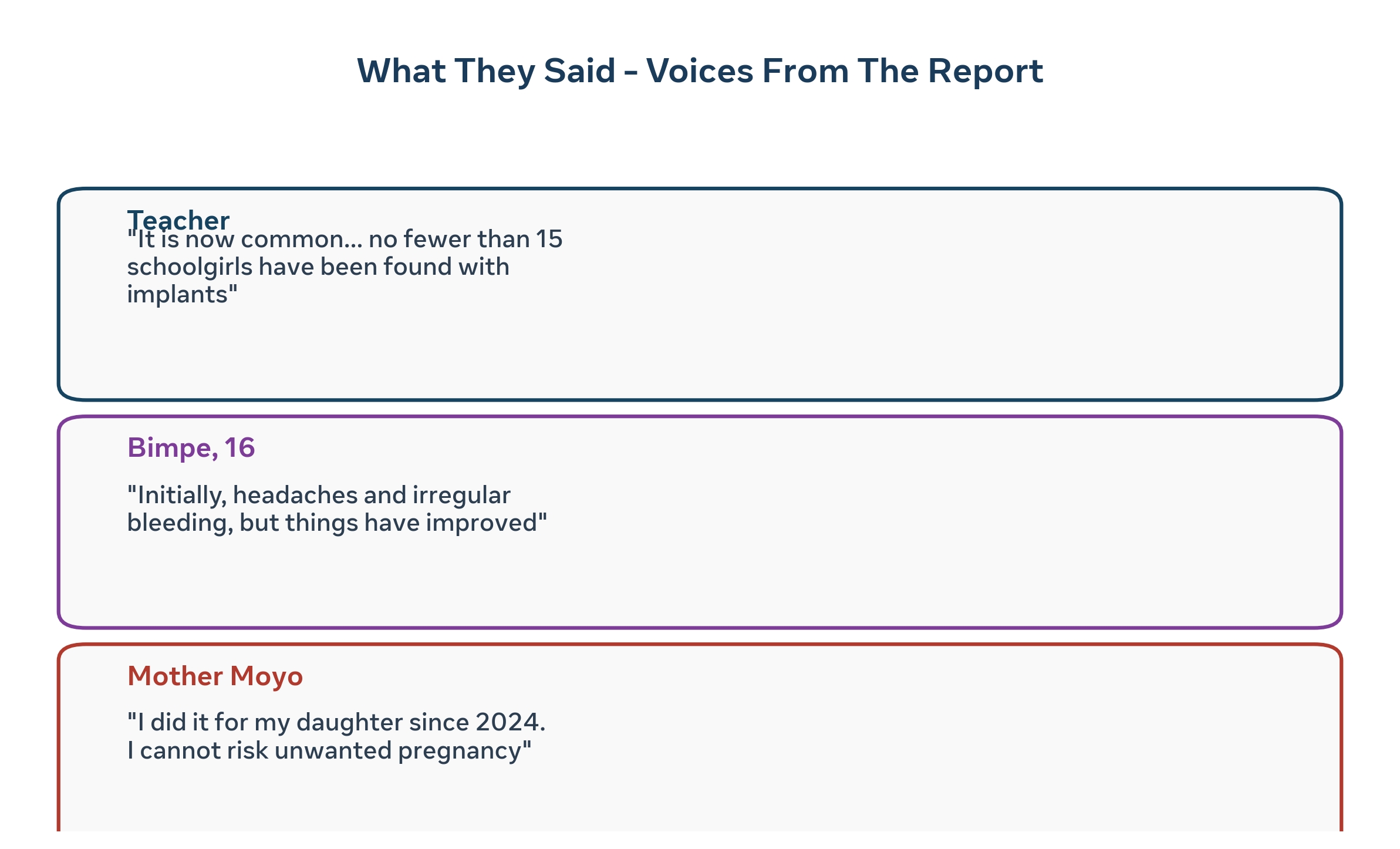
Akinlade Olalekan, a teacher at a public secondary school in Osun (name withheld), told WITHIN NIGERIA he discovered thin, matchstick-sized rods inserted under the skin of the upper arm on no fewer than 15 schoolgirls.
“How did you know that it’s birth control or contraceptives?” the reporter asked.
He described it as a thin, matchstick-sized rod inserted under the skin of the upper arm.
“The first time I saw it, I was very angry. I sent the girl home and asked her to return the next day with her mother. I told her mother and she was not shocked or surprised about it,” Akinlade disclosed.
According to Akinlade, the trend is a growing concern, particularly in public schools, as colleagues who teach in other schools have shared similar experiences.
He appealed to the government, NGOs, school authorities and local education inspectors to find ways of addressing the issue before it becomes a menace, if it is not already one.
Students, Parents Speak
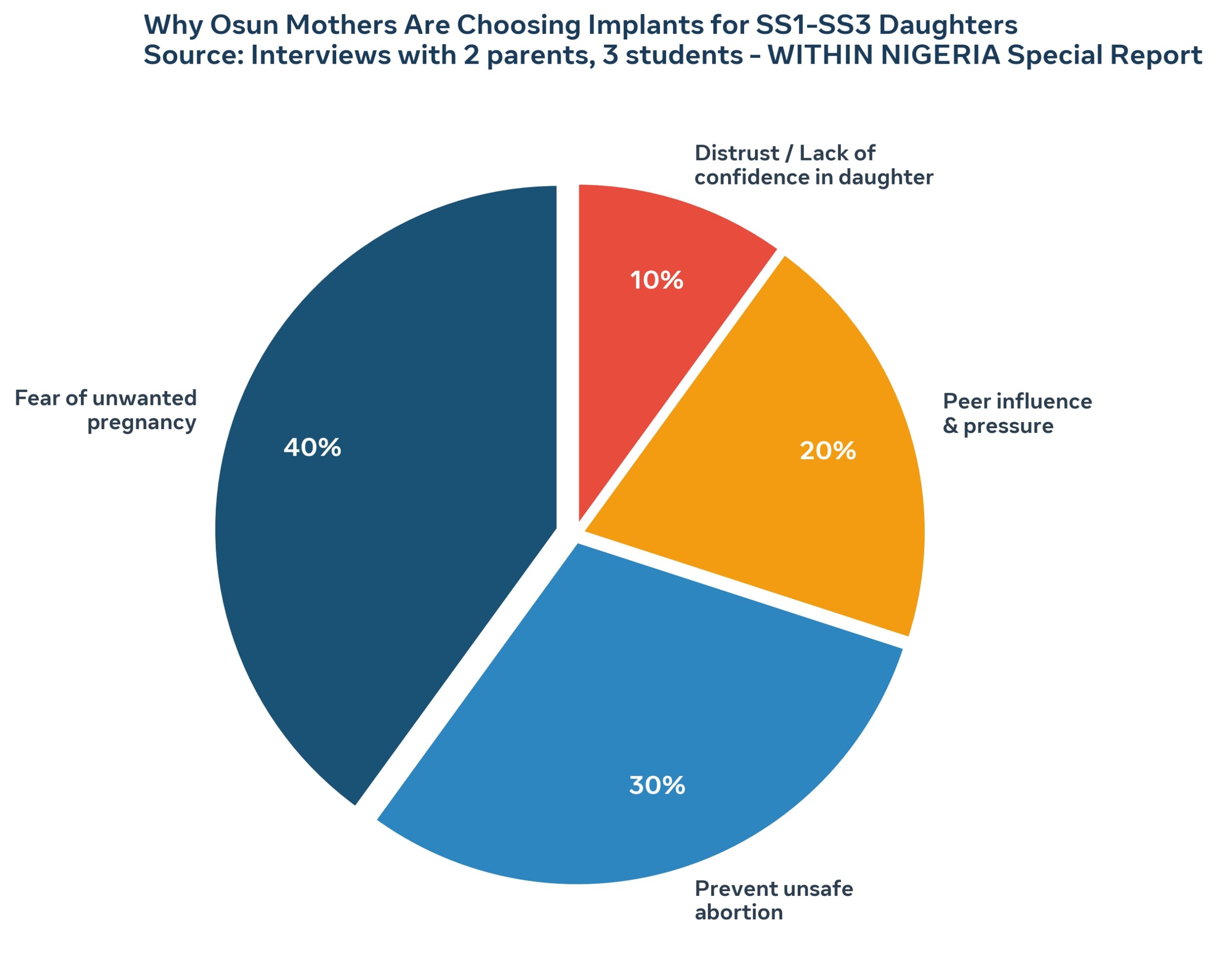

Meanwhile, Bimpe (real name withheld), a 16-year-old secondary school student, in a conversation with this reporter, disclosed that her mother took her to a nurse who lives on the same street because she did not want her to get pregnant.
Bimpe said her mother’s action was prompted by fear that she might get pregnant.
When asked a personal question about her sexual history, she declined to respond.
She claimed she has been wearing the implant for almost a year.

“I think I am used to it. Initially, I used to have headaches and irregular bleeding, but things have improved. Although people complain that I’m getting fat, I think it’s my body responding to it,” Bimpe told WITHIN NIGERIA in Yoruba.
Deborah (not real name), now an SS 3 student in another school (name withheld), shared that she experienced teenage pregnancy at the age of 17 while in SS 1.
“My dad was angry. I lost the pregnancy and was hospitalized,” Deborah stated.
Following a four-week hospital recovery, her mother arranged for a nurse to insert a birth control implant to prevent future pregnancies before she returned to school.
Toyin, a 16-year-old secondary student in another school (name withheld), disclosed that her mother also had a birth control implant inserted for her, despite Toyin not being sexually active.
Her mother made the decision after a friend whose daughter experienced an unwanted pregnancy recommended the procedure as a preventative measure.
“I think my mother does not trust me,” Toyin explained. “She is afraid and does not want me to have an unwanted pregnancy. She took me to the nurse and we did it in less than 30 minutes.”
A parent identified as ‘Moyo’ informed WITHIN NIGERIA that birth control implants are not new, and are common among female secondary school students.
Moyo highlighted the case of her friend’s daughter, Racheal, who had undergone two abortions before her mother took her to a nurse to have a contraceptive implant inserted.
“I did it for my daughter, too. In fact, she has it on her body since 2024. I cannot risk any unwanted pregnancy and unsafe abortion. If I train my daughter well, what about peer influence?” A rather worried Moyo inquired.
Another parent and child rights advocate, Omolola Adebisi, attributed this trend to a lapse in modern societal values. She characterized the reliance on implants as evidence of declining parental oversight and deteriorating moral standards.
“School girls are not impregnated by ghosts,” Omolola noted, emphasizing that society places disproportionate focus on girls while failing to properly guide and raise young boys.
She voiced deep concern for the future of young female students, calling for equal accountability and attention in how boys are raised to address the root of the issue.

Experts React
Dr. Charles Adeyemo, a public health expert, told WITHIN NIGERIA that the issue of contraception for teenagers must be examined holistically — culturally, religiously, and medically.
Dr. Charles noted that culturally, the practice is seen as against the traditional way of life, where female children are expected to be taught morals and the dangers of premarital and teenage promiscuity.
“Religiously, every religion is pro-life,” he added.
However, from a medical perspective, he described contraception as a welcome development with caveats, noting it is a way to prevent teenage pregnancy and unsafe abortions.
He stressed that any method adopted must be the most suitable for the individual to avoid complications, as there are several methods of prevention and contraception, and every procedure has a tendency for side effects.
“In reality, today’s children are difficult to sell the idea of no-sex to, so unwanted pregnancy prevention seems a necessity,” he said.
Why Accurate Data Is Difficult – Dr. Adetoye
Another medical expert and stakeholder, Adedapo Omowonuola Adetoye, raised concerns over the secrecy surrounding the use of contraceptive implants among teenagers, saying accurate data may be difficult to obtain.
According to Adetoye, the development could occur because people may see it as an easier option than abortion.
“Data may not be available on this because of secrecy. It can happen. They will believe that it is easier than trying to abort,” Adetoye said.
He called for more attention to be paid to the implications of the trend.
Birth Control Should Not Replace Responsible Parenting, Says Dr. Akinsuroju
A medical practitioner and child rights advocate, Dr. O. E. Akinsuroju, stated his opposition to putting secondary school girls on birth control as a routine measure for preventing teenage pregnancy.
According to Dr. Akinsuroju, parents have a responsibility to provide proper guidance, sexuality education, supervision, and moral support to their children.
He noted, however, that where there is a genuine medical indication or a specific circumstance, the matter should be discussed with a qualified healthcare professional and handled in the best interest of the child.
“Birth control should never become a substitute for responsible parenting,” he said.
Mothers Can Legally Consent to Implants for 16-Year-Olds — Child Rights Lawyer
Child Rights lawyer and advocate, Chidera Eze told WITHIN NIGERIA that mothers and legal guardians can legally consent to the implants procedure for their under-18 daughters under Nigerian law.
According to Eze, the Child Rights Act 2003 — which has been adopted in many states with equivalent state laws elsewhere — defines a child as anyone under 18, and minors generally lack legal capacity to give independent consent for medical treatment.
“For invasive medical procedures, which include insertion of a contraceptive implant such as Implanon or Jadelle, parental or guardian consent is required for anyone under 18,” he stated.
He noted that there is no formal “mature minor” doctrine in Nigerian law equivalent to the UK’s Gillick competence rule.
“Healthcare providers are expected to obtain parental consent for treatment of minors,” Eze added.
The lawyer further cited the National Health Act 2014 and related policies which reinforce informed consent, but for under-18s this is exercised through the parent or guardian.
On how it works in practice, Eze explained that family-planning clinics and providers commonly require a signed parental consent form or the physical presence of a parent/guardian before inserting an implant in a minor.
“Parents do bring their teenage daughters for implants in some cases, for menstrual management, protection against unplanned pregnancy, or other reasons. Providers may still counsel the adolescent and document her understanding, but the legal consent comes from the parent,” he said.
He stressed that sexual activity is not a legal prerequisite.
“The decision rests on parental authority and clinical appropriateness, not on whether the teen is currently sexually active,” Eze stated.
He, however, noted that practice can vary slightly by state, facility — public versus private — or individual provider interpretation of what counts as an “invasive” procedure, but the baseline legal requirement remains parental consent for under-18s.
GOVERNMENT YET TO RESPOND
When contacted, the Osun State Government did not provide answers to our questions. WITHIN NIGERIA reached out to the Osun State Commissioner for Education, Hon. Dipo Eluwole (calls and WhatsApp messages on September 21, 22 and 26, 2026), the Commissioner for Information, Hon. Kolapo Alimi (September 26, 27). And none supplied answers to inquiries made via calls, messages, and WhatsApp as of 8 a.m. on September 28, 2026, when this report was filed.
CAVEAT: All students’ names have been changed to protect minors. Schools’ names withheld for child protection.