Nigerians buying mobile phones and other cellular devices may need to pay closer attention to regulatory compliance following the Nigerian Communications Commission’s (NCC) enforcement of existing type approval and device verification requirements.
The system, which took effect on October 7, 2026, is intended to ensure that devices connected to Nigerian mobile networks meet applicable technical standards.
The commission says the enforcement strengthens an existing regulatory framework rather than introducing a new obligation, while a new Device Checker service allows consumers to check a device’s status before purchasing it.
How the new checks work
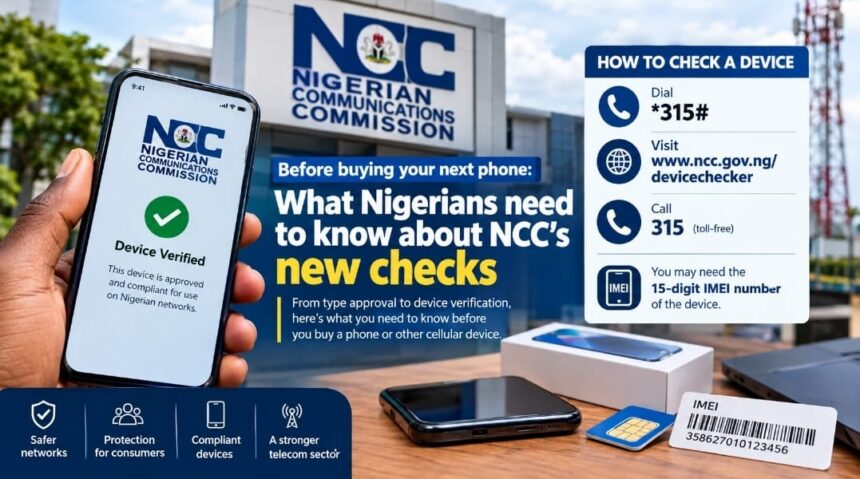
The NCC’s Device Checker is available through three channels: dialling *315#, visiting www.ncc.gov.ng/devicechecker or calling the toll-free number 315.
Users may need a device’s 15-digit International Mobile Equipment Identity (IMEI) number when checking a phone other than the one they are using to access the service.
The IMEI can usually be displayed by dialling *#06# or found in the phone’s settings and original packaging.
The commission says phones already connected to Nigerian mobile networks before October 7 were automatically verified, meaning most existing users do not need to take further action.
The requirements cover smartphones, feature phones, cellular tablets, SIM-enabled laptops, point-of-sale terminals, eligible Internet of Things devices and other equipment designed to connect to Nigerian mobile networks.
What buyers and sellers must do
Manufacturers, importers, suppliers and other businesses responsible for introducing communications devices into the Nigerian market must ensure that applicable products receive the necessary type approval and verification.
Consumers purchasing phones locally are not expected to obtain type approval themselves, but the NCC advises them to check a device’s status before making payment.
Second-hand phones can still be bought and sold, although previous use on a Nigerian network does not automatically guarantee that a device will meet all current verification requirements.
Devices purchased abroad may also be used in Nigeria if they meet the relevant approval and verification conditions, with different procedures applying to personal imports and commercial shipments.
According to the commission, visitors using international roaming with foreign SIM cards are not affected by the verification requirement, while phones intended for use with Nigerian SIM cards may operate for up to 30 cumulative days within a one-year period without verification if they have never previously been used in Nigeria.
Where a check fails, the commission advises users to seek clarification from the seller or mobile network operator rather than immediately assuming the device is counterfeit.
Privacy, fraud and stolen devices
The NCC says its verification system uses device identifiers, including IMEI numbers, to establish compliance and does not give the commission access to users’ calls, messages, photographs or other personal files.
It also says the system does not track users’ physical locations or movements.
Consumers are advised to use only the official verification channels and never disclose a one-time verification code to a caller, seller or anyone claiming to represent the commission.
A counterfeit phone imitates a genuine product without the manufacturer’s authorisation, while a cloned device uses an IMEI duplicated from another device, potentially making identification and enforcement more difficult.
The NCC says stolen devices can be blocked across Nigerian mobile networks after they are reported and ownership is verified.
However, a successful Device Checker result does not independently establish that a phone is genuine in every respect, nor does it guarantee the device’s condition, repair history or software integrity.
The legal basis for enforcement
The regulatory framework rests on the Nigerian Communications Act 2003, including Section 132(2), and the Nigerian Communications (Type Approval) Regulations 2024, supported by the Type Approval Business Rules 2024.
These provisions establish requirements for relevant communications equipment to obtain the necessary approval before being sold or used in Nigeria.
The commission says the current enforcement is intended to make compliance checks more efficient and help consumers make informed purchasing decisions.
For Nigerians planning to buy a new or second-hand phone, the practical step is to check its reported status through *315# or www.ncc.gov.ng/devicechecker before paying, and contact the NCC or a mobile service provider if the result requires clarification.