For almost two years, the relationship between West Africa’s main regional bloc and the three Sahel countries that walked out of it played out mostly through speeches, suspicion and closed borders of the mind. On Saturday that changed. In Dakar, the Economic Community of West African States (ECOWAS) and the Alliance of Sahel States held their first formal negotiation session on October 17, and both sides left the room agreeing to build something new together.
The Alliance of Sahel States (AES), made up of Burkina Faso, Mali and Niger, is not coming back to ECOWAS. But it is no longer refusing to talk to it either.
What happened in Dakar

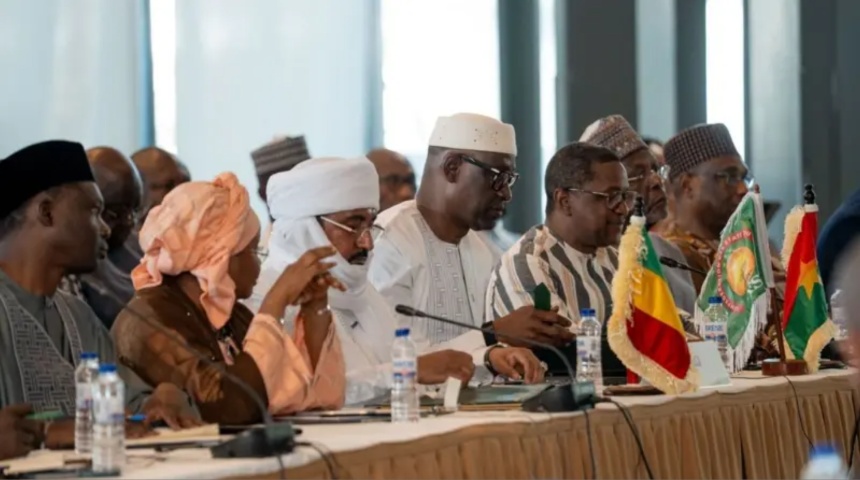
The meeting was the first ministerial session of what both sides are calling the ECOWAS-AES Dialogue on Cooperation. It was co-chaired by Senegal’s foreign minister, Cheikh Niang, who heads the ECOWAS Council of Ministers, and Burkina Faso’s foreign minister, Karamoko Jean-Marie Traoré, who chairs the AES ministerial steering committee.
Talks between the two camps had technically been under way since January 2025, but Saturday was the first official ministerial meeting. That distinction matters. Earlier contacts were mostly consultations and quiet diplomacy. This one ended with a signed joint communiqué.
In that document, the delegations welcomed the spirit of fraternity, mutual respect and openness of the discussions and stressed good neighbourliness with respect for sovereignty. The practical outcome was an agreement to set up joint thematic working groups to reach a framework cooperation agreement. Technical experts were due to continue their work on Sunday, October 18. The date and venue of the next ministerial meeting will be settled later through diplomatic channels.
To be precise about where things stand: no deal has been signed. What exists is an agreement to negotiate one.
Not a return, a reset
If you read the headlines quickly, you could mistake this for a reconciliation. The AES has gone out of its way to say otherwise.
Days before the Dakar meeting, foreign ministers from the three countries met in Ouagadougou to align their positions and insisted the talks would not involve rejoining ECOWAS. Traoré dismissed speculation about a return, saying there was no truth in it. He described the aim as finding a new legal framework that lets people keep benefiting from what the countries built together over the years. Mali’s foreign minister, Abdoulaye Diop, pushed the same line: these must be entity-to-entity discussions between two separate organisations.
Reporting from RFI, as summarised by Ghanaian outlet Modern Ghana, says the AES sees the talks as a way to formalise new relations, not to discuss rejoining ECOWAS. ECOWAS has not pushed back on that framing in public. The Rio Times reports that both sides presented the dialogue as the creation of a new cooperation mechanism rather than negotiations on the return of the three states.
How the split happened
The backstory explains why Dakar feels like a turning point. Mali, Burkina Faso and Niger are all run by military governments that took power between 2020 and 2023. The AES began in September 2023 as a mutual defence pact, signed in the Liptako-Gourma Charter, and it was widely read as a shield against possible ECOWAS military intervention after the coup in Niger that July.
In January 2024 the three announced they were leaving ECOWAS, after long disputes over military rule, sanctions and demands for a return to civilian government. Their withdrawal took effect on January 29, 2025. By then the three had also signed a confederation treaty, turning the alliance into a more formal union. ECOWAS tried a mediation push in 2024 through Senegalese President Bassirou Diomaye Faye, and consultations were held in Bamako on May 22, 2025, but nothing like Saturday’s session had happened until now.
The AES has also drifted politically toward Moscow, framing itself as anti-imperialist and pro-sovereignty, and its leaders have been openly critical of coastal West African states they see as too close to France.
What a framework agreement could change
Nobody knows yet what the final text will contain. But the communiqués and early commentary point to a handful of areas where the working groups will have the most to do.
Trade: This is the most immediate worry for ordinary people. One commentary reported that ECOWAS still allows visa-free travel and duty-free trade across its borders with the three countries, even though the AES imposes tariffs on ECOWAS goods. That imbalance cannot hold forever. A framework deal is the obvious place to sort out how goods, traders and transporters move between a bloc of fifteen states and a three-country confederation. The stated aim of the process includes protecting cross-border trade, which matters a great deal to markets and border communities from the Nigerian north to the Sahel.
Security: The region’s armed groups do not respect membership lists. Armed groups continue to pressure security forces and civilians in Burkina Faso and Niger, and violence increasingly threatens northern Benin and Togo. Niger’s exit from the Multinational Joint Task Force in March 2025 showed how quickly cooperation can unravel. Right now, security cooperation depends on ad hoc bilateral arrangements between neighbouring states, which is fragile. A framework agreement could create a more dependable channel for sharing intelligence and coordinating along shared borders.
Free movement and citizenship: Millions of West Africans live, trade or study across these borders. Whatever the new framework says about movement, residence and documentation will be felt first by them, not by diplomats.
Political recognition: The AES wants to be treated as an equal partner. ECOWAS, for its part, is an organisation of fifteen states with its own rules, and treating a confederation as a counterpart without bending those rules is a real legal puzzle.
Why Nigeria is watching closely
For Nigerian readers this is not a distant story. Nigeria is ECOWAS’s largest economy and shares a long land border with Niger. Traders, herders, families and security agencies on both sides rely on that border working. Any agreement that keeps it open and predictable has direct consequences for border states in the north, and any breakdown would too.
Where the talks could stumble
Observers are cautious, and with good reason. One report noted that agreeing to build a framework does not on its own resolve the political differences behind the withdrawal. The AES governments accuse some coastal neighbours of hostility, while ECOWAS members worry about mercenary and foreign military presence in the Sahel. Those are not small disagreements, and neither side has said how it plans to deal with them.
There is also no timetable. Working groups can move quickly or stall for months, and the next ministerial meeting has no date.
Three things will show whether Dakar was a real breakthrough or a polite pause: the announcement of a date and venue for the next ministerial meeting, the make-up and mandate of the joint working groups, and early signals on trade rules at the borders. A realistic outcome is not a return to the old arrangement. It is a workable agreement between two blocs that now sit side by side rather than under one roof.
For the first time in nearly two years, though, both sides are at the same table. After a long stretch of hostile rhetoric, that alone is news.