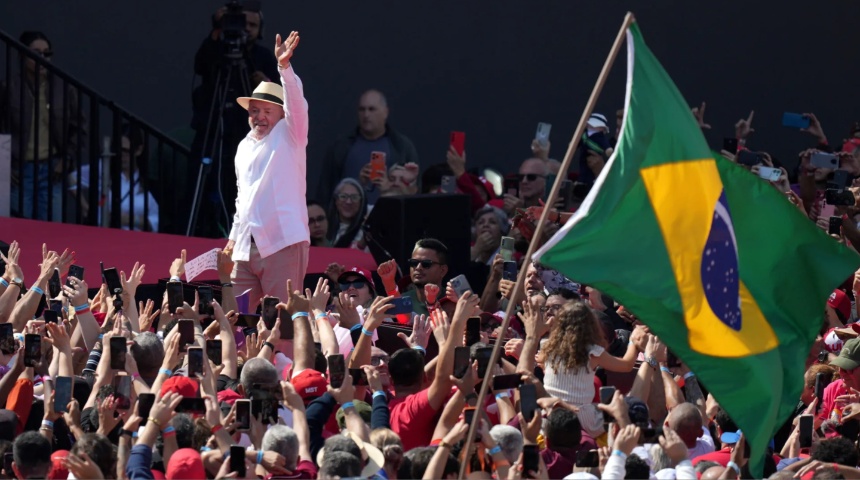
Luiz Inácio Lula da Silva has won the Brazil presidential election. He pulled off one of the most striking comebacks in the country’s democratic history on Sunday, October 25, 2026, and secured a fourth term as president.
Brazil’s Superior Electoral Court put Lula at 51.8% of valid votes against 48.2% for Senator Flávio Bolsonaro, with nearly all ballots counted. With 100% of the vote counted, the court said Lula held a lead of nearly 4.4 million votes. The margin is comfortable in raw numbers. It is also a reminder of how evenly this country of more than 200 million people is divided.
Brazil presidential election results: the numbers
The court’s tally shows how narrow the contest was and how decisively it turned between rounds.
| First round (Oct 4) | Runoff (Oct 25) | |
|---|---|---|
| Lula (PT) | 45.16% | 51.8% |
| Flávio Bolsonaro (PL) | 47.03% | 48.2% |
Flávio led the first round with 47.03% to Lula’s 45.16%. In the runoff count, Flávio had received 59,728,246 votes, or 48.24%, when the court’s dashboard marked the race as mathematically decided. On that tally, Lula’s total comes to roughly 64 million votes.
A comeback with no precedent
The result is historic in more than one way. It is the first time since Brazil returned to direct elections in 1989 that a candidate has won the runoff after losing the first round. Lula also becomes the first Brazilian leader to win four presidential terms. He turns 81 this week.
Few people predicted this ending three weeks ago. Flávio collected about 56 million votes in the first round, more than his father won in either 2018 or 2022. São Paulo’s stock exchange jumped more than 8% at the open the next day. Flávio told supporters that night that it was the end of the era of the Workers’ Party. Lula’s campaign had to regroup quickly, and the runoff polls offered little comfort. Final surveys showed a technical tie.
What drove the vote
Two worries dominated the campaign: the cost of living and security. Flávio built his campaign around a tough-on-crime message and promised to bring down food prices, while Lula spent heavily on incentives to win over undecided voters. Not long before the runoff, Lula raised the benefits under the government’s flagship social assistance programme to regain momentum.
Scandal and institutional tension ran through the race as well. Polls tightened in September as a crisis at the Supreme Court weighed on Lula’s bid. Flávio denied wrongdoing in dealings linked to a jailed banker, which federal police were investigating.
Lula leaned on his record and on sovereignty. His campaign centred on defending Brazil against pressure from Donald Trump and on recalling the social programmes of his three earlier governments.
The Trump factor and a father in prison
The shadow of Jair Bolsonaro hung over the whole campaign. Flávio, 45, campaigned on closer ties with Trump and pledged to pardon his father, who is serving a 27-year sentence under house arrest for plotting a coup to overturn his 2022 defeat to Lula.
Washington was a constant presence. The Trump administration imposed high tariffs on Brazilian exports, revoked the visa of the country’s ambassador and sanctioned the Supreme Court justice who chaired the investigation that led to Jair Bolsonaro’s conviction. Trump never formally endorsed a candidate, though he hosted Flávio at the White House and praised him publicly.
The result also stands against a regional trend. Right-of-center candidates allied with Trump have been winning elsewhere in Latin America, and Lula’s victory leaves Mexico and Brazil, the region’s two most populous nations, with left-of-center leaders.
Chaos at the polls and a missing concession
Election day itself was messy. Lula’s campaign reported that public transport had been suspended in some key areas, and allegations of voter suppression followed. The court extended voting by two hours. The late decision came from a Supreme Court justice, and it may prompt legal action from Bolsonaro.
Officials stressed that the system itself is sound. No significant fraud has been detected since Brazil adopted electronic voting in the 1990s.
As of Monday morning, Flávio’s reaction remained the open question. CNBC reported that he was reportedly refusing to concede. Brazil has been here before. Jair Bolsonaro’s 2022 defeat was followed by weeks of tension, which ended with the assault on government buildings in Brasília in January 2023.
Markets react
Investors had briefly bet on a Bolsonaro win after round one, and the reversal hit hard. The iShares MSCI Brazil ETF fell nearly 20% in overnight trading, according to CNBC, as markets absorbed an outcome that few had priced in. Analysts will now watch Lula’s fiscal plans and whether he can govern effectively.
The new term begins on January 5, 2027. Lula will take office in a divided country. The right made gains in both the Senate and the Chamber of Deputies in the first round, so he will need to bargain with Congress. He also has to deliver on food prices and public safety, the two issues that nearly cost him the race.
His allies see the result as a rejection of the foreign pressure he campaigned against. His opponents see a country that came within a few points of changing course. Both readings may be partly right.
Brazil presidential election 2026: quick answers
Who won the Brazil presidential election?
Luiz Inácio Lula da Silva of the Workers’ Party won the October 25 runoff with 51.8% of valid votes.
Who did Lula defeat?
Senator Flávio Bolsonaro of the Liberal Party, son of former president Jair Bolsonaro, who received 48.2%.
What was the margin?
Nearly 4.4 million votes.
When does Lula take office?
On January 5, 2027.
Has Flávio Bolsonaro conceded?
Reports as of Monday morning said he had not.