Apple’s first touchscreen Mac starts at $2,899 and ships on Friday, November 6.
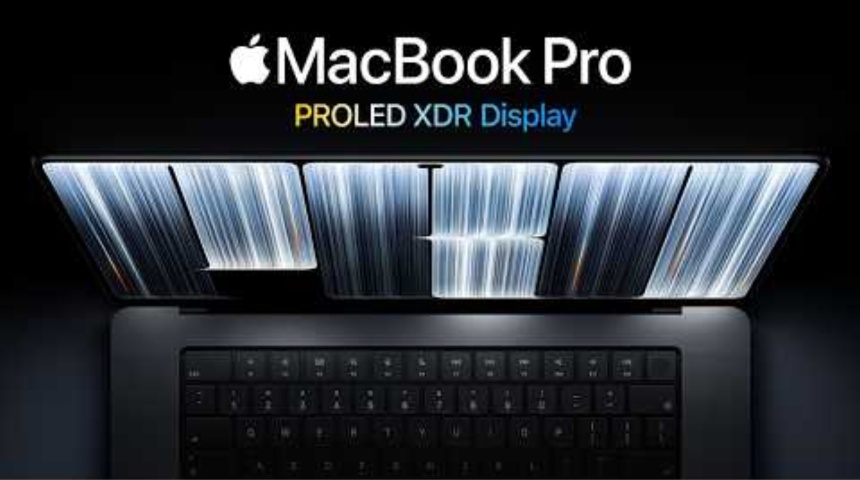
Apple has finally put a touchscreen on a MacBook. The company announced the Apple MacBook Pro with PROLED XDR Display on Wednesday, October 28, 2026, at a “Pro and tell” press experience in Los Angeles. There was no livestreamed keynote this time. It is the first Mac with an OLED panel, the first with built-in touch, and the first with a Dynamic Island instead of a notch.
It is also the most expensive MacBook Pro Apple sells at its starting price.
What is the PROLED XDR display?
PROLED is Apple’s marketing name for a tandem OLED panel, a design that stacks two OLED layers to get more brightness and contrast than a single layer allows. The iPad Pro already uses the technology. Apple pairs it with a display engine that adjusts colour and brightness pixel by pixel, based on the content, temperature, ambient light and how much each pixel has been used.
This panel replaces the mini-LED screen, branded Liquid Retina XDR, that has been in the 14-inch and 16-inch MacBook Pro since 2021. Apple calls it the best display in a pro laptop. The numbers back up part of that claim.
| Display feature | PROLED XDR MacBook Pro |
|---|---|
| Panel type | Tandem OLED |
| Peak brightness | Up to 2,000 nits (HDR and SDR) |
| Contrast ratio | 10,000,000:1 |
| Refresh rate | ProMotion, 10Hz to 120Hz |
| Screen size | 14.2-inch and 16.3-inch (smaller bezels) |
| Finish options | Antireflective coating, optional nano-texture |
| Cutout | Dynamic Island (no notch) |
The 2,000-nit figure applies to ordinary SDR content as well as HDR. On the older mini-LED models, the top brightness was reserved for HDR. That should matter for people who work outdoors or near windows.
How the touchscreen works
The touch sensor sits inside the display panel itself, so Apple says there is no added input lag. Apple’s demonstrations focused on everyday gestures: swiping through a web page, pinching to zoom into a photo, dragging slides from one presentation to another, and double-tapping a window to make it fill the screen.
Apple also redesigned the hinge so the lid does not wobble when you tap it, and added video stabilisation so your camera feed does not shake when you touch the screen during a call. macOS converts touch into clicks automatically, which means many existing apps should respond to a finger without any update from developers.
Two follow-up reports from MacRumors, published after the announcement, address the obvious worries. One says touch input can be switched off. The other says adding touch did not cost the laptop any battery life.
The keyboard and trackpad are unchanged. Apple is not asking anyone to give up either.
Why the change of heart?
For over a decade, Apple argued against this exact product. Steve Jobs said vertical surfaces are tiring to touch for long stretches. In 2021, John Ternus told the Wall Street Journal that the iPad is Apple’s touch computer. Ternus is now Apple’s CEO, and on launch day he posted that you have to touch the new MacBook Pro to believe it.
The reaction online has been mixed. Plenty of readers on MacRumors’ forums grumbled about price and “gorilla arm” fatigue. Others see it as a long-overdue answer to Windows laptops, which have had touchscreens for years.
Specs at a glance
Here is the headline hardware, as announced.
| Spec | Details |
|---|---|
| Sizes | 14-inch and 16-inch |
| Chips | M5 Pro and M5 Max (same as the March 2026 models) |
| Memory | Up to 128GB unified memory |
| Storage | Up to 16TB |
| Weight | About 3 lb (14-inch), about 4 lb (16-inch) |
| Thickness | Up to 1mm slimmer than the current model |
| Ports | Three Thunderbolt 5, HDMI, SDXC card slot, MagSafe, headphone jack |
| Wireless | Wi-Fi 7, Bluetooth 6 |
| External displays | Up to four |
| Charging | 50% in 30 minutes with fast charging |
| Audio | Six-speaker system, 50% deeper bass |
| Cooling | Redesigned thermal system that moves warm air away from the display |
| Extra | Illuminated Apple logo on the lid |
A few notes on this table. Apple did not move to a new processor. The OLED models use the M5 Pro and M5 Max that were already on sale, since there will be no M6 Pro or M6 Max this cycle. A second-generation OLED MacBook Pro with M7 Pro and M7 Max chips is reportedly planned for late 2027.
The weight saving is real but modest. CNN reports the 14-inch model is roughly half a pound lighter than the non-touch M5 Pro. Bloomberg’s Mark Gurman had earlier suggested the redesign would be much thinner, then walked that back in early October, saying he did not expect a dramatic difference. Apple’s “up to 1mm” claim bears him out.
Price of the MacBook Pro with PROLED XDR Display
Apple is charging a clear premium for OLED and touch.
| Model | Starting price (US) |
|---|---|
| MacBook Pro PROLED XDR, 14-inch | $2,899 |
| MacBook Pro PROLED XDR, 16-inch | $3,399 |
| MacBook Pro M5 Pro, 14-inch (mini-LED) | $2,499 |
| MacBook Pro M5 Pro, 16-inch (mini-LED) | $2,999 |
| MacBook Pro M6, 14-inch (new base model) | $1,999 |
That is $400 more than the equivalent mini-LED machine in each size. It echoes 2012, when Apple launched the first Retina MacBook Pro at a $400 premium. Gurman predicted both prices correctly the day before the announcement.
Fully loaded, the new MacBook Pro can reach $14,549, according to MacRumors.
Release date and where to buy
Pre-orders opened on October 28 through Apple’s online store and the Apple Store app. Customers get their orders, and the laptops reach stores, on Friday, November 6. Best Buy has been offering gift cards of up to $100 with pre-orders.
Apple does not run an official store in Nigeria, so buyers there will usually go through resellers or travel contacts. Prices will depend on the exchange rate and any import costs at the time of purchase, so check local listings before ordering.
Where it sits in Apple’s laptop lineup
Apple is not retiring anything yet. The MacBook Pro range now has three tiers.
- Entry: The 14-inch MacBook Pro with the M6 chip, at $1,999. It keeps the older design, announced October 27 and shipping November 6.
- Middle: The existing mini-LED 14-inch and 16-inch models with M5 Pro and M5 Max, unchanged and still on sale.
- Top: The new PROLED XDR models with touch.
Gurman has said the mini-LED models will eventually be discontinued. Analysts at Omdia expect those panels to stay in production through 2028, so they are not disappearing soon.
Should you buy it?
If your work is colour-critical or heavy on HDR video, photo editing or design, the display is a real upgrade, and the brighter SDR output is useful in daily use. If you mostly browse, write and send email, the $1,999 M6 model or a discounted M5 Pro will do the same job for far less. Remember that the chip performance is identical to the cheaper M5 Pro machines. You are paying for the screen, touch and thinner body.
Frequently asked questions
Does the new MacBook Pro have a touchscreen?
Yes. It is the first Mac with one. Touch is built into the OLED panel, and it can be turned off.
What does PROLED mean?
It is Apple’s branding for its tandem OLED display, paired with a display engine and factory calibration.
How much does the apple macbook pro proled xdr cost?
$2,899 for the 14-inch and $3,399 for the 16-inch, before upgrades.
When can I get the apple macbook pro proled xdr?
Pre-orders are open now. Delivery and store availability begin November 6, 2026.
Which chips does the apple macbook pro proled xdr use?
The M5 Pro and M5 Max, the same ones as the current mini-LED models.
Does it replace the older MacBook Pro?
Not yet. Apple is selling it alongside the existing models and the new M6 model.