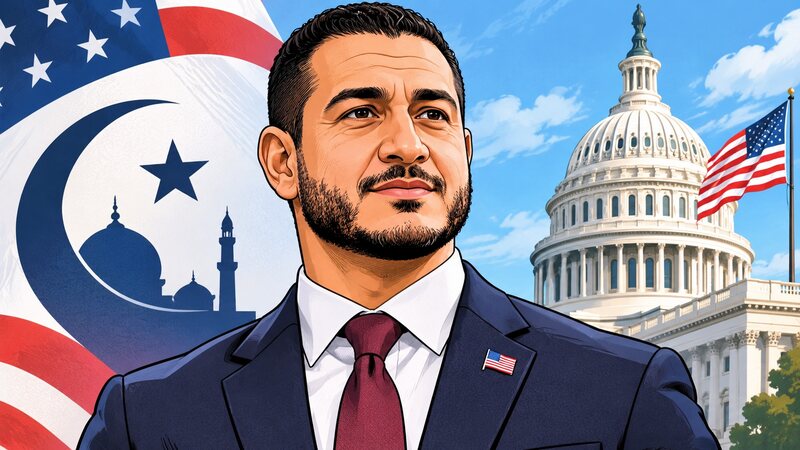
Democrat Abdulrahaman El-Sayed has been elected the first Muslim Senator in the United States after winning Michigan’s open Senate seat in the November 3 midterm elections.
El-Sayed defeated Republican candidate Mike Rogers, a former congressman and FBI agent, in a keenly contested race to become the first Muslim elected to the United States Senate. He polled 2.4 million votes while Rogers, his closest challenger, garnered 2.1 million votes.
The victory of the 42-year-old epidemiologist, public health administrator, and academic retains an important Democratic seat after incumbent Senator Gary Peters, also a Democrat, decided to retire. It also marks a major inroad for the socialist-leaning wing of the Democratic Party after Zohran Mamdani won the New York City mayoral election last November.
About El-Sayed
El-Sayed was born on October 31, 1984, in Detroit, Michigan, to Egyptian immigrant parents. His father, Mohamed El-Sayed, was raised in Alexandria, Egypt, and immigrated to the United States to pursue a PhD at Wayne State University. His mother, Fatten El-Komy, is a nurse practitioner in Missouri. His parents divorced when he was three years old.

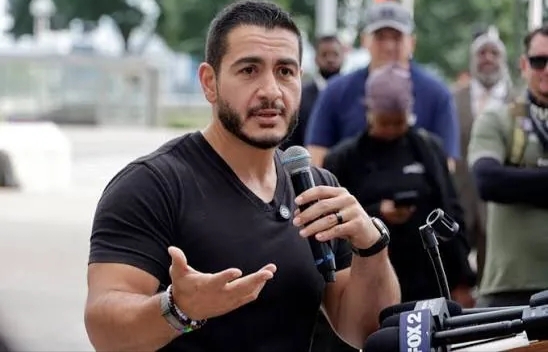
He is married to Sarah Jukaku, and they have two daughters together.
El-Sayed graduated from Bloomfield Hills Andover High School in 2023. He was a three-sport athlete and captain of the wrestling, football, and lacrosse teams. He then attended the University of Michigan, majoring in biology and political science and playing on the men’s club lacrosse team. He graduated Phi Beta Kappa with highest distinction in 2007 with a bachelor’s degree.
El-Sayed received a full-tuition scholarship to the University of Michigan Medical School, where he completed the first two years of a combined MD-PhD program. As a second-year medical student, El-Sayed received a Rhodes Scholarship to attend Oriel College, Oxford, where he completed a Doctor of Philosophy in public health in 2011. In 2014, he completed a Doctor of Medicine degree at the Columbia University College of Physicians and Surgeons.
In August 2015, Mayor Mike Duggan appointed El-Sayed Health Officer and Executive Director of the Detroit Health Department in August 2015, making him, at 30 years old, the youngest health officer in a major U.S. city at the time. In that role, he was tasked with rebuilding the Detroit Health Department as a nonprofit had taken over government public health activities when the city went bankrupt in 2013.
In his first year as director, he spearheaded the opposition to increases in sulfur dioxide emissions by Marathon Petroleum’s Southwest Refinery, which resulted in reductions in overall emissions. He also led efforts to test Detroit schools for lead in the wake of the Flint water crisis and to increase funding for the city’s Animal Control department.
El-Sayed was appointed to the governor’s statewide Childhood Lead Elimination Board. He also served on the State of Michigan’s Public Health Advisory Commission and the advisory committee to the US Secretary of Health and Human Services for the Healthy People program.
In February 2017, El-Sayed declared to run for governor of Michigan in the 2018 Democratic Party primary, saying his ambition was fuelled by the Flint water crisis. El-Sayed promised not to accept campaign donations from corporations and raised over $5 million from individual donations
He, however, lost the August 7 primary to Gretchen Whitmer. He polled 340,560 votes, or about 30% of the vote.
Road to Senate
In April 2025, after incumbent Gary Peters announced his retirement, El-Sayed launched his campaign in the 2026 United States Senate election in Michigan.
During the Democratic primary, El-Sayed defeated Haley Stevens, who was reportedly backed by the moderate, establishment wing of the party. He garnered 48.4% of the vote cast to Stevens’s 47.6%.
Fending off Mike Rogers
The Michigan race drew national attention, with Republicans hoping to take the seat to consolidate their control of Congress.
El-Sayed, who is widely regarded as an economic populist, campaigned on socio-economic issues centred on reducing the cost of living for working families, expanding access to healthcare and limiting the influence of wealthy corporations in politics.
A major component of his programme was Medicare for All, a progressive proposal that seeks to establish a government-funded universal healthcare system for Americans.
His opponent, Rogers, was strongly backed by President Donald Trump and prominent national Republican figures. He hinged his campaign on the portrayal of El-Sayed as a radical candidate sympathetic to Islamic extremism, citing his alleged ties to the Muslim Brotherhood.
El-Sayed refuted the allegations, which were not supported by publicly available evidence. Democrats criticised the attacks, describing them as attempts to exploit Islamophobic stereotypes against the candidate.
Rogers appealed to Jewish voters who had concerns about El-Sayed’s opposition to US military support for Israel and his description of Israel’s actions in Gaza as genocide.
However, the Republican struggled to overcome concerns among voters about the economy and dissatisfaction with Trump’s performance.
During the final weeks of the campaign, Rogers also disagreed with the president on some foreign policy and trade issues, including the war in Iran and the trade dispute with Canada. He asserted that ending both disputes was necessary to reduce costs for American businesses and consumers.
Growing Muslim Representation in American Politics
El-Sayed’s election is an epochal moment for Muslim in the United States, where they constitute a minority of the population but have become a force to reckon with in electoral politics in recent years.
Muslim Americans have previously won seats in the House of Representatives, including Democrats Ilhan Omar of Minnesota and Rashida Tlaib of Michigan, both of whom made history in 2018 as the first Muslim women elected to Congress.
Keith Ellison, also a Democrat from Minnesota, became the first Muslim elected to Congress in 2006.
Unlike members of the House, senators represent entire states and serve six-year terms, making El-Sayed’s victory a significant expansion of Muslim representation at the federal level.