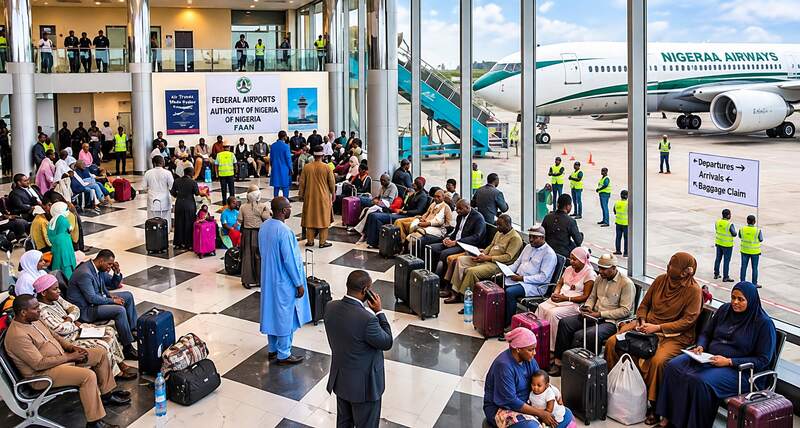
Nigeria’s aviation industry is facing a difficult period, with passengers increasingly finding themselves caught between delayed departures, unexpected cancellations, aircraft technical problems and last minute changes to flight schedules. For travellers who choose air transportation to save time, a journey that should take less than 2 hours can turn into an exhausting experience involving several hours at the airport, missed appointments, additional expenses and uncertainty about when they will eventually reach their destinations. Across the country’s busiest airports, the situation has drawn attention to the operational challenges confronting domestic airlines and the growing pressure on an aviation system expected to connect people and businesses across the country.
The problem has become more concerning as fresh disclosures from airlines and the Nigeria Civil Aviation Authority reveal the difficulties behind some of these disruptions. Grounded aircraft, shortages of qualified pilots, expensive aviation fuel, maintenance challenges and airport congestion have all featured in the explanations surrounding delayed flights. Passengers have also complained about inadequate communication, rearranged departures, missing baggage and difficulties obtaining appropriate assistance. The figures published by the aviation regulator, alongside several incidents recorded between May and November 2026, provide a closer look at an industry where operational difficulties are increasingly becoming a passenger experience problem.
NCAA’s August Figures Reveal the Scale of Flight Delays
The Nigeria Civil Aviation Authority’s August 2026 domestic airline flight disruption report provides one of the clearest indications of the situation. The statistics, released in September, covered 7,961 domestic flights operated by 15 airlines, with 4,765 recorded as delayed and another 36 cancelled. This means approximately 59.9 per cent of the recorded flights experienced delays during the month, leaving only 3,196 flights outside the delayed category. The figures immediately raised questions about the reliability of domestic flight schedules, particularly for passengers who depend on morning departures to attend business meetings, official engagements and other time sensitive appointments.
The duration of the disruptions also deserves attention because the figures extend beyond ordinary short waiting periods. Some 2,801 flights were delayed between 16 minutes and 1 hour, while 1,322 experienced delays lasting between 1 and 2 hours. Another 407 flights were delayed between 2 and 3 hours, with 235 experiencing delays of at least 3 hours. Combined, 642 flights suffered delays of 2 hours or more, demonstrating how many passengers were exposed to disruptions capable of affecting their entire travel plans. These figures also make the NCAA’s passenger protection regulations particularly relevant, since certain assistance and compensation obligations depend on the duration and circumstances of a disruption.
United Nigeria Airlines recorded 943 delayed flights out of 1,231 operations, representing approximately 76.6 per cent, the highest delay rate among the listed operators. Air Peace recorded the highest absolute number, with 1,330 delayed flights out of the 1,864 attributed to it in the NCAA dataset, representing approximately 71.4 per cent. Enugu Air recorded 582 delays from 878 operations, while ValueJet had 435 from 767 flights. Ibom Air recorded 254 delays out of 560 operations, Aero Contractors had 246 from 469, Max Air recorded 204 from 336, while Arik Air had 188 from 301 flights. The statistics also included Rano Air, Overland Airways, Green Africa, XE Jet, Binani Air and Umza Air, showing that the problem affected operators of different sizes.
The cancellation figures presented another dimension of the disruption. United Nigeria recorded 8 cancellations, Air Peace had 7, while Enugu Air recorded 4. Max Air, Green Africa, ValueJet, Ibom Air and Rano Air each recorded 3 cancellations, while Arik Air had 1. These numbers represent the August dataset and should not be mistaken for the airlines’ total cancellations throughout 2026. They also do not establish that every affected flight was delayed because of an airline’s internal failures, since the published statistics did not provide a complete breakdown assigning individual disruptions to technical, operational or external causes.
Air Peace’s Grounded Aircraft Raise Questions About Operational Capacity
One of the most revealing developments occurred on September 10, 2026, when the NCAA’s Director General, Captain Chris Najomo, met representatives of Air Peace to discuss recurring flight delays, crew shortages and passenger complaints. During the meeting, the airline’s Chief Operating Officer, Oluwatoyin Olajide, disclosed that Air Peace had 20 aircraft in its fleet, with 5 classified as Aircraft on Ground, leaving 15 serviceable aircraft available for operations. The airline was operating approximately 80 to 85 flights daily, making the availability of aircraft particularly important to its ability to maintain advertised schedules.
The airline identified several circumstances behind its grounded aircraft, including bird strikes, component shortages and a cracked windshield, alongside weather conditions and airport restrictions affecting operations. These problems illustrate the difficulties airlines face when an aircraft unexpectedly becomes unavailable, particularly when several flights have already been planned around its daily movement. A grounded aircraft cannot simply be replaced immediately, especially when another available aircraft is already assigned to a different route. The airline may have to rearrange departures, move passengers, adjust crew assignments or postpone services until the affected aircraft can return to operation.
The meeting also raised questions about whether airlines have sufficient operational reserves to handle unexpected disruptions without affecting several subsequent flights. An operator running a tight schedule with limited serviceable aircraft can experience significant difficulties when even 1 aircraft develops a technical fault. The NCAA emphasised the need for airlines to align their flight schedules with available operational resources, rather than exposing passengers to repeated changes after they have already made travel arrangements.
Air Peace Disputes the NCAA’s Flight Statistics
The August figures also produced a disagreement between Air Peace and the aviation regulator. After the NCAA published its report, the airline disputed the 1,864 flights attributed to it, claiming that it actually operated 2,564 flights during August, a difference of 700 operations. Air Peace argued that the regulator’s figures did not accurately reflect its actual operational performance and presented its own explanation of the delays recorded during the period.
According to the airline, its internal assessment identified 391 delayed flights as resulting from factors within its own operations, representing approximately 15 per cent of the delays in its dataset. It attributed other disruptions to circumstances including airport congestion, bird strikes, adverse weather, airport infrastructure problems, industrial action by aviation unions and damage to an aircraft by a ground handling company. The airline also acknowledged internal challenges involving technical problems requiring unscheduled maintenance and fuel related difficulties.
The disagreement is important because the number of flights operated affects the calculation of an airline’s delay rate. Until the different figures are reconciled using flight records, departure logs and operational information, the NCAA’s reported rate and Air Peace’s competing account cannot be treated as identical measurements. The airline’s explanation also remains its own account of the disruptions, rather than an independently verified allocation of every delayed flight.
United Nigeria’s Technical Problems Leave Passengers Stranded in Abuja
A particularly revealing passenger experience occurred on May 21, 2026, involving United Nigeria Airlines flight UN0505 from Abuja to Lagos. Passengers were scheduled to depart at 9am but encountered a delay after arriving at the Nnamdi Azikiwe International Airport. According to accounts from affected travellers, they had not received sufficient advance notification before getting to the airport, leaving them uncertain about the status of their journey.
At approximately 12:09pm, the airline sent a message informing passengers that the flight had been rescheduled to 12:55pm because of unscheduled maintenance. The airline explained that the decision was necessary to protect passenger safety, but the disruption continued beyond the revised departure time. Nearly 100 passengers were reportedly booked on the Lagos bound service, with approximately 70 moved onto another aircraft travelling towards Owerri, which was expected to continue to Lagos. Some travellers were accommodated on another Lagos bound flight, while the remaining passengers reportedly departed after 3pm, more than 6 hours after their original scheduled departure.
The disruption extended beyond the departure itself when some passengers discovered that their luggage had not arrived with them in Lagos. Their baggage had reportedly remained in Abuja and was placed on another flight. Helen Ikechukwu, one of the affected passengers, explained that the missing luggage prevented her from continuing her journey to Ibadan as planned. Another passenger, Fatimah Hamid, also complained about the delay, saying her 9am departure was eventually pushed to approximately 3pm. The incident demonstrated how an aircraft maintenance problem can affect several aspects of a journey, including passenger arrangements, baggage handling and onward transportation.
Air Peace’s Lagos to Enugu Delay Leaves Lawyer Unable to Attend Court
Another significant incident occurred on September 21, 2026, involving human rights lawyer Inibehe Effiong, who had booked an Air Peace flight from Lagos to Enugu. His departure was scheduled for 6:45am, and he said he arrived at Murtala Muhammed Airport Terminal 1 at approximately 5:50am after checking in the previous night. According to his account, the airline had sent passengers a reminder at 2:01am asking them to come for the flight, but the service was subsequently rescheduled.
Effiong said passengers waited for approximately 1 hour before being informed that the departure had been moved to 4:50pm. The lengthy postponement affected his planned appearance in court in Enugu, which he eventually missed. The disruption attracted the attention of the NCAA, whose Director of Public Affairs and Consumer Protection, Michael Achimugu, disclosed that the regulator had investigated the complaint.
According to the NCAA, Air Peace acknowledged that passengers should have been informed about the rescheduling. The airline’s station and duty managers reportedly confirmed that the notification sent to travellers was issued in error. The regulator also said the disruption was connected to a ripple effect from operational problems experienced the previous night. Air Peace reportedly stated that affected passengers had been taken to a hotel, although the NCAA said it was still verifying the claim.
The NCAA subsequently directed the airline to develop a compensation package for affected passengers under Part 19 of the Nigeria Civil Aviation Regulations 2023. Effiong also complained about the accommodation and food provided, explaining that the circumstances had worsened and that he no longer needed to travel because his court appearance had been overtaken by events. The case became particularly important because the regulator publicly acknowledged a communication failure and directed the airline to prepare compensation for affected passengers.
Max Air’s Crew Shortage Leaves Serviceable Aircraft Unused
Aircraft availability is not the only operational difficulty facing Nigerian airlines. During the September 10 meeting with the NCAA, Max Air disclosed that it had 3 serviceable Boeing 737 aircraft available for domestic operations but was operating only 2 because of crew limitations. The airline’s General Manager of Ground Operations and Business Development, Raymond Omadiagbe, identified pilot retention as a major challenge affecting its ability to deploy all available aircraft.
The disclosure highlights a problem that can easily be overlooked when discussing flight delays. An aircraft may be technically sound, have completed its necessary checks and be ready for commercial service, but it cannot operate without the required qualified crew. Airlines must have appropriately licensed pilots and other personnel available to operate their aircraft while complying with aviation safety requirements and crew duty limitations. When staffing levels become inadequate, the airline may have to reduce its schedule even when some aircraft are ready to fly.
Max Air also discussed the condition of its international fleet, including 2 Boeing 747 aircraft and 1 Boeing 777 undergoing checks. The company said it had adjusted its domestic schedule to match available resources and discontinued late night Kano operations following passenger feedback. The NCAA discussed support for training arrangements and foreign crew licence validation, while stressing that licence verification and simulator checks remained necessary. The situation shows why increasing the number of aircraft alone cannot automatically improve an airline’s operational capacity.
Nigeria’s Pilot Training Challenge
The crew shortage discussion also connects with the difficulties facing aspiring and experienced pilots in Nigeria. In a July 19, 2026 interview, Zino Aviation Chief Executive Officer, Captain Zino Mario, discussed the gap between obtaining a commercial pilot licence and securing employment with an airline. He explained that some licensed pilots struggle to enter commercial operations because airlines increasingly require additional qualifications, including aircraft type ratings.
A type rating is an additional qualification that allows a pilot to operate a particular aircraft type, such as a Boeing 737 or Embraer E190. Mario estimated that type ratings for many commercial aircraft could cost between $15,000 and $25,000, while some private jet ratings could cost between $30,000 and $50,000. He also identified a shortage of experienced captains, training captains and line training captains, partly because experienced aviation personnel leave Nigeria for opportunities abroad.
His explanation draws attention to the different stages involved in building an airline pilot workforce. Holding a commercial pilot licence does not automatically mean someone is qualified for every aircraft operated by an airline, while additional training and operational experience can make recruitment more difficult. His assessment is an industry interview rather than a comprehensive national workforce census, but it provides useful context for understanding the staffing challenges disclosed by Max Air.
Rising Jet A1 Prices Put More Pressure on Airlines
Fuel costs have become another major concern for Nigerian airline operators. Commercial aircraft depend on Jet A1, also known as aviation turbine fuel, and its price directly affects the cost of operating domestic routes. Reuters reported in May 2026 that Nigerian airlines were struggling with sharply rising fuel prices and supply difficulties, creating additional pressure on operators already dealing with expensive maintenance and foreign exchange challenges.
The National Association of Aircraft Pilots and Engineers warned that fuel scarcity was disrupting flight schedules and forcing airlines to make operational adjustments. Its president, Captain Bunmi Gindeh, also raised concerns about extended crew duty periods and fatigue. Rano Air reported that aviation fuel prices had increased more than fourfold, making some routes commercially difficult to sustain. The combined pressure from fuel prices, foreign exchange availability, imported spare parts and maintenance expenses has made airline planning increasingly challenging.
The consequences can extend beyond the price passengers pay for tickets. When fuel is unavailable at the required airport, an airline may have to postpone a departure, seek alternative arrangements or adjust its schedule. When prices become commercially unsustainable, operators may reduce frequencies or reconsider certain routes. These decisions can affect passengers who depend on regular domestic connections, particularly those travelling between Lagos, Abuja, Port Harcourt, Kano and other commercial centres.
Fuel Shortage Disrupts Air Peace’s Abuja to Maiduguri Service
A September 27, 2026 incident involving Air Peace demonstrated how fuel supply difficulties can combine with airport operating restrictions. The airline explained that aviation fuel was unavailable at Abuja airport, affecting its operations and those of other carriers. Although fuel subsequently became available, the Abuja to Maiduguri service encountered another difficulty involving the destination airport’s operating hours.
According to Air Peace, the Maiduguri airport control tower had initially granted an extension for the aircraft to arrive but later informed the airline that the airport was closed to further operations beyond sunset. The flight could therefore not proceed as originally planned. The airline said affected passengers received refreshments and hotel accommodation, with arrangements made for the service to operate the following day.
The incident illustrates how a disruption can develop through several connected events. A fuel shortage at the departure airport can delay an aircraft, while a restriction at the destination can prevent it from completing the journey after the original problem has been resolved. Passengers may consequently face an overnight wait even when the airline has eventually obtained the fuel required for the flight.
Aviation Union Dispute Disrupts Flights Across Lagos, Abuja
Industrial action also contributed to flight disruptions during 2026. On August 11, aviation unions picketed Air Peace operations at Murtala Muhammed Airport in Lagos and Nnamdi Azikiwe International Airport in Abuja. The dispute involved the 5 per cent Ticket Sales Charge and the unionisation of airline workers, with the National Union of Air Transport Employees and the Air Transport Services Senior Staff Association of Nigeria backed by the Nigeria Labour Congress and Trade Union Congress.
The unions accused airlines of failing to remit charges collected from passengers to relevant aviation agencies and raised concerns about workers’ rights to unionise. The Airline Operators of Nigeria subsequently alleged that union members blocked access to departure terminals, check in counters, offices and workstations. The affected airlines reportedly had to cancel or reschedule flights, rebook passengers, provide accommodation and reposition aircraft and crew.
On September 29, the Airline Operators of Nigeria disclosed that more than 70 Air Peace flights and over 30 United Nigeria flights had been affected, with approximately 13,000 passengers reportedly affected on United Nigeria services. The association also estimated Air Peace’s losses at more than ₦2 billion. These figures were supplied by the airline operators’ association and were not independently audited totals.
The unions maintained that their actions concerned workers’ rights and statutory financial obligations. Aviation Minister Festus Keyamo intervened, after which the unions suspended the picketing. The incident exposed another source of disruption within the industry, showing that flight schedules can be affected by labour disputes even when aircraft and crew are otherwise available.
Airport Congestion Creates Additional Departure Problems
Airport congestion has also featured prominently in discussions about domestic flight punctuality. During the September 16, 2026 Aviation Day of the 23rd Akwaaba African Travel Market in Lagos, United Nigeria Airlines Chief Commercial Officer, Adedayo Olawuyi, argued that airlines should not automatically be blamed for every delayed departure. He explained that an aircraft could be ready to leave but remain on the ground because other aircraft were occupying the ramp or competing for access to the runway.
Olawuyi gave the example of an aircraft scheduled to push back at 6:59am but taking off more than 30 minutes later because of congestion. ValueJet Chief Commercial Officer Trevor Henry also identified presidential movements, weather, check in congestion, security checks, crowded boarding gates and runway restrictions as possible contributors. MMA2 Chief Operating Officer Remi Jibodu proposed improved coordination of airline schedules and a slot system to reduce congestion during peak periods.
Weather and airport infrastructure can also combine to disrupt operations. Olawuyi described a United Nigeria flight from Lagos to Kano that departed at approximately 10:30pm but encountered a thunderstorm near Kano, affecting runway lighting. The aircraft could not land and returned to Lagos, arriving at approximately 1am. The example illustrates how an airline may complete its departure but encounter circumstances at the destination that make landing unsafe or impossible.
Grounded Aircraft Create Chain Reactions Across Flight Schedules
The Aircraft on Ground situation remains one of the most important issues behind recurring airline disruptions. An aircraft may be removed from commercial service because of an unexpected technical defect, scheduled maintenance, bird strikes, windscreen damage or the unavailability of a specialised component. Some parts must be sourced internationally, meaning an aircraft can remain grounded while the airline waits for the required equipment and maintenance intervention.
The consequences can extend beyond the passengers booked on the affected aircraft. An aircraft scheduled to operate Lagos to Abuja, Abuja to Kano and Kano to Lagos may develop a technical problem during its first journey. Once it becomes unavailable, the airline may struggle to operate the remaining services, particularly when replacement aircraft are already committed to other routes. Passengers on subsequent departures can then experience delays even though they were never booked on the aircraft that originally developed the fault.
Crew schedules can also be affected because pilots and other personnel are assigned to specific aircraft and planned routes. When an airline changes its aircraft arrangements, it may need to reorganise crew assignments while ensuring that duty limits and safety requirements are respected. This is how a single technical problem can spread through an airline’s daily schedule, affecting several destinations and hundreds of passengers.
Flight Merging Leaves Passengers Waiting for Other Departures
Flight merging is another practice that has attracted the NCAA’s attention. It occurs when an airline combines passengers booked on separate scheduled services onto a single departure, often because an aircraft is unavailable or the operator is experiencing operational difficulties. For example, passengers booked on Lagos to Abuja flights scheduled for 9am and 11am may be moved onto one aircraft if the airline cannot operate both services separately.
The practice can help an airline manage limited aircraft availability, but passengers may experience substantial waiting periods when the arrangement is not communicated early enough. Travellers who arrive expecting a particular departure may discover that their flight has been combined with another service, leaving them waiting for additional hours. The NCAA raised concerns about flight merging during its September discussions with Air Peace and urged operators to improve passenger communication and complaint handling.
Passengers Bear the Cost of Repeated Disruptions
Behind the operational figures are travellers whose daily activities can be affected by unexpected changes to their journeys. A passenger travelling for a business meeting may lose an important opportunity, while someone attending a court hearing, wedding, funeral or medical appointment may have no practical way to recover the time lost. Additional transportation costs, hotel reservations, meals and missed onward journeys can turn an ordinary ticket purchase into a much more expensive experience.
The case involving Inibehe Effiong illustrates the seriousness of these consequences because the Lagos to Enugu delay prevented him from attending a court appearance. The United Nigeria disruption in Abuja also affected passengers whose baggage was left behind, including Helen Ikechukwu, who could not continue her planned journey to Ibadan. The Abuja to Maiduguri disruption required passengers to wait for next day arrangements after fuel supply difficulties and airport restrictions prevented the original service from operating as planned.
Families travelling with children, elderly relatives and people with disabilities can face additional difficulties during prolonged airport waiting periods. Passengers may have to purchase meals, arrange alternative transportation or contact people waiting at their destinations to explain why they cannot arrive as scheduled. These experiences demonstrate why airline communication and passenger assistance should remain important parts of the industry’s response to operational difficulties.
What Nigerian Aviation Regulations Say About Passenger Rights
Part 19 of the Nigeria Civil Aviation Regulations 2023 provides the framework governing passenger protection, including flight delays, cancellations, denied boarding and baggage related complaints. The regulations establish obligations for airlines and provide passengers with specific entitlements depending on the circumstances and duration of a disruption. The NCAA has repeatedly reminded operators that passengers should receive appropriate information and assistance when their flights are affected.
For domestic flights, delays exceeding 2 hours attract obligations involving refreshments and communication assistance under the applicable provisions. Where a delay exceeds 3 hours, passengers may become entitled to reimbursement or rerouting, subject to the relevant regulatory conditions. Qualifying delays exceeding 6 hours can also attract compensation, while overnight disruptions between 10pm and 4am or airport closures can trigger hotel accommodation and transportation obligations where prescribed.
For qualifying domestic flight cancellations, passengers may be entitled to reimbursement or alternative routing, alongside compensation equivalent to at least 25 per cent of the fare where the applicable conditions are satisfied. The compensation provisions contain exceptions, including circumstances involving qualifying advance notification and extraordinary events. These entitlements are not automatic payments for every delayed or cancelled flight, since the specific circumstances, notice period and applicable regulatory provisions must be considered.
Passengers experiencing unresolved problems should retain their booking confirmations, boarding passes, airline messages, revised departure notifications and receipts for additional expenses. They should first submit complaints to the airline and escalate unresolved cases to the NCAA Consumer Protection Department. The regulator’s ability to establish how many complaints are received, how many are resolved and how many passengers actually receive refunds or compensation will be important in assessing the effectiveness of passenger protection enforcement.
NCAA Warns Passengers Following Assault on Consumer Protection Officer
Another development emerged on November 9, 2026, when the NCAA warned passengers against attacking its Consumer Protection officers following an alleged assault on a female officer attending to travellers affected by a flight disruption. The regulator’s Director of Public Affairs and Consumer Protection, Michael Achimugu, said the officer was allegedly slapped and punched while carrying out her duties at the airport.
The authority explained that passengers had the right to express dissatisfaction with airline services but should not assault personnel assigned to assist them. The incident highlighted the tension that can develop at airports when travellers face prolonged delays, inadequate information and uncertainty about their journeys. The NCAA also recalled previous airport confrontations, including the January 2025 assault allegation involving an officer over missing baggage on a Royal Air Maroc flight and the August 2026 Ibom Air incident involving Comfort Emmanson.
The November development does not establish that every flight disruption results from airline misconduct, but it demonstrates the difficult environment in which passenger complaints are sometimes handled. Airlines must provide timely information and appropriate assistance, while passengers must be able to raise complaints without violence against airport personnel.
The Questions Nigeria’s Aviation Authorities Must Answer
The growing number of documented disruptions raises important questions about the operational capacity of domestic airlines and the effectiveness of regulatory supervision. The NCAA needs to establish how many aircraft are registered to each operator, how many are serviceable and how many remain grounded for extended periods. Updated information about maintenance capacity, spare parts availability and the time required to return grounded aircraft to commercial service would also help explain the scale of the problem.
Crew availability requires similar attention, particularly following Max Air’s disclosure that it was operating 2 of its 3 serviceable domestic Boeing 737 aircraft because of staffing limitations. The regulator should establish how many qualified captains and first officers are available to domestic operators, how many disruptions are specifically connected to crew shortages and whether airlines are advertising schedules beyond their available staffing capacity.
Fuel supply also deserves closer examination, especially following the May 2026 warnings about Jet A1 shortages and the September disruption involving Air Peace’s Abuja to Maiduguri service. Airport congestion, runway restrictions and limited night operating facilities should also be investigated using actual movement records. The regulator should equally clarify differences between its flight statistics and figures supplied by airlines, particularly when competing operational totals produce different delay rates.
Passenger compensation remains another important issue. How many travellers have received refunds, compensation, hotel accommodation and other assistance following qualifying disruptions in 2026? How many airlines have received formal warnings or sanctions for failing to comply with Part 19? These figures would provide a clearer picture of whether existing regulations are translating into practical protection for passengers.
Nigeria’s Flight Delay Crisis Requires More Than Apologies
The developments recorded between May and November 2026 reveal an aviation industry dealing with several connected pressures. Air Peace disclosed that 5 of its 20 aircraft were grounded, while Max Air admitted that crew limitations prevented it from operating all 3 of its serviceable domestic Boeing 737 aircraft. The NCAA’s August report recorded 4,765 domestic flight delays and 36 cancellations, while individual passengers experienced disruptions that affected court appearances, onward journeys and baggage collection.
Fuel shortages, expensive maintenance, imported components, pilot recruitment difficulties, airport congestion, weather and industrial disputes have all contributed to the difficult operating environment. Some of these circumstances are outside the immediate control of individual airlines, particularly severe weather and certain airport restrictions. However, the responsibility to plan realistic schedules, communicate changes promptly and provide assistance to affected passengers remains central to airline operations.
The most important issue is whether Nigerian airlines are scheduling flights according to the aircraft, qualified crew and operational resources they can reliably deploy. Passengers should not repeatedly discover major changes only after arriving at the airport, particularly when an airline already knows that an aircraft is grounded or that a scheduled service is unlikely to operate. The NCAA’s role must extend beyond publishing delay statistics to ensuring that operators maintain credible schedules, explain disruptions and comply with passenger protection requirements.
For travellers, the consequences are measured in missed appointments, additional expenses, lost opportunities and hours spent waiting for information about journeys they have already paid for. For airlines, repeated disruptions threaten customer confidence and add further pressure to already expensive operations. Nigeria’s flight delay crisis therefore requires a coordinated response involving airlines, airport authorities, aviation regulators, fuel suppliers and other industry stakeholders, with passenger safety, reliable scheduling and accountability placed at the centre of the effort.