With 61 days to Nigeria’s 2027 presidential election, opposition leaders are exploring ways to cooperate, but disagreements over candidates, party leadership disputes and electoral procedures continue to complicate efforts to present a united front.
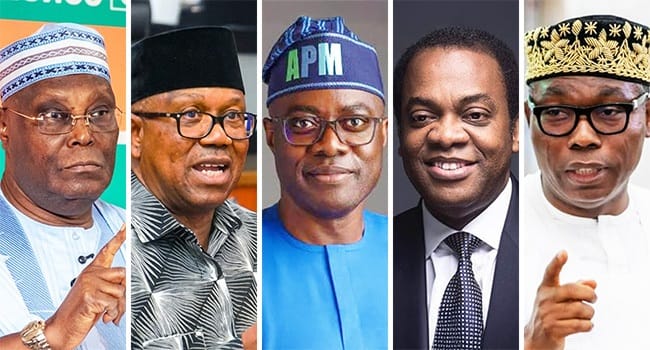
The consultations, which gained attention between November 9 and 15, involved Oyo State Governor Seyi Makinde, former Vice-President Atiku Abubakar and the presidential candidate of the Nigeria Democratic Congress, Peter Obi.
However, the discussions have yet to produce an agreed presidential candidate or a common political programme, leaving questions about how the parties intend to translate their conversations into a workable alliance.
Makinde, who is the presidential candidate of the Allied Peoples Movement, said during an interview with ARISE News that potential partners should assess candidates’ manifestos, previous performance and public support before deciding on a common choice.
He did not endorse any of the contenders or outline a specific process for reaching a final decision.
The Oyo State commissioner for information, Dotun Oyelade, said Makinde was willing to explore cooperation, while the African Democratic Congress spokesperson, Bolaji Abdullahi, and Atiku’s campaign official, Phrank Shaibu, confirmed that discussions were ongoing.
The Peoples Redemption Party presidential candidate, Donald Duke, also expressed willingness to support an opposition candidate selected through a democratic process, provided the parties first agreed on a national programme.
The NDC, however, has indicated a preference for its own ticket, comprising Obi and his running mate, Rabiu Kwankwaso.
The party’s national publicity secretary and director of communication and media for its campaign, Osa Director, said other opposition figures should rally behind the pair.
“Everybody can coalesce around the candidacy of Obi and Kwankwaso,” he said.
Director, however, could not confirm whether the NDC had formally participated in the reported discussions involving Atiku and Makinde.
Electoral rules complicate possible changes
The Independent National Electoral Commission’s published presidential candidate list contains separate tickets for the ADC, NDC and APM, with Atiku and Rotimi Amaechi representing the ADC, Obi and Kwankwaso for the NDC, and Makinde and Lawal Daura for the APM.
Under the Electoral Act 2026, a candidate seeking to withdraw must submit a signed notice and affidavit through the nominating political party to INEC at least 90 days before the election.
For the January 16, 2027 presidential poll, the deadline was October 18, meaning the ordinary withdrawal window had elapsed before the latest consultations.
The law also restricts candidate substitution to cases involving death or withdrawal and requires another primary election, while a formal party merger involves a separate procedure requiring nine months’ notice and INEC approval.
Consequently, an endorsement of an existing candidate would not automatically change the names on INEC’s list, while replacing a nominee or merging parties would require compliance with the relevant legal provisions.
ADC leadership dispute adds uncertainty
The opposition negotiations are also unfolding against the backdrop of the legal battle over the ADC’s leadership and the status of its presidential nomination.
On November 5, Justice Peter Lifu of the Federal High Court in Abuja invalidated the leadership of the David Mark-led faction and official actions taken under it, following a suit instituted by Nafiu Gombe.
The judgment restrained INEC from recognising Mark, Rauf Aregbesola and other affected national officers in their disputed positions, while directing the commission to recognise Gombe as the sole elected member of the National Working Committee entitled to supervise the party’s affairs.
However, the court’s final orders did not specifically name Atiku or expressly direct INEC to remove all ADC candidates, leaving the effect of the judgment on the party’s primaries and nominations open to legal interpretation.
INEC National Commissioner Mohammed Haruna said the commission’s legal department would examine the certified judgment before recommendations were presented for consideration.
The ADC received the certified copy on November 11, according to reports, but the party had not secured a court order staying the judgment as of the period covered by the report.
Shaibu said applications for a stay and injunction had been filed at the Federal High Court and Court of Appeal.
“None for now, but there are applications for Stay and injunction pending in the FHC and Court of Appeal.”
Abdullahi also confirmed that the party had not obtained an order stopping the judgment, although he said it had appealed and notified INEC of the proceedings.
He argued that Atiku’s nomination resulted from a nationwide direct primary conducted by party members rather than a decision made by Mark and Aregbesola.
“It wasn’t a decision taken by David Mark and Rauf,” he said.
However, Section 17 of the Court of Appeal Act provides that filing an appeal does not, by itself, suspend the execution of a judgment.
The legal dispute therefore remains significant for any proposed opposition arrangement involving the ADC, particularly over which officials have the authority to negotiate and communicate decisions to INEC.
Alliances do not always mean a joint ticket
Recent political developments in states also demonstrate that parties can support the same presidential candidate while retaining separate candidates for legislative and other elections.
At the November 6 campaign launch of the All Progressives Grand Alliance in Anambra State, Governor Chukwuma Soludo backed President Bola Tinubu while presenting flags to 44 candidates contesting legislative seats under APGA.
Similarly, APC leaders in Osun State discussed cooperation with the Accord party while promoting support for Tinubu’s re-election bid, without announcing a joint slate of candidates.
In Ondo State, the absence of flag presentations to National Assembly and state assembly candidates at a presidential campaign rally prompted questions about the level of support they would receive from the party.
The developments highlight the distinction between presidential endorsements and arrangements covering other electoral contests.
Manifestos and campaign structures remain key
Beyond selecting a presidential candidate, opposition parties would also need to reconcile their policy proposals and determine how they intend to organise campaigns across the country.
The APC unveiled its 2027–2031 manifesto, which includes targets of six per cent annual economic growth, 10,000 megawatts of electricity generation and the recruitment of 20,000 additional teachers.
Atiku, meanwhile, renewed his promises on fuel and electricity subsidies during a rally in Bauchi, while Makinde’s Reset Agenda focuses on reducing the cost of living through improvements in transport, energy and infrastructure.
Any common opposition programme would need to explain how such proposals would be financed and implemented, particularly where the parties have different approaches to subsidies, public spending and economic reforms.
The organisation of polling agents presents another challenge, as the parties currently maintain separate campaign structures and candidate networks.
INEC requires political parties to nominate polling agents through authorised officials using its designated portal, with each agent assigned to a polling unit and required to provide identification and a photograph.
An alliance would therefore need clear arrangements for recruiting, training and coordinating agents, as well as deciding which party officials would be responsible for submitting their details to the commission.
With the presidential election approaching, the opposition’s ability to agree on a candidate, settle questions of party authority and coordinate its campaign structures will determine whether the current consultations develop into a functioning electoral alliance.