


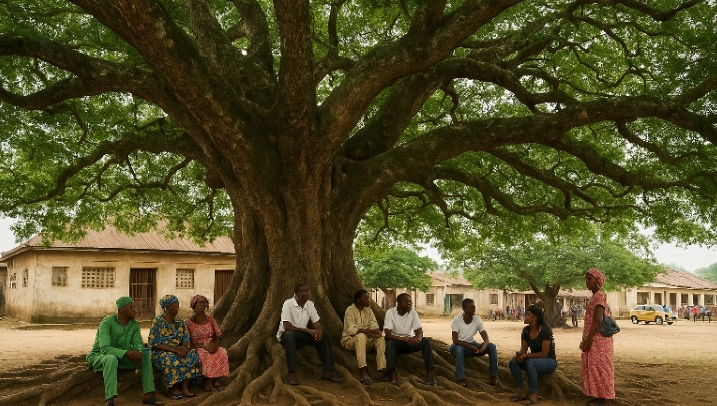
There is a corner of Ijebu-Ode where the air never quite stands still. Even on dry mornings when the markets sleep and the harmattan holds its breath, the wind insists on circling one particular patch of ground — the space where the Arere, the Iroko Oba, still stands. The tree’s bark is weathered like the hands of old fishermen, its trunk broad enough to shame a house, its leaves whispering even when no one is there to hear.
Children are told never to pluck its leaves after dusk; elders lower their voices when they pass. It is not fear they carry, but a reverence too ancient for words — a reverence born of memory older than the town’s oldest graves.
From a distance, it looks less like a tree and more like something half-awake — a custodian of secrets that has outlived four republics, three generations of Awujale, and countless attempts by men to measure time. The people call it “Iroko Oba” not because of what it is, but because of what it has become: a quiet monarch of the soil, reigning where kings reign but never speaking where kings speak.
Yet to stand before it is not simply to meet history; it is to confront patience itself. The Arere does not age the way men do. Its silence mocks our urgency. Its calm unsettles our ambitions. And in that stillness, Ijebu-Ode hears something between warning and benediction — a reminder that civilizations, like trees, survive not by power but by memory. The story of the Arere is therefore not the story of a plant, but of a people who built a city around a living witness.
Roots Before Memory – When Ijebu Was a Kingdom of Silence
Long before British maps divided Yoruba land into protectorates and provinces, Ijebu was already a self-contained kingdom — proud, disciplined, and secretive. Its boundaries were not drawn by treaties but by memory, and its symbols of authority were not flags but living presences: rivers, stones, forests, and, most enduring of all, trees. Among these natural sentinels, none held the same awe as the Arere, which old men said had been standing long before the first Awujale wore a crown. In those distant centuries, when the land was an orchestra of forests and silence, the Arere rose in the heart of what would later become Ijebu-Ode, a green pillar in a world still innocent of iron roads and church bells.
The elders told that in the beginning, the tree was not called Iroko Oba. It was simply Arere, a word spoken softly, almost fearfully, as though to name it too loudly might rouse something within. The people believed the tree was a listener — that it understood the language of wind and footsteps. Hunters would pause before it to pour libations, not because they worshipped it, but because they trusted it to keep their intentions. The forest, after all, was not only a place of survival but also of diplomacy — between men and the land, between ambition and patience. The Arere stood as a treaty in bark and roots.
As settlements thickened and pathways met to form the first clusters of Ijebu hamlets, the Arere became a natural landmark. Travellers heading from Imagbon or Oru would measure distance by its sight. Traders rested their loads under its shade, marking the point where wilderness ended and home began. To those early settlers, it was more than a tree; it was a compass of belonging. And with every passing generation, it absorbed not just rainfall and sunlight but the collective memory of a people — the laughter of market women, the drums of coronations, the quiet tears of farewells.

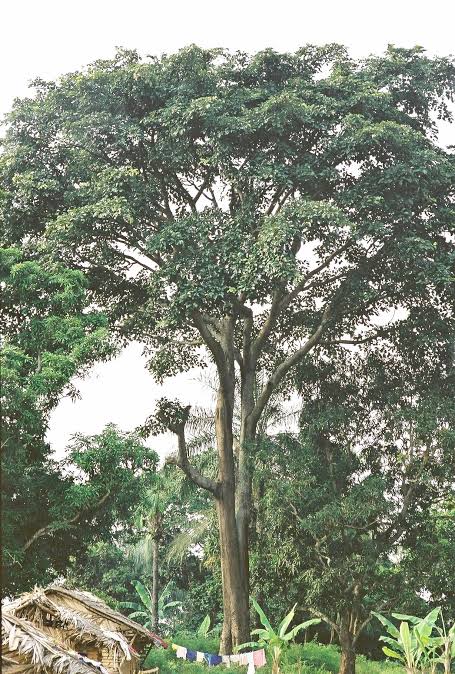
By the time the first Awujale established his palace near its roots, the Arere had already grown into a metaphor. Its roots, spreading unseen beneath the palace ground, mirrored the network of alliances that held the Ijebu kingdom together. Its trunk symbolized strength; its crown of leaves, the dignity of the throne.
To uproot it would have been to uproot memory itself. So the palace grew around the Arere, not over it, and in doing so, Ijebu consecrated a principle that still defines its culture: that power must stand beside patience, not above it.
Colonial Footsteps Beneath the Branches
When the British expeditionary officers first entered Ijebu-Ode in 1892, they brought with them rifles, flags, and the arrogance of empire. They expected to meet warriors; instead, they found silence — a kind of self-assured calm that seemed to unsettle them more than any battle could. The Arere tree stood quietly near the Awujale’s compound, indifferent to the arrival of new rulers. Its roots had seen strangers before. Yet to the British, it was a curiosity: an enormous tree the townspeople treated with the same respect they gave their monarch. Early records from colonial administrators mention “a massive Iroko tree, uncut and revered,” as though even the newcomers sensed it was older than their mission’s authority.
One District Commissioner once ordered his men to clear the land around the palace for easier access. When they approached the Arere with axes, the local guides hesitated. They warned him — not in superstition, but with quiet insistence — that this was no ordinary tree. The officer laughed and told them to proceed. By the next morning, one of his men had collapsed with a fever, another with a mysterious wound from a falling branch. The work was abandoned. The report filed later would omit the details, reducing the incident to “an unfit site for clearing.” But the story took root in the town’s memory: a sign that arrogance breaks before endurance does. The Arere had survived another attempt at erasure, not through violence, but through presence.
As colonial influence deepened, the Ijebu people learned to bend without breaking. Mission schools rose, churches spread, roads carved through ancient forests. Yet even as the landscape changed, one thing remained untouched — the space around the Arere. The new British-style courthouse was built far enough not to cast its shadow over the tree. Civil servants posted to Ijebu wrote home of a “mystical landmark,” though none could explain why locals bowed before it without fear. They were witnessing a society negotiating modernity without surrendering memory. The Arere stood as proof that modern civilization and ancestral respect could share the same soil.
By the time independence arrived in 1960, the tree had already become a quiet legend. Generations who had never seen the colonial troops still spoke of how the Arere “refused to fall.” It became a metaphor in school lessons, a caution in political speeches, and a resting place for old men who remembered Ijebu before telegraphs and taxes. It had seen a kingdom humbled, a culture tested, and yet its leaves still rustled with the same defiant calm. When the Union Jack came down and Nigeria raised her green and white flag, the people of Ijebu looked to their Arere and whispered, “It has seen another dawn.”
The Four Republics – Witness to Nigeria’s Democratic Struggles
The Arere tree of Ijebu-Ode has seen more than ordinary lifetimes. From the dawn of the First Republic in 1963 to the fragile hope of the Fourth Republic today, its branches have silently recorded the rhythms of Nigeria’s democratic experiments. Independence brought optimism to towns across the southwest, and Ijebu’s elders often gathered under the tree to discuss civic responsibilities. Campaign banners fluttered against its trunk, and the tree bore witness to the first elections, debates, and the eventual collapse that came with military intervention.
The Second Republic (1979–1983) briefly revived hope. Beneath the Arere, political rallies, community councils, and student debates reflected a country trying to reinvent itself. Yet even then, the elders whispered warnings: history had a habit of repeating itself. When the 1983 coup toppled the civilian government, the tree remained — unbowed, a silent witness to promises broken and hopes deferred. Its presence reminded the people that endurance, not rhetoric, defined the true pulse of the nation.
During the Third Republic, an era that never fully blossomed (1992–1993), the Arere again served as a sanctuary. Citizens who protested or whispered dissent found courage under its shade. The annulment of the June 12, 1993 election — a pivotal moment in Nigeria’s democratic struggle — was felt deeply in Ijebu. Even in despair, people turned to the tree as a symbol of continuity, tying cloths to its branches and leaving small offerings as a gesture of hope that democracy, though delayed, would return.
Finally, the Fourth Republic (1999–present) brought a more stable, yet still turbulent, experiment with civilian rule. Presidents changed, reforms were promised, and corruption persisted, but the Arere remained a constant. Students, tourists, and local citizens now gathered beneath it for reflection, education, and cultural preservation. Across these four republics, the tree has endured what governments could not: the passage of time, the memory of the people, and the silent strength of continuity. It is not merely a tree, but Ijebu’s living testament to Nigeria’s democratic struggles and resilience.
Why the Arere Tree Still Stands When Time and Empire Have Fallen
To fathom why the Arere tree still stands, one must step beyond folklore and into the quiet logic of nature itself. The tree — known botanically as Milicia excelsa, and in Yoruba cosmology as Iroko Oba or Arere — is no ordinary species. It is a hardwood giant, revered across West Africa for its density, endurance, and longevity. Timber merchants call it the “African teak,” but to the Yoruba, it is something greater: the living architecture of memory.
Scientists who have studied the Iroko describe its survival with reverence. Its roots grow wide before they grow deep, forming a network strong enough to resist erosion and even mild flooding. The bark, thick and fibrous, contains natural antifungal compounds that repel decay. It can thrive in both humidity and drought, adapting to the temperamental rhythms of tropical weather. In short, it is a tree built to outlast uncertainty — much like the people who have lived under its shade for centuries.

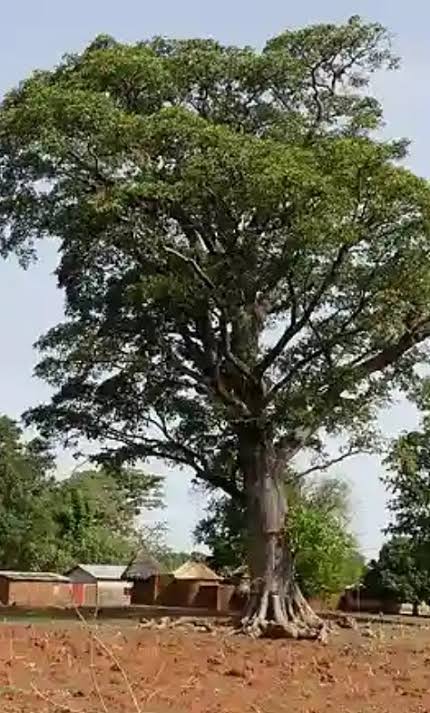
But in Ijebu, the endurance of the Arere is not explained by biology alone. To the locals, it is Aye l’orun se — a bridge between the seen and unseen. They say its spirit carries the wisdom of the old kingdoms: the Ijebu Empire, the early Oyo influence, the colonial disruption, and every republic that has risen and fallen since independence. When elders pass, their memories are said to join the wind that moves through its leaves. When new rulers emerge, prayers are said at its base, not as idolatry, but as dialogue — between continuity and change.
In the early 2000s, botanists from Obafemi Awolowo University visited Ijebu to document “heritage trees.” When they arrived at the Arere, they were astonished to find it measured nearly six meters in diameter and towered above the roofs of the surrounding houses. Carbon testing and growth-ring analysis suggested that it might be over four centuries old — older than the amalgamation of Nigeria itself. The discovery sparked local pride. Newspapers in Ogun State briefly ran headlines calling it “The Tree That Witnessed Empires.” For the people, it wasn’t science confirming legend; it was science finally catching up to what they had always known.
What makes the Arere’s story truly remarkable, though, is not just its survival in nature, but its endurance in culture. It has stood at the crossroads of monarchy and democracy, empire and republic, faith and reason — and through it all, it has remained neutral, yet profoundly human in meaning. It reminds Nigerians that the true test of civilization is not how tall we build, but how long we remember.
Even now, conservationists and elders meet yearly under the tree to clear its surroundings, preserving it not as a tourist attraction but as a teacher. They call the gathering Irewole Arere — “the renewal of the sacred.” Each year, the same cycle repeats: prayers for rain, for peace, for continuity. And with every ceremony, the lesson deepens — that strength is not in defiance alone, but in endurance without bitterness.
For those who visit, the Arere offers a strange stillness. Standing before it, one feels both small and expanded — aware of time’s vastness and one’s own fleetingness. It has outlived conquerors, kings, generals, and governors. It has seen modern roads paved over ancient paths, and still, it holds its ground. The tree, in essence, has mastered what the republics have not: the art of lasting without losing purpose.
The Iroko Oba and the Crown – A Tree’s Coronation
When the Awujale’s palace began to take form in the heart of Ijebu-Ode, it was said that no wall was raised until the Arere tree had first been greeted. This was not ceremony; it was duty. Builders, masons, and carvers paused before each dawn’s labor to acknowledge the silent monarch whose shadow measured the ground. They called it Iroko Oba — “the king’s tree” — a title not granted but earned by endurance. The Awujale’s courtiers believed that the Arere had witnessed the crowning of kings before palaces had doors, and that within its core lay the memory of every oath ever sworn on Ijebu soil.
In those years, kings were not enthroned by mere lineage but by the approval of unseen witnesses. The Iroko Oba stood as one of them — a natural archive of integrity. When the new Awujale was installed, processions circled the tree in respectful silence, a ritual gesture that acknowledged its quiet sovereignty. To pass the Arere without bowing was to deny the continuity of the crown itself. Even British officers, puzzled by this custom, noted in their diaries that “the natives defer to a tree as though it were a chief.” What they missed was that the Arere was not a symbol of worship but of accountability; it represented the idea that kingship was not absolute but watched — that even power must answer to patience.
The bond between the tree and the crown deepened as Ijebu modernized. When new palaces were constructed, planners still left the Arere untouched, as though its roots had become part of the architectural blueprint. Visitors from other Yoruba towns, noticing its position beside the royal compound, would ask if the tree had ever fallen ill. The reply was always the same: Oba ki se alaisan, Iroko ki sun — “A king does not take ill, and the Iroko does not sleep.” In that fusion of metaphors, the people captured something profound: that stability was not merely a political idea but a living condition, embodied in bark and breath.

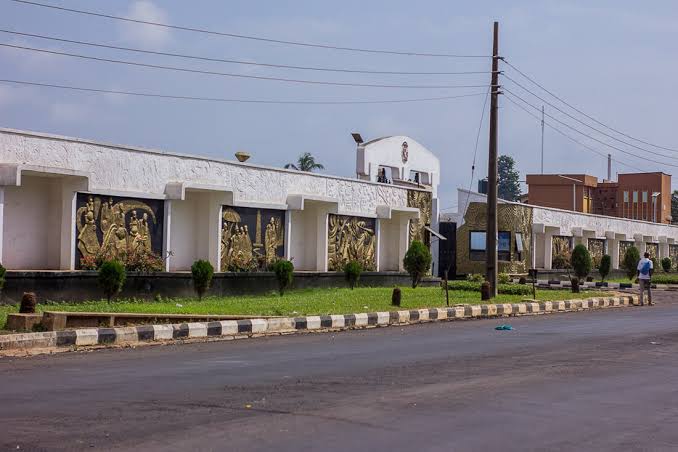
Through coronations and funerals, petitions and reforms, the Arere remained unbothered by the noise of human cycles. Elders often joked that the tree had seen more coups than the palace guards. Yet beneath that humor lay a serious truth — that the endurance of Ijebu identity was rooted not in gold or power, but in continuity. Each new Awujale inherited not just a throne but a neighbor — a silent witness that reminded him that time is the only true ruler. To sit on the throne was to sit under the same sky that shaded the Iroko Oba, and to remember that leadership, like life, is only borrowed.
What the Arere Tree Teaches About Power, Time, and Nationhood
If one were to trace a finger across the bark of the Arere tree, they would not just feel wood — they would feel the grooves of time itself. Each line, each knot, each scar tells a different story. Some are marks of nature — lightning strikes, insect trails, years of harmattan winds. Others, locals say, are human: carvings left by generations who came to pray, to protest, or simply to remember. It is in these markings that the tree’s truest teachings are inscribed — lessons not spoken, but learned through endurance.
The first lesson is patience. The Arere’s life unfolds in rhythms humans can barely comprehend. Empires have risen and fallen in the time it took for its crown to widen. Where men hurry to conquer, the tree waits. It knows that all noise fades eventually. This quiet defiance is what many in Ijebu admire — its refusal to be hurried by history. It is said that when young people complain about the slow pace of progress, elders simply point to the tree and say, “The one who endures, reigns.”
The second lesson is balance. In Yoruba philosophy, harmony between opposites — life and death, joy and sorrow, power and humility — is the root of wisdom. The Arere embodies that truth. Its roots burrow deep into darkness, yet its leaves stretch toward the light. It absorbs storm and sunlight alike, turning both into strength. To those who study it, it mirrors Nigeria itself — a land constantly wrestling with contradiction, yet always returning to center.
The third lesson is memory. The Iroko Oba does not forget. Beneath its roots, the earth holds centuries of human footsteps — farmers, soldiers, traders, rulers, wanderers. The Yoruba say the land never loses the sound of those who walked it. In that sense, the Arere is not just a tree but an archive — the custodian of the echoes of generations. In its shade, power has been debated, prayers have been whispered, and decisions have been made that shaped the fate of many. And though the world changes around it, it never erases the past to make room for the future. It simply holds both in one trunk.
The final lesson is humility before time. No matter how mighty a ruler or how ambitious a republic, all must eventually return to dust. Yet the Arere endures — not because it resists time, but because it flows with it. This is perhaps its most profound metaphor for nationhood. Nigeria’s struggle has always been one of impatience — governments eager to modernize without remembering, leaders quick to rebuild without reflection. But the Arere teaches that progress must be rooted in patience, growth in groundedness, and power in humility. A nation, like a tree, cannot thrive if its roots forget where they began.
Today, when elders speak of leadership in Ijebu, they often invoke the tree’s example. They say, “The Arere does not speak, yet it rules the square.” It is a reminder that authority can come from presence, not position; from service, not speech. It teaches that greatness is not measured in how loudly one leads, but in how deeply one stands.
In a world obsessed with speed, the Arere stands as the slow pulse of truth — a living parable that tells the story of Nigeria without ever uttering a word. It is both witness and warning: that only what is deeply rooted can truly survive the storms of time.
How the Younger Generation is Rediscovering Ijebu’s Living Sentinel
Every generation inherits history in its own language. For the youth of Ijebu today — those raised on smartphones, Afrobeats, and hashtags — the Arere tree is not a myth told by elders in moonlight, but a rediscovered truth waiting behind their screens. To many of them, the sacred tree had long been a rumor: a relic whispered about in old family tales, dismissed as superstition in classrooms that worshipped modernity. But time, like the roots of the tree itself, has a way of circling back.
In recent years, a quiet revival has begun — not through rituals, but through curiosity. Students studying environmental science at Tai Solarin University and Olabisi Onabanjo University began visiting the tree, initially to collect data on indigenous plant resilience. What they found there was more than a research subject. They felt, as many before them had, the overwhelming stillness of the place — a sense of perspective that no textbook could explain. They began photographing the tree, sharing its image on social media. Slowly, a new generation began to claim the sacred tree not as an ancient monument, but as a modern identity marker.
For these young people, the Arere represents something their era rarely offers — continuity. In a world of fleeting trends and unstable politics, the tree provides a counterweight. It reminds them that not everything old must be discarded; that wisdom can coexist with Wi-Fi; that to be modern is not to be rootless. The youth movements around the Arere are not religious; they are reflective. They organize poetry readings beneath its shade, record podcasts about Yoruba heritage, even hold environmental awareness events. To them, the Arere’s story is not folklore — it is evidence of African resilience, ecological intelligence, and spiritual depth all in one.
Yet, this rediscovery carries a quiet melancholy. Many of the older generation, who once prayed and held meetings beneath the tree, now watch from afar, unsure if the youth understand what it truly meant to them. The elders fear that in translating heritage into hashtags, something sacred may be lost — that the reverence of silence is being replaced by the noise of performance. But even they admit that perhaps this is the tree’s final lesson: that survival demands adaptation. Just as the Arere has weathered centuries by bending without breaking, so too must culture evolve without erasing itself.
Today, the sight of teenagers sitting under the tree with phones and sketchbooks is common. They livestream its towering trunk, write essays about its symbolism, and connect it to global conversations on sustainability and decolonization. What once was a local shrine has become a global metaphor. Foreign visitors, having seen it online, now include Ijebu in their travel itineraries — not to seek miracles, but meaning. And in this new way, the Arere continues its role as guardian: protecting not just the memory of the past, but the imagination of the future.
The young call it “The Tree That Tweets Without Words.” The elders smile at that name — a blend of humor and homage — and agree that perhaps the Arere’s truest magic lies in how it speaks differently to every age. For their ancestors, it was a covenant. For their parents, a compass. And for them, a code — a symbol of how roots can reach across time, unbroken.
Conclusion: The Heartbeat Beneath the Leaves
Beneath the Arere’s sprawling branches, time moves differently. It does not rush, it does not shout; it waits. It waits while generations pass, while children grow and leave, while kings and republics rise and crumble. And in that waiting, it teaches the kind of lessons no school can ever capture: that survival is not about triumph over others, but about staying present, listening, and holding space for the world around you.
The tree has witnessed tears that history forgot — mothers mourning sons lost to wars or famine, students trembling with hope and fear during coups, fathers who rebuilt homes from ashes, and lovers who whispered dreams into the wind. It has felt the pulse of a people trying again and again to understand themselves, to build a nation worthy of memory. And it has stood there silently, letting the grief and joy pass through its roots, as though carrying the weight of the collective heart of Ijebu — and of Nigeria itself.
Perhaps this is the deepest lesson of all: that time, like the Arere, is generous when we honor it. That history, like the tree, is not merely a record but a living heartbeat. That Nigeria, like the Arere, is not defined by the failures of its leaders, or the chaos of its streets, but by the resilience of its people and the continuity of its spirit. And in that truth lies hope: that even when everything seems broken, there is something sacred still standing — steadfast, listening, and quietly, profoundly, waiting for us to remember who we are.
The Arere is more than a tree. It is the pulse of memory, the silence of endurance, the heartbeat beneath the leaves — and in its shade, we understand that to last, to truly endure, is the greatest act of courage of all.