


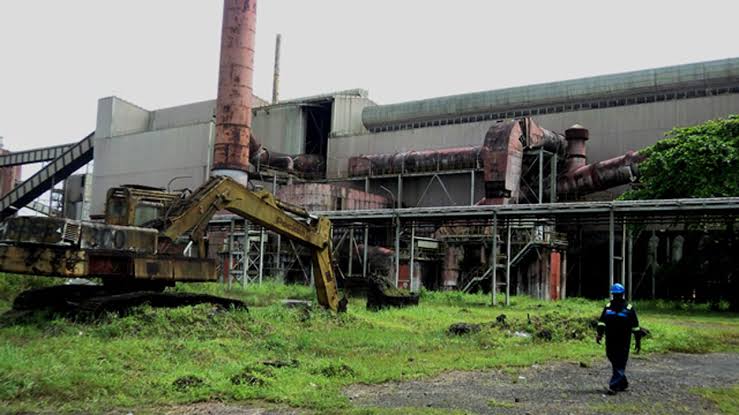
- As troubling and heartbreaking as the situation is, the Nigerian steel industry can still be revived. But the revival of such an important sector of our wobbling economy will require a government with the political will to do the right thing and also go after the vested interests who profit from our nation’s stagnation, and, some will say, destruction
Please make no mistake about it, steel is a veritable cornerstone and key driver for the world’s economy. The industry employs more than three million people directly worldwide. In addition to two million contractors, plus four million people in support industries like construction, transport and energy.
Steel is also known as the core of the green economy, meaning that renewable energy sources like solar, wind and tidal, all depend on steel. The element touches every aspect of human life and activity.
China is the world’s leading producer/exporter of steel. In 2024, it produced approximately 1,005.1 million metric tons of crude steel, accounting for about 54% of global production. This makes it the largest producer by a considerable margin. India came in second, and Japan, the U.S., Russia and South Korea followed in that order. South Africa, Africa’s ranking steel producer, with a yearly average of 4.7 million tons, is the world’s twenty-ninth.
President Shehu Shagari’s second republic, had in its wisdom, invested heavily in the steel sector, when the Delta Steel Company, Aladja, Katsina Steel Rolling Mill, Katsina, Jos Steel Rolling Mill, Jos, Ajaokuta Steel Complex, Ajaokuta and Oshogbo Steel Rolling Mill, Osogbo; were commissioned with pomp, and why not. Add to this the National Iron Ore Mining Company at Itakpe, Kogi State and the stage was set for an industrial revolution never before seen in this part of the world.
Lamentably, the so-called Nigerian factor, another name for the twin-evil of corruption and vested interest, was unleashed on the gold mine. Today, this same country inexorably blessed by the Godhead, is shamelessly importing steel products from a country she could have been rubbing shoulders with. A staggering four billion dollars is what we expend on this avoidable and needless importation. When we say government is a continuum, we are simply inferring that succeeding administrations in a country would build on laid foundations and never uproot what had been planted. It is not only willful but wicked and evil.
Imagine a Nigeria that imports six million tons of steel and allied products every calendar year when she has the raw material in confounding quanta. Ajaokuta has gulped seven billion dollars when a mere one billion dollars was required to complete it before its criminal abandonment. The other four were supposedly privatized with little or no effect.
No nation can fully industrialise, attain the height of its economic potential and build a thriving and prosperous nation without having an independent and buoyant steel industry that guarantees sufficiency in local steel production. The President Bola Tinubu-led administration has talked a good game about building a one trillion dollar economy, but beyond the rehashed economic talking points and regurgitated promises of building a prosperous nation, there is no clear sign of how he intends to achieve this. There is no actionable policy framework to revive the steel industry and no conscious effort to address the infrastructural deficit that has now become a stumbling block to trade and ease of doing business in the country. His macroeconomic policies have also tanked the economy.
Today, Nigeria dreams big, to the point of wanting to produce vehicles. This is never a bad thing, but you have to wake into consciousness to actualize your dream, beyond winning elections. Our sole dependence on receipts from oil sales would have made much more economic sense if rent-seekers and powerful interest blocs had been let go.
As troubling and heartbreaking as the situation is, the Nigerian steel industry can still be revived. But the revival of such an important sector of our wobbling economy will require a government with the political will to do the right thing and also go after the vested interests who profit from our nation’s stagnation, and, some will say, destruction
As the former president of the United States, Theodore Roosevelt, said, “In any situation, the best thing you can do is the right thing, the next best thing you can do is the wrong thing; the worst thing you can do is nothing”