


- Ijaw group insists derivation funds have not translated into visible infrastructure in Edo, Delta, Ondo, and other Ijaw areas.
- Oil Rivers state will include Isaka Town as capital, hosting over 30 oil fields and vast marine economic potential.
The Ijaw National Congress (INC) has demanded the creation of two new states as part of Nigeria’s ongoing constitution review process.
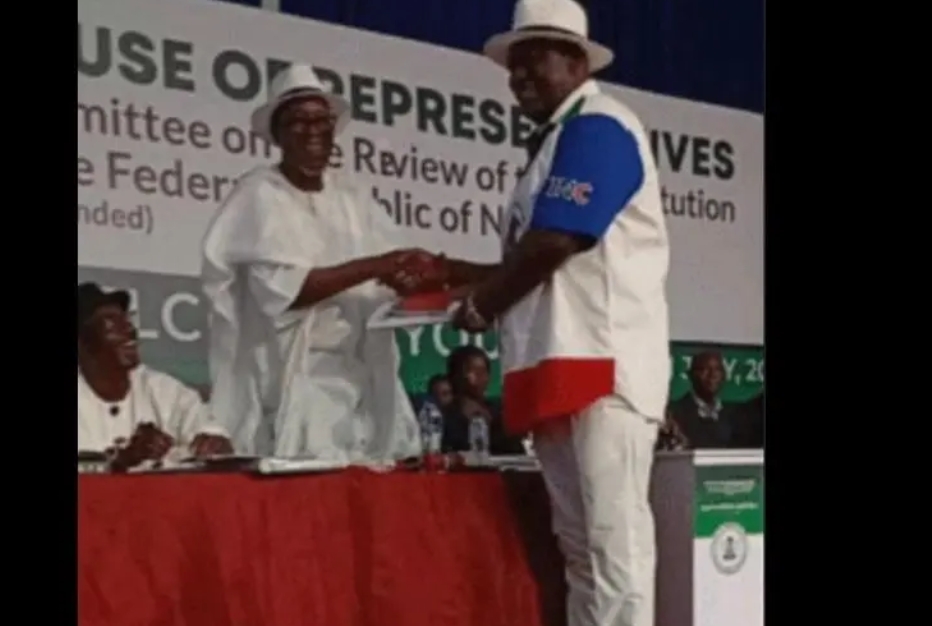
President-general of the congress, Prof Benjamin Okaba, presented the request in a memorandum during the constitution review hearing for the south-south zone at the national assembly.
He explained that the push for Toru-Ebe state was rooted in the Ijaw people’s demand for justice, peace, self-determination, and regional development.
“We reaffirm our demand for the creation of two additional homogeneous Ijaw states — Toru-Ebe, comprising Ijaws in Delta, Edo, and Ondo; and Oil Rivers, made up of Ijaws in Rivers and Akwa Ibom,” he said.
“The territorial configuration of the proposed Toru-Ebe state includes only Ijaw clans in the present Delta, Edo, and Ondo states.”
“These distinct yet culturally homogeneous clans of the Ijaw ethnic nationality — customary owners of all the land, living in a geographically contiguous territory of their own — have been deliberately balkanised into different political and administrative units in the country. They are the ones demanding the creation of the proposed state.”
Prof Okaba lamented that despite their huge contribution to Nigeria’s oil revenue, Ijaw communities were still grappling with underdevelopment.
He said the 13 per cent derivation funds being collected by host states had not been utilised for the benefit of Ijaw communities.
“Modern infrastructure and social services such as schools, hospitals, and potable water are almost non-existent in Ijaw communities, especially in Edo,” he said.
“Due to this fragmentation, it has become impossible for an Ijaw person in Edo to even become a ward councillor.”
He added that the continued marginalisation had triggered migration and loss of cultural identity among the people.
Okaba said the proposed Toru-Ebe state had a population of about 2.7 million and possessed enormous natural and economic resources.
“We also propose Oil Rivers state, comprising Ijaws in Rivers and Akwa Ibom,” he said.
“This area remains the most naturally blessed but environmentally degraded in the entire world, with massive oil spills and gas flaring threatening the very survival of the people.”
“Just like our counterparts in Edo, the Ijaws — especially in Akwa Ibom — are left with no basic infrastructure, electricity, or healthcare services.”
“There is no meaningful state or federal government infrastructure in these Ijaw communities.”
“Due to the long period of fragmentation, many Ijaw communities face cultural extinction, with some losing their native language and traditions.”
“With the creation of Oil Rivers state, the rich heritage and environment of our people can be resuscitated.”
“The proposed Oil Rivers state — with Isaka Town, located in the northern part of Okrika local government area, as its capital — is endowed with abundant natural and human resources, such as vast mangrove forests, rich fishery and agricultural potentials, a palm oil industry, tourism opportunities, natural harbours, and oil and gas reserves, with over 30 major oil and gas fields, making it economically viable.”
Okaba also decried the underrepresentation of Bayelsa in Nigeria’s federal structure.
He said the state had just eight local government areas despite being a major contributor to the country’s oil production.
“In terms of GDP, the state’s contribution stands at $4.3 billion, with a GDP per capita of $1,773, according to 2020 rankings,” Okaba said.
“The state’s economy is largely driven by the petroleum industry, with crude oil and natural gas as major contributors.”
“The state, therefore, has a critical role in the actualisation of Mr President’s projection to meet the OPEC quota of 2.06 million barrels per day.”
“We also propose an additional 33 local government areas for Bayelsa, which currently has just eight.”
“We all know that eight LGAs for Bayelsa is an injustice in many ramifications — in terms of federal resource allocation and fair representation.”
“Our other concerns include the protection and remediation of our environment, equitable federal resource contribution through resource control and tax payments, and a truly federal constitution without a unitary character.”
“We also want the reintegration of Ijaws through the wholesale prosecution of the Ijaw struggle for self-determination, which has lasted centuries.”
The Ijaw leader also proposed a constitutional amendment to replace the current six-zone structure with 10 federating regional units.
He recommended the restructuring of Nigeria’s geopolitical layout under Section 3(1) of the 1999 Constitution.
Meanwhile, the constitution review committee of the house of representatives said it had received 46 requests for state creation.
It added that 117 proposals for new local government areas had also been submitted by different interest groups across the country.