


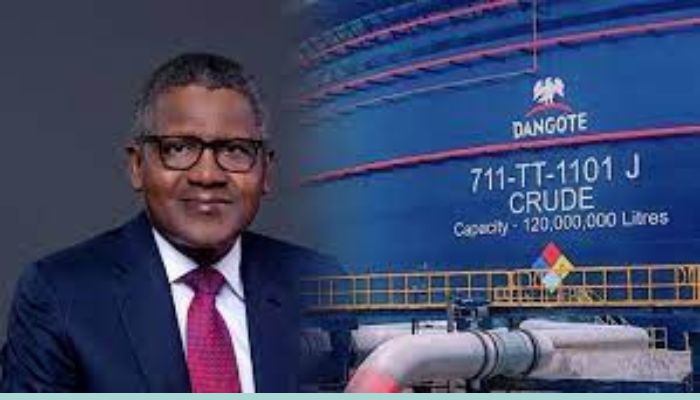
- He charges African leaders to summon the political will and tackle the critical challenges facing the continent’s refining capacity
Billionaire industrialist and President of the Dangote Group, Alhaji Aliko Dangote, has called on leaders and politicians in Africa to tackle the endemic destructive vested interests in the petroleum sector
This is even as he said the activities and actions of these rent-seeking interests are mitigating against the construction of a new large-scale refinery project that may ever be built in Africa.
He charges African leaders to summon the political will and tackle the critical challenges facing the continent’s refining capacity and to root out the vested interests that have turned the continent into an enclave of substandard petroleum products.
The African wealthiest Businessman sounded the warning note on Tuesday at the Global Commodity Insights Conference on West Africa’s refined fuel market, jointly organised by the NMDPRA and S&P Global Commodity Insights in Abuja.
He spoke during his presentation titled, “Building an African Refinery Hub: Prospects and Challenges”.
Dangote particularly mentioned the Lomé Floating Storage Terminal, a vast offshore oil depot situated just off the coast of Togo, as a major threat to Africa’s crude oil refining independence.
According to him, the terminal with a storage capacity of over two million tonnes of petroleum products at any given time serves as a strategic dumping ground for imported fuel, controlled almost exclusively by powerful international trading firms.
He asserted that these floating storage hubs have become the primary source of fuel supply to much of West and Central Africa, not because of efficiency or price competitiveness, but due to the continent’s acute lack of refining infrastructure.
Dangote said, “Let me speak to the third and perhaps the most complex category of contextual challenges. Beyond infrastructure deficits, the most formidable challenge we face is entrenched in rent-seeking within the petroleum value chain across many African countries. This sector has historically been a major avenue for corruption and rent-seeking.
“When you build a factory and disrupt that system, you are not just invading, you are actually going against powerful interests that will seriously fight back aggressively. Another major barrier is the floating storage terminal off Lomé, Togo, a uniquely African phenomenon. International traders maintain a floating fleet of over 2 million tonnes of petroleum products, just offshore.
“This would later be sold at inflated prices, given the lack of local refinery capacity. But immediately, the Dangote refinery became operational, and they started driving down prices. But make no mistake, those who profit from this system will do everything they can to prevent other refineries from emerging.
“The whole essence of the Lome floating market is to ensure that no refinery operates in sub-Saharan Africa. In fact, I don’t see any new major refinery project succeeding in the existing offshore domain market. The obstacle must be dismantled through policy alignment, regional cooperation and above all strong political will.”
He insisted that unless governments across Africa take collective action to break the monopoly of this terminal and prioritise domestic refining, the region will remain hostage to foreign supply chains that profit at Africa’s expense.
“Without political support, there is no way for any new large refinery to be built in our lifetime. What I would say is that if that support is not there, we will not. The entire people who are here with us, none of us will see a new refinery being built in our lifetime.
Speaking further, Dangote painted a grim picture of the hurdles his $20bn refinery in Lekki had to overcome and warned that other investors may never succeed unless decisive reforms are implemented.
“Let me be blunt: if strong political will is not mustered, nobody in this room, myself included, will live to see another major refinery built in sub-Saharan Africa,” Dangote said.
He identified corruption, rent-seeking, and sabotage by international oil traders as some of the most dangerous obstacles facing refinery development on the continent.
“This sector has historically been a breeding ground for corruption and rent-seeking. When you build a refinery, you are disrupting powerful vested interests who thrive on Africa’s dependence on imported fuel,” he said.