


- Nigeria’s FDI plunged 70% in Q1 2025, with most inflows diverted into speculative ventures instead of industry.
- Manufacturing sector investment dropped by 32.1%, reflecting weakening industrial capacity and job creation prospects.
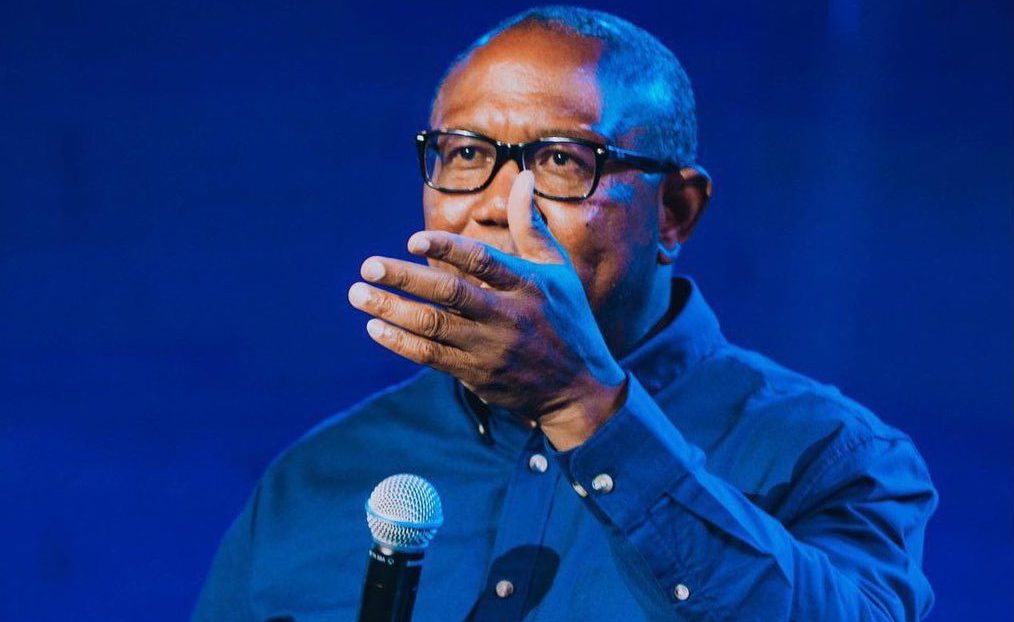
The Labour Party presidential candidate in the 2023 election, Peter Obi, has taken a swipe at President Bola Tinubu’s economic management, citing fresh statistics.
Obi warned that poor leadership and weak governance were choking the country’s ability to attract sustainable foreign investment.
His comment followed a claim by the director-general of the World Trade Organisation, Ngozi Okonjo-Iweala, that the nation’s economy had stabilised under Tinubu.
Okonjo-Iweala said the ongoing reforms under the current administration were “moving in the right direction.”
She spoke to State House correspondents on Thursday after paying a courtesy visit to the President.
But in a post on X on Friday, Obi stated: “FDI to Nigeria declines amidst unending global galivanting and uncoordinated reforms.
While the President, Ministers, and other government officials continue their global galivanting in search of FDI, our poor performance in key governance indicators, such as rule of law, regulatory quality, government effectiveness, and voice and accountability, continues to prove that you cannot attract sustainable foreign investment with poor leadership and governance.”
Citing data from the National Bureau of Statistics, Obi noted that Foreign Direct Investment into Nigeria plunged by about 70% in the first quarter of 2025, dropping to $126.29 million from $421.8 million in the last quarter of 2024.
He pointed out that of the $5.64 billion total capital importation in Q1 2025, FDI accounted for just 2.24%, compared to 8.2% in Q4 2024.
“Disturbingly, about 90% of the imported capital went into speculative money market instruments,”
Obi said. “With such a high proportion of capital importation flowing into speculative investments, the impact on industrial growth or job creation is highly insignificant and elusive, given the ease with which such ‘hot money’ can exit the economy.”
He revealed that inflows to the manufacturing sector declined by 32.1%, falling to $129.92 million in Q1 2025 from $191.92 million in the same quarter of 2023.
“In 2024, while global FDI flows declined, FDI to Africa significantly increased to $97 billion—a rise of about 75% compared to 2023,” Obi said.
“Egypt attracted the highest share in Africa, with $46.58 billion.
Other top recipients included Ethiopia ($3.98 billion), Côte d’Ivoire ($3.80 billion), Mozambique ($3.55 billion), Uganda ($3.30 billion), Democratic Republic of Congo ($3.11 billion), South Africa ($2.47 billion), Namibia ($2.06 billion), Senegal ($2.02 billion), Guinea ($1.83 billion), and Morocco ($1.64 billion).”
Obi lamented that Nigeria secured only $1.08 billion in 2024, barely 1% of Africa’s total, representing a 42% drop from the previous year.
“Worse still, after this 42% drop between 2023 and 2024, FDI to Nigeria has further declined by 75% between Q4 2024 and Q1 2025,” he added.
“We cannot achieve sustainable growth and development with ineffective leadership and a weak government,” Obi said.