


- National grid achieved 41% plant availability factor in July, generating average 4,340 MWh per hour from 5,577 MW available capacity
- Top performers included Egbin at 665 MWh/hour and Kainji at 98% load factor, while Afam 1 and Alaoji recorded zero availability
Nigeria’s national power grid improved its operational performance in July 2025, increasing its plant availability factor by 2% over the previous month.
Data from the Nigerian Electricity Regulatory Commission (NERC) were shared by the Nigeria National Grid on its official X handle on Saturday, revealing important insights into the country’s power sector.

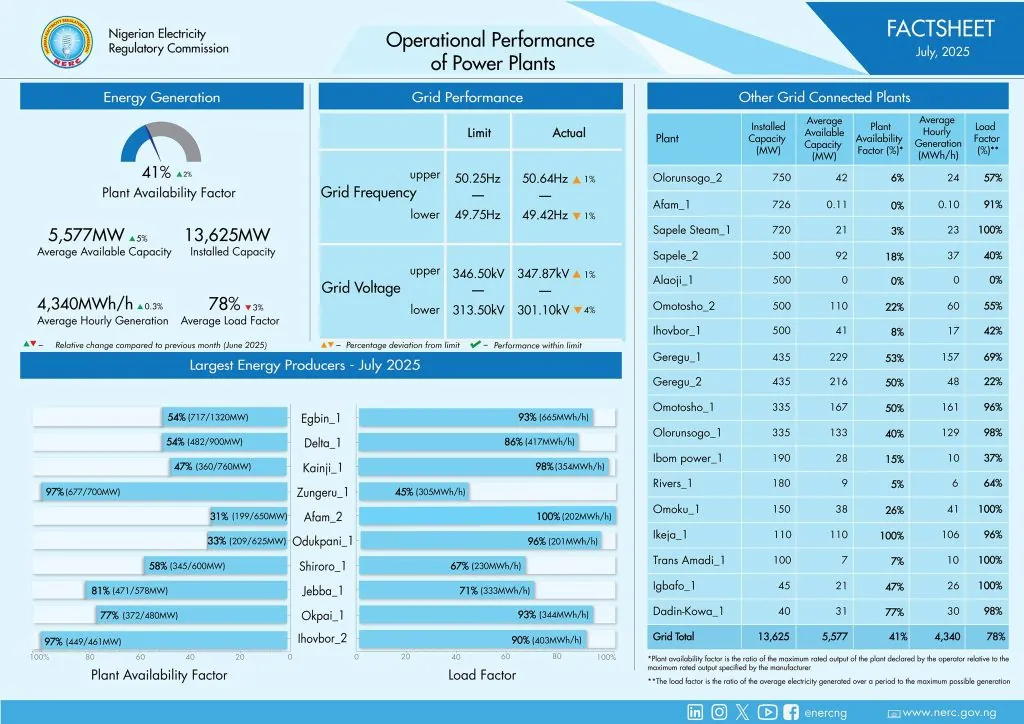
According to the report, Nigeria’s power grid, which has a total installed capacity of 13,625 MW, had an average available capacity of only 5,577 MW in July, indicating a 41% plant availability factor.
This was a 2% increase over the figures from June 2025. The average generation increased by 0.3% to 4,340 MWh per hour, while the average load factor fell by 3% to 78%.
The report emphasized the contributions of several major power plants. The largest contributors to energy generation were Egbin, which averaged 665 MWh per hour with a load factor of 93%.
Delta contributed 417 MWh per hour at an 86% load factor. Kainji recorded 354 MWh per hour with an impressive 98% load factor. Okpai generated 344 MWh per hour at a 93% load factor, while Ihovbor 2 added 403 MWh per hour at a 90% load factor.
Despite these positive contributions, the report also exposed significant underperformance. Afam 1, with a 726 MW installed capacity, and Alaoji 1 both recorded 0% availability for the entire month of July. Similarly, Sapele Steam 1, with a 720 MW capacity, managed only a 3% availability.
The NERC factsheet also noted that the grid’s stability continued to be a concern. The frequency operated outside the set limits of 49.75 Hz and 50.25 Hz, while the voltage also breached its acceptable range, with a high of 347.87 kV (1% above the limit) and a low of 301.10 kV (4% below the limit).