


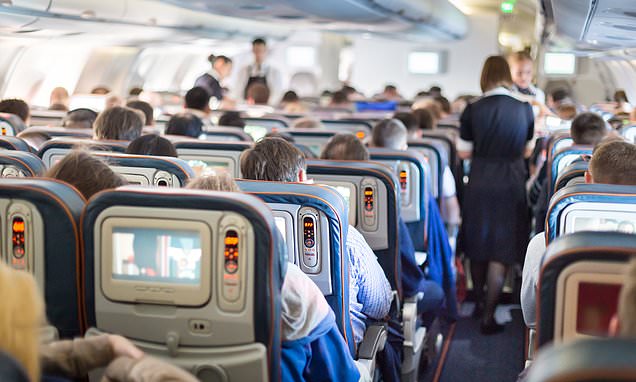
The aisle was already crowded when the argument began. Cabin crew on an Ibom Air evening service from Uyo to Abuja tried to calm a passenger who insisted she wouldn’t fly without her checked luggage. Voices rose, phones came out. The aircraft never left the stand.
By the time the standoff ended on January 8, scores of other passengers had missed appointments, onward connections, even school runs, and the airline had scrapped the flight entirely.

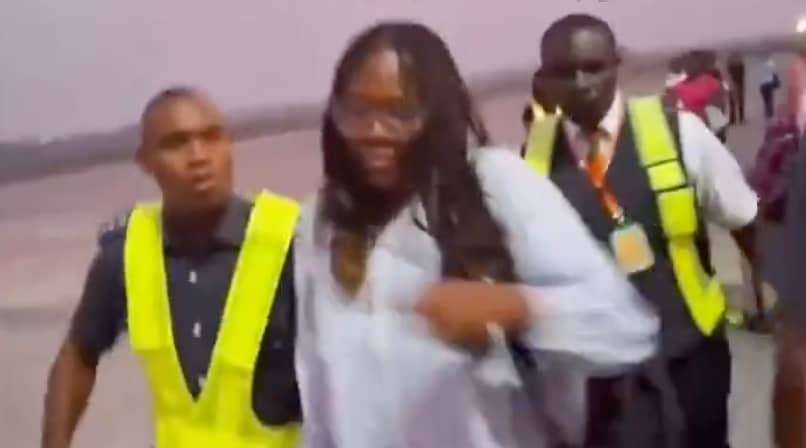
In the days that followed, the video spread, the airline briefed its lawyers, and regulators promised consequences.
If the Uyo episode looked like an aberration, the months that followed suggested a pattern. In February, three passengers on an Air Peace London–Lagos run were arrested in Lagos for disruptive conduct and later arraigned.
In June, a different scene played out on the domestic side of Murtala Muhammed: Senator Adams Oshiomhole, having missed a departure, ended up in a heated confrontation at the terminal.

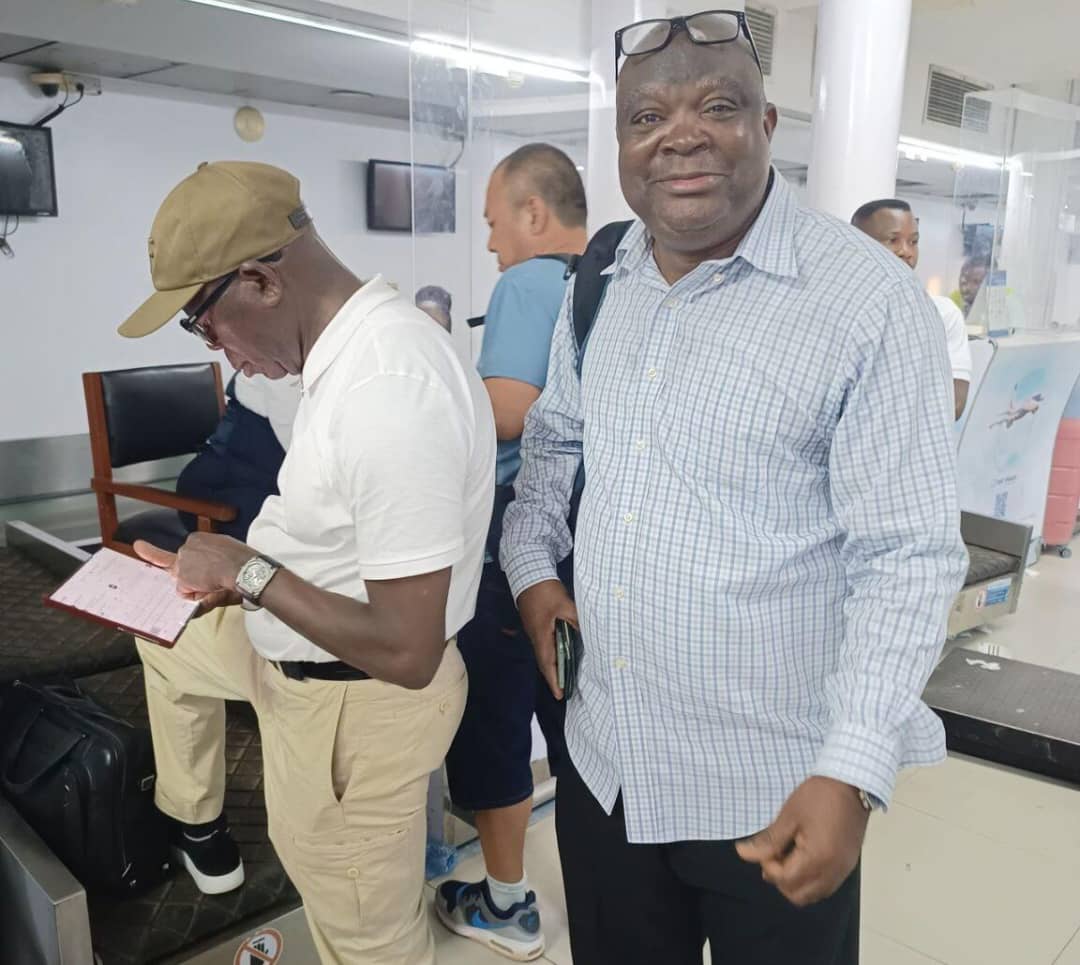
The lawmaker was addressing some airport officials over his missed Air Peace flight from Lagos to Abuja.
In a statement explaining the situation, the airline accused Oshiomhole of assaulting its staff and forcefully barricading the terminal’s entrance.
The Airline Operators of Nigeria (AON) called the conduct “unacceptable,” while the carrier publicly condemned “unruly” behaviour and the aviation minister ordered an investigation.
The dust had settled on the skirmish with Oshiomhole, but it wouldn’t be for long.

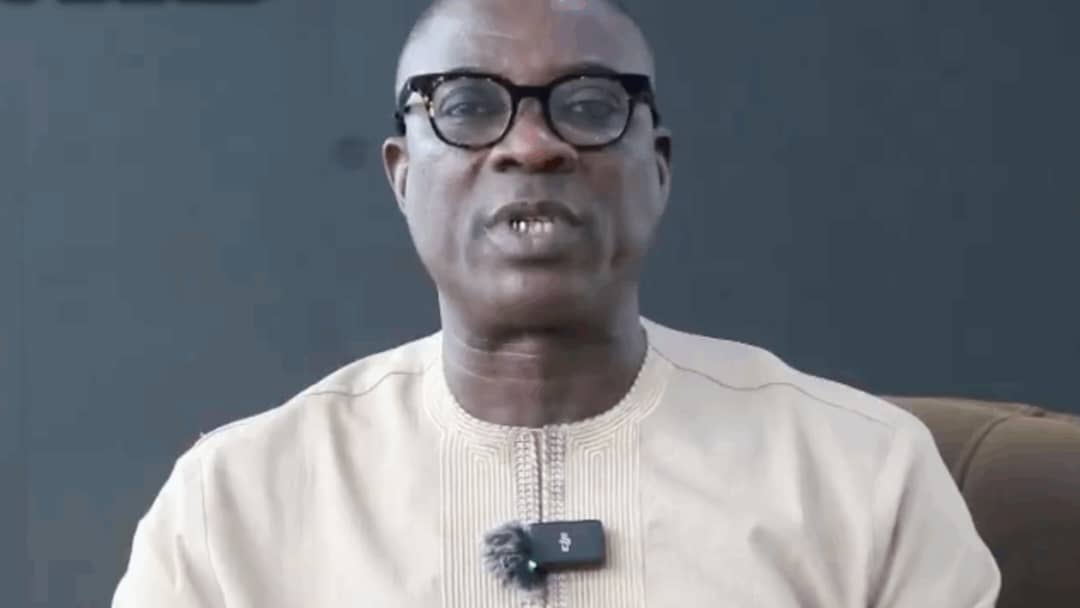
Fuji maestro, Wasiu Ayinde, better known as KWAM1, has been placed on a no-fly list by the Nigerian Civil Aviation Authority (NCAA).
The sanction followed an incident at the domestic terminal of the Nnamdi Azikiwe International Airport, Abuja, on August 5.
The musician was accused of obstructing a ValueJet aircraft from taxiing after a confrontation with the airline’s crew.
According to ValueJet, Ayinde allegedly spilled a liquid substance, suspected to be alcohol, on a staff member who approached him.
Viral videos captured Ayinde in a heated argument with airport officials before standing in front of the aircraft.
The aircraft swerved during the confrontation, forcing Ayinde and some airport personnel to scramble for safety as the wings rolled past.
Ayinde, however, denied the allegation, insisting that the content of his bottle was water prescribed by his doctor.
He explained that he carries the bottle at all times as part of treatment for dehydration.
In response, the NCAA suspended the licences of two ValueJet pilots for breaching aviation safety protocol.
It also barred Ayinde from flying for six months, warning that his behaviour endangered aviation operations.
The agency later announced that his ban would remain indefinite until investigations into the incident are concluded.
NCAA further stated that actions like Ayinde’s could be treated as terrorism offences in some countries.
Then, on August 10, another Ibom Air flight, inbound to Lagos from Uyo, reported assaults on crew and security staff by a female passenger, prompting a fresh regulatory warning that enforcement would “become more frequent.”


Each incident brought familiar fallout: delayed flights, shaken staff, and mounting frustration among travellers who hadn’t done anything wrong.
Seen together, these episodes have pushed a once-occasional aviation nuisance into the centre of a public conversation about rules, accountability and safety at Nigerian airports.
The NCAA has been unusually blunt in its recent responses, saying unruly conduct has become “rampant,” warning that passengers must obey crew instructions on board, and reiterating that safety rules are “not sentiment-based.”
The Federal Airports Authority of Nigeria (FAAN) added its own advisory last week, citing “recurring incidents” and urging calm compliance at checkpoints, gates and boarding.
What these moments look like up close varies. In Uyo, it was an aisle blockade and a sunset flight that timed out. In Lagos, it was a high-profile argument at a gate.
On the London–Lagos service, it was a security-led disembarkation at the end of a long-haul trip.
But the common mechanics are straightforward: a trigger (a missed flight, a baggage worry, a denied request, a device not switched off), a refusal to follow instructions, and then a spiral—crew step in, security is called, other passengers wait, schedules unravel, and the operational clock starts working against everyone in a system already tight on slots, daylight windows and aircraft utilisation.
Behind the scenes, the costs to airlines and airports are concrete. A single disruption can cascade through rosters and rotations; a cancellation means reaccommodation, refreshments, sometimes hotel bills and ground transport, and often reputational damage amplified by viral clips.
Fact-checkers who retraced the January video’s timeline noted dozens stranded and tangible rescheduling costs—a reminder that air rage is not only a social media spectacle but a balance-sheet item.
There is also a human toll. Front-line staff—check-in agents, gate teams, cabin crew—absorb the first wave of anger and, in some cases, physical risk.
That is why industry bodies have foregrounded worker protection in their responses. AON’s public statements after the June confrontation were framed not just as a defence of procedures but as solidarity with staff who bear the brunt of deteriorating behaviour.
The NCAA’s communiqués likewise stress that aviation safety depends on undisputed crew authority at critical moments—doors closed, taxi, take-off, landing.
To understand how we got here, it helps to trace the past year in policy. In late December 2024, the NCAA convened operators and airport authorities in Lagos to address a spike in disruptions and agreed to deploy mobile courts at airports—swift, on-site adjudication meant to deter misconduct and avoid protracted impunity.
The plan went public the following week and has since been cited in follow-up briefings as the agency links enforcement credibility to real-time consequences.
That same communique emphasised faster AVSEC response and joint sensitisation campaigns by NCAA and FAAN.
This regulatory track sits alongside a legal background. Nigeria has, in recent years, moved to align more closely with international frameworks for dealing with unruly passengers, a point raised repeatedly in local coverage that contrasted ratification timelines with the apparent rise in incidents.
The tension is familiar to many jurisdictions: laws and protocols expand formal jurisdiction and penalties, but deterrence still depends on consistent, visible application.
What’s changed on the ground is less law than attention. Smartphones have made small rebellions against procedure instantly visible, and the presence of celebrities and politicians magnifies that visibility.
A recent synthesis—“from a passenger blocking an aisle to a senator staging a sit-in”—captured the arc of a news cycle that now treats airport friction as a public moment rather than a private annoyance.
Regulators and airlines have adjusted, issuing more frequent, more detailed statements that name behaviours (refusing to switch off devices, obstructing crew, assaulting staff) and signal next steps (referrals to police, prosecutions, internal bans).
Yet amid the headlines, some people almost vanish from the story. Regular travellers—families, students, professionals connecting to regional flights—often appear only as background: the waiting, the sighing, the missed obligations.
Their losses are diffuse and therefore less visible: a meeting that didn’t happen, a non-refundable ticket forfeited, a childcare scramble.
Industry statements increasingly point to those collateral costs when explaining why zero tolerance is not just rhetoric but a duty of care to the silent majority on board.
Airlines, for their part, have begun to detail their own operational responses. After the January cancellation, Ibom Air said it would pursue legal action; after the August incident, it published a timeline and emphasised crew safety.
Air Peace, following the February arrests and the June confrontation, publicised its referrals to authorities and its internal protocols for de-escalation, while underlining that enforcement is ultimately a state function.
These are not just press tactics; they are also meant to buttress the next legal step—documented facts, named offences, preserved video, witness logs.
Is it a trend? Authorities now say so explicitly.
The NCAA calls the behaviour “rampant,” the AON says carriers are experiencing a rise in “unruly passenger behaviour,” and airport managers have issued serial advisories.
Media monitoring shows the phrase “air rage” appearing more frequently in headlines since the start of 2025, a shorthand reflecting both frequency and public salience.
In court, too, there is a drumbeat: the London–Lagos trio were arraigned in February, and the case has moved through adjournments—slow, but moving.
If the system is to bend the curve, aviation officials argue, two things matter most: swift, even-handed penalties and clearer passenger education.
The first is why mobile courts are on the table; the second is why FAAN and the NCAA have promised joint campaigns that translate the technical bluntness of safety rules into plain, anticipatory guidance—what to expect when a flight is delayed, why phones must be off during take-off, how baggage irregularities are handled, when to ask for volunteers, what rights passengers have and where they stop.