


-
However, from the turbulent colonial times to the heady periods of self-governance, the progress made in the nation’s railway transport sector has been perennially plagued by one problem: derailment
.
Railway transport in Nigeria is one of the oldest forms of transport in the country. It’s as old as the country itself. From aggressive and comprehensive construction of railways across the vast largely uninhabited terrain by the British colonial masters in the late 19th century — mainly to move extracted raw materials from the perilous hinterlands to the coast for onward shipment to England — to the expansion of the railway networks for commerce and humans movement in the early years of independence to the revamping of the railway sector by successive administration at the turn of the century which also incidentally ushered in the fourth republic, the Nigerian railway transport sector has undergone a plethora changes and transformation.
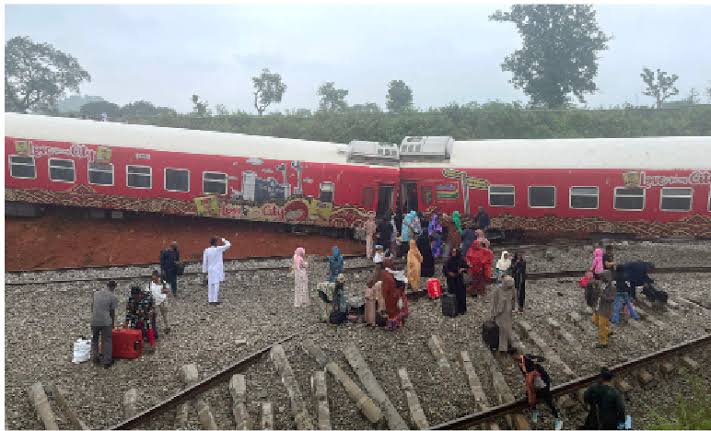
However, from the turbulent colonial times to the heady periods of self-governance, the progress made in the nation’s railway transport sector has been perennially plagued by one problem: derailment. On Tuesday, Nigerians were inundated with reports of another train accident. The train derailment happened along the Abuja–Kaduna rail line, one of the busiest rail corridors in the country.
What we know so far
According to reports, the train derailed at about 11.09 at KM 49, between Kubwa and Asham stations along the Abuja–Kaduna rail line.
What authorities are saying.
Authorities disclosed that six passengers were injured in the mishap. According to a statement signed by Bimbo Olawumi Oladeji, the spokesperson for the Nigerian Safety Investigation Bureau (NSIB), a team of investigators had been deployed to the site to gather evidence, interact with stakeholders, and initiate a comprehensive investigation into the derailment.
The Director-General of NSIB, Captain Alex Badeh, also sympathised with the victims, assuring that the cause of the derailment would be thoroughly investigated.
“We deeply sympathise with all who sustained injuries. The Bureau has deployed investigators to the site to ensure the root cause of this derailment is uncovered. Our commitment is to ensure safer rail transport for Nigerians through a transparent and independent investigation,” Badeh said.
However, while authorities are claiming that no fatality was recorded during the incident, a passenger on board the ill-fated train disclosed that one person actually died in the accident. “One person died on the train. The one who died was in the toilet when it happened,” Sahara Reporter quoted an Eyewitness as saying.
Managing Director of the Nigerian Railway Corporation, Kayode Opeifa, described the derailment as the worst that the corporation has seen, as the damage caused to the entire railway infrastructure along the axis where the mishap happened is quite monumental.
Speaking on Channels Television’s morning brief on Wednesday, he took responsibility for the accident, adding that the injured were taken to the hospital and four of them have been discharged after receiving treatment while two are still receiving medical care due to the severity of their injury. He stated that the train operation will resume on the Abuja-Kaduna rail line in thirty days.
A cursory look at some previous train derailments in Nigeria.
While derailments and train accidents are not peculiar to Nigeria, the frequency with which they happen here is concerning. In the last six years, the nation has recorded 188th train derailments, threatening the ambitious rail modernisation drive and raising questions about the safety and security of the over $7 billion project.
On June 12, 2024, a train heading to Kaduna from Abuja derailed. The mishap came a week after, on June 5, 2024, the train skidded off the rails at Asham station in the Federal Capital Territory (FCT), just less than an hour after it departed from the Kubwa station.
On May 26, 2024, an Abuja-bound train departed Rigasa station in Kaduna and derailed around a hilly enclave near Jere. Three coaches reportedly veered off tracks, but there were no casualties.
The NRC on March 28, 2023, halted the Abuja-Kaduna rail line operations due to an attack on the trains during an evening trip. At least eight people died and over 60 passengers were abducted during the attack.
At least one person lost his life and hundreds of passengers escaped death on January 10, 2019, when a mass transit train derailed in the early hours at the Ashade railway crossing on the Agege-Ikeja corridor in Lagos.
Way forward.
While it is easy and tempting to attribute these unfortunate and tragic incidents to sabotage and vandalism, one must not also lose sight of other underlying issues, like maintenance, inspection and monitoring, that the authorities are either treating with scant regard or have totally abandoned.
For instance, the recent derailment has been attributed largely to dereliction of duty and negligence on the part of the appropriate and concerned authorities and government officials.
“The Abuja–Kaduna train that derailed today is a direct result of negligence. For months, passengers have complained about the wobbling tracks but were ignored,” former Kaduna Senator, Shehu Sani said.
In light of the latest derailment, calls for investment in highly fortified barricades, CCTV, and patrols along vulnerable and attack-prone sections have intensified, with some commuters stating that the mishaps were both predictable and preventable.
Managing Director of Jeerea Rail Nigeria, James Akpoviroro, insisted that railways were not like roads, where repairs could be done once in a while.
According to him, railway maintenance has to be done every day. He stated that tracks should be monitored from time to time and patrolled every seventy-two hours, divided into sections with staff on shifts around the clock. Every fault must be documented and rectified quickly, he explained, but instead, he attributed cases of coaches’ detachment while moving to a lack of proper maintenance.
Also speaking on the matter, the President of the Nigerian Economic Society, Professor Adeola Adenikinju, highlighted the importance of deploying technology to tackle the security challenges that contribute significantly to these train mishaps.
He opined that drones and aerial surveillance could be used to monitor tracks in real time as is done with oil pipelines. He noted that depending only on security operatives will never be enough owing to the large terrain.
The railway transport is very critical to the growth of our economy and opening up the nation, but for us to experience the growth and development that come with the railway modernisation drive, we must address the challenges that matter. Constant derailments of trains erode the confidence of Nigerians in using them, which then defeats the purpose of having them in the first place. For us to reap the benefits of our investments in our railway, top-notch security and adequate maintenance must become a second nature.