


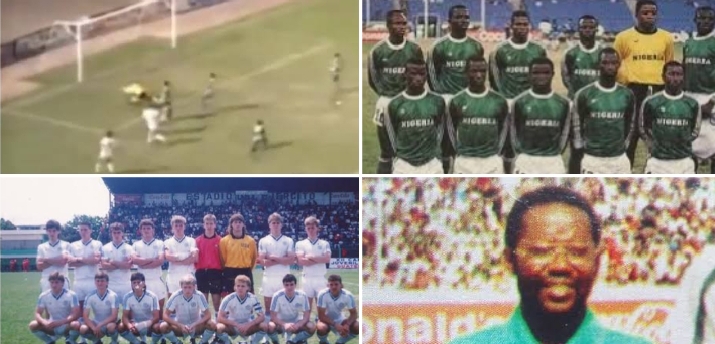
On a February night in 1989, the city of Dammam exhaled a silence that felt almost unnatural. The desert sky hung low, the floodlights over the Prince Mohamed bin Fahd Stadium burned too white, and the restless murmur of a crowd carried a tension that no one could quite name. It was supposed to be a game—ninety minutes of youth football—but the air suggested something else.
The Saudi night was crisp, the floodlights carved harsh shadows, and the Flying Eagles of Nigeria were staring into the abyss.
They had come to the quarterfinals of the FIFA World Youth Championship, a stage Nigeria had never dared to imagine reaching with such audacity.
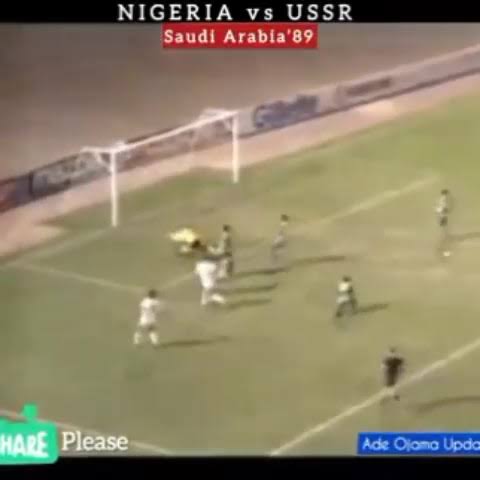
And by the 46th minute, the score read Nigeria 0 – USSR 4.
The silence from Nigerian fans in the stands was so heavy it seemed to suffocate the stadium. The Soviets smirked, exchanged high-fives, and gestured casually as if rehearsing a coronation.
But then, from the embers of humiliation, something flickered. Four goals in 24 minutes. A penalty shootout. A ‘Dammam’ miracle.
In that arena by the Gulf, a story was written that Nigerians would never stop retelling. It would become folklore, memory, and burden all at once. For some, it was proof of destiny. For others, it was the beginning of a curse.

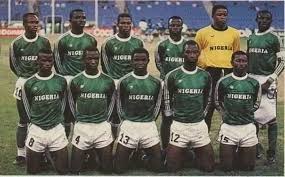
Nigeria Before the Miracle
To understand why the Dammam Miracle carries such mythical weight, we must return to Nigeria in the late 1980s.
The country was under the rule of General Ibrahim Babangida, a military leader whose regime balanced economic hardship with elaborate public shows of nationalism. Football, as always in Nigeria, was more than sport—it was the one unifying language across ethnic and regional divides. Victories on the pitch soothed political fractures, while defeats often mirrored national frustrations.
Nigeria’s senior team, the Green Eagles, had experienced sporadic continental success, most notably the 1980 African Cup of Nations triumph on home soil. But at youth level, Nigeria was still finding its feet. The Flying Eagles had qualified for the FIFA U-20 World Cup (then called the World Youth Championship) in 1983 and 1985 but had not gone beyond the quarterfinals.
The 1989 squad, however, brimmed with promise. Players like Nduka Ugbade, already famous for captaining Nigeria’s victorious U-17 team at the 1985 Kodak U-17 World Cup, carried the aura of pioneers. Names like Christopher Ohenhen, Oladimeji Lawal, Mutiu Adepoju, and Samuel Elijah symbolized a new generation eager to etch their names in Nigerian football folklore.
Their coach, Tunde Disu, was a pragmatic tactician but also a man who believed in destiny. “Football is never just football,” he would later recall, hinting that the events of Dammam were fueled as much by faith as by fitness.

The Quarterfinal That Turned Into a Myth
The Soviet Union, coached with the cold precision characteristic of its sporting machinery, had already shown its strength in the group stage. They were powerful, fast, and ruthless in front of goal. Against Nigeria, they wasted no time in stamping their authority.
30th minute: Sergei Kiriakov struck, silencing the green-clad contingent of Nigerian fans.
38th minute: Kiriakov scored again, exploiting a defensive lapse.
45th minute: Bakhva Tedeev made it three.
46th minute: Oleg Salenko, who would later win the Golden Boot at the 1994 FIFA World Cup, added the fourth.
At 0–4, Nigerian players got tired. Goalkeeper Alloy Agu shouted in vain. Ugbade, the captain, tried to rally spirits, but despair had crept in. Even the Saudi crowd, largely neutral, sensed a slaughter.

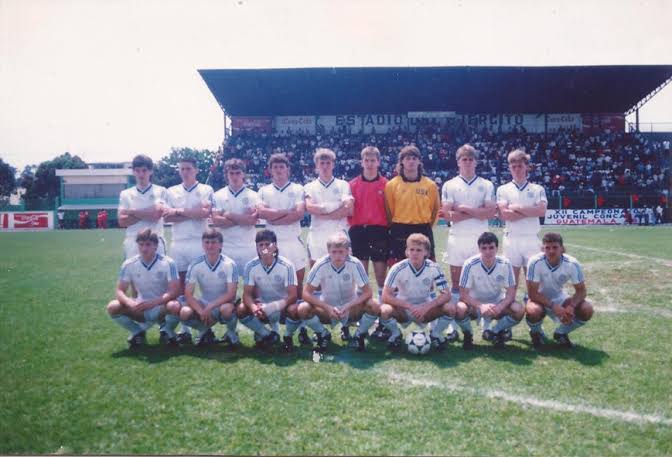
What happened next was not tactical genius alone—it was an eruption of willpower.
61st minute: Oladimeji Lawal scored. A flicker of hope.
75th minute: Christopher Ohenhen buried a chance. The Soviets began glancing nervously at the scoreboard.
83rd minute: Samuel Elijah, remembered today as “Sammy Goal,” thundered in Nigeria’s third. The stadium shook with disbelief.
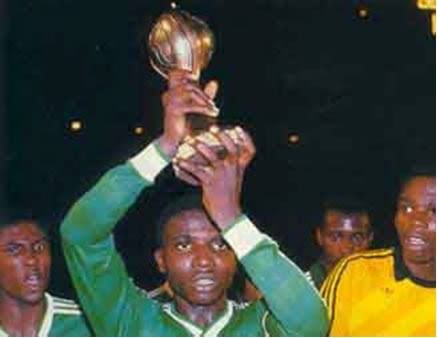
84th minute: Captain Nduka Ugbade equalized. The impossible had happened.
Fans wept. Commentators screamed. The Soviet players, who had been smirking minutes earlier, now stood pale and frozen.
The game went to penalties. Nigeria converted five. The Soviets faltered. Nigeria won 5–3.
The comeback was instantly christened the “Miracle of Dammam.” FIFA itself acknowledged it as one of the most dramatic matches in youth football history.

Nigeria Wakes to Glory
When the news broke back home, Nigeria erupted. Newspapers from Lagos to Kaduna ran banner headlines. Radios replayed the goals with breathless commentary. For a nation wearied by economic austerity and military decrees, the victory was more than sport—it was proof that Nigerians could snatch victory from the jaws of despair.
The Flying Eagles advanced to the semifinals against the United States, defeating them to reach the final against Portugal. Although they lost 2–0 in the final, the Dammam Miracle overshadowed the defeat. Nigeria had announced itself as a global football force.
Youngsters across the country replayed the story in schoolyards, pretending to be Elijah, Ohenhen, or Ugbade. For the first time, Nigerian youth football carried a mystical aura—the belief that no deficit was insurmountable.
The Curse of Dammam
But glory has its shadows.
The curse of Dammam is not superstition in the occult sense—it is the burden of impossible expectations.
1. Unfulfilled Careers
Several heroes of Dammam struggled to replicate their youth success at senior level. Christopher Ohenhen faded from global relevance. Samuel Elijah never became a household name in European football. Even Nduka Ugbade, though revered, never reached the global heights many predicted.
2. National Burden
Since 1989, Nigeria has reached the U-20 World Cup final four times—1989, 2005, 2009, and 2015. Each time, they lost. The memory of Dammam made every failure heavier. Fans and pundits spoke of a “curse”—Nigeria could perform miracles but never claim the ultimate prize.
3. Cultural Symbolism
The Dammam Miracle became a metaphor for Nigerian resilience: always fighting back, always refusing to die. But it also mirrored the nation’s cyclical disappointments: moments of brilliance overshadowed by systemic failures.


Coach Tunde Disu later revealed that a Saudi stranger had given him tapes of Soviet matches before the quarterfinal, urging him to believe Nigeria could win. For Disu, the victory was a mix of divine intervention, tactical insight, and sheer refusal to surrender. Yet even he admitted that the burden of that miracle haunted Nigerian football for years.
Echoes Through Time
The Dammam Miracle has never been forgotten, but it has often been misremembered. To some, it is only a footballing anecdote, a trivia question for FIFA quizzes. To Nigerians, however, it is a cultural memory—a night when destiny bent in their favor.
Yet the so-called curse persists:
- Nigeria dominates youth tournaments but often falters at the final hurdle.
- Great comebacks are celebrated, but sustained dominance eludes.
- Footballers shine early, then fade, leaving fans to wonder whether the miracle itself set standards no mortal could maintain.
The players themselves, now in their 50s, carry mixed feelings. Pride, yes. But also the weight of nostalgia for a night that defined their lives, even as it constrained them.
Conclusion: The Miracle and the Shadow
The “Miracle of Dammam” remains one of the greatest comebacks in the history of FIFA competitions—yet it is also a story of promise unfulfilled, of careers that crumbled under the weight of legend, and of a nation condemned to chase the ghost of that impossible night.
For Nigeria, the miracle was proof of resilience. The curse was the inability to live outside its shadow.
Perhaps that is the real story: in Dammam, Nigeria discovered both its greatest victory and its longest burden.
And so, every time the Flying Eagles step onto the pitch, the ghosts of Dammam hover, whispering: Miracles are possible—but are they repeatable?