



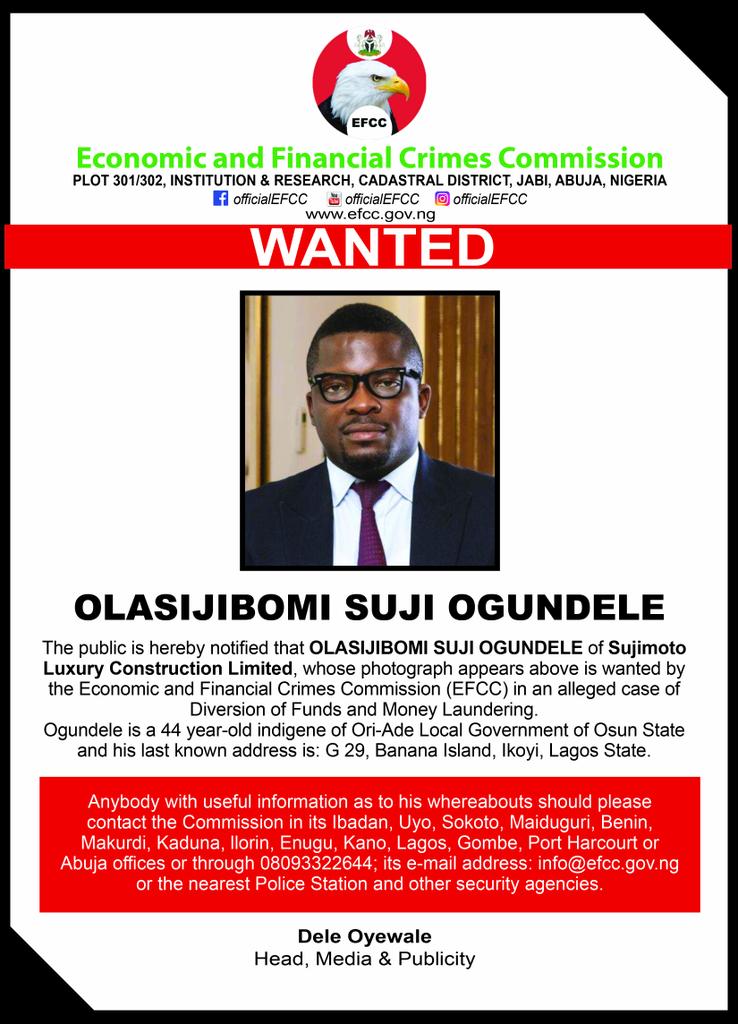
Nigeria’s foremost anti-graft agency, the Economic and Financial Crimes Commission, on Thursday declared Olasijibomi Síji Ogundele, the CEO of Sujimoto, a popular luxury real estate company in Nigeria, wanted for alleged fraud and money laundering. The real estate industry in Nigeria is a risky and dicey terrain. It is a business with small margins and cutthroat competition. The industry has also proven to be a fortress and palladium for shady businessmen and unscrupulous politicians who want to hide and launder their ill-got wealth.
This is not the first time Sujimoto is in the wrong aisle of the media and court of public opinion, if he is not being called out by an employee over non-payment of salaries, then he is at the centre of a questionable sale of crappy property to unsuspecting buyers. But the entity and personality whose path he has crossed this time around have heightened the public spotlight on him and put him in a terrible place.

The school building contract that landed him in trouble
Ogundele’s travail is reportedly not unconnected to a contract awarded to him by the Enugu state government to build over 200 smart schools. He was said to have collected funds for the project but ended up not executing it, incurring the wrath of the state governor, who reported the matter to the EFCC.
A teary and emotional response
To clear his name and set the record straight, Ogundele in a now distressing viral video on social media, narrated what truly transpired between him and the governor and the circumstances surrounding the contract in question.
Ogundele affirmed that is ordeal is connected to a contract that was awarded to him to build smart schools in Enugu state but the funds provided for the project is not anywhere near its real and actual cost, a situation he claimed the state government was fully aware of, adding that he only accepted the project because of the governor’s assurance that he will be reimbursed for any shortfall and personal financial sacrifice he makes towards the execution and completion of the project via future projects he will handle for the state. This disclosure from Ogundele about how he secured the contract raises questions about adherence to public procurement laws and the governor’s use of his influence to arm-twist and induce another party into taking up an unprofitable endeavour which may nullify the contract.
According to him, aside from the fact that the project was already dangerously under-priced, the galloping inflation made the execution of the project impossible.
In the same video, he also alleged that he was attacked by armed men at project sites. That is not a minor distraction or fleeting discomfort. Such violent attacks that make it exceedingly difficult to carry out a government project indicate force majeure or frustration by supervening causes. Add to this his claim of a broken back and you see a strong defence and watertight case, because injuries sustained in line of duty can impede a contract where the contractor’s skill or supervision is essential.
If the video released by Ogundele is anything to go by, he is in the clear legally and he has enough legal firepower to emerge from his trouble unscathed. The video discloses the very legal ammunition he could have used to win his war if indeed he had done nothing wrong.
“He could have raised undue influence or misrepresentation, arguing that the Governor’s promise was the inducement.” Gimba Kakanda, a writer and social commentator, said “He could also have relied on frustration, citing inflation, insecurity and injury. At the very least, he could have claimed payment for the work already done and been discharged from the rest under the doctrine of quantum meruit.”
Gimba stated that the matter between Ogundele and Enugu State is purely a civil matter and not a criminal one, hence hounding Ogundele with the anti-graft agency is illegal.
“Contractual disputes fall squarely within the realm of civil law, and inviting the EFCC—a law enforcement agency—into what is essentially a contractual disagreement raises another legal question: the misuse of law enforcement to settle civil disputes. The law is settled that parties must avoid clothing purely civil matters with criminal colouration to harass and intimidate contracting parties,” He wrote.
If there is an element of truth in the claims of Mr. Ogundele and if the story he narrated is what actually transpired, then he may institute a legal act against both the complainant, the Enugu State Government, and the agency acting on its behalf, and could even seek compensation. But his story does not add up, and if he were truly innocent of any wrongdoing, he would not be in hiding; he would have stormed the office of the EFCC with the confidence of a man who is sure of his innocence.