


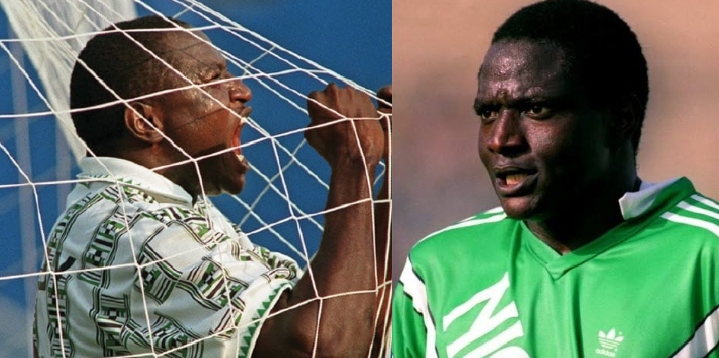
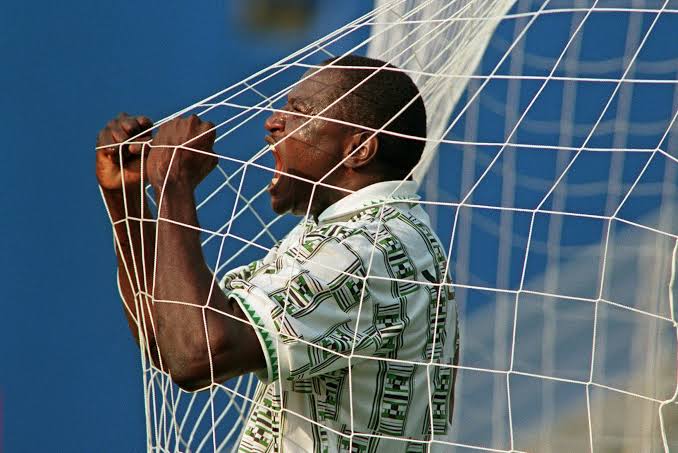
There are goals, and then there are prophecies. In June 1994, under the heat of a steamy afternoon in Dallas, one Nigerian striker stretched his long arms through the mesh of a World Cup goal and pulled history close to his chest. The ball had rattled the net with the force of destiny, but the celebration — eyes blazing, fists clenched, body trembling as though electricity had passed through him — said more than the goal itself. That image of Rashidi Yekini, shouting not to teammates but to the net, became Nigeria’s baptism into the world’s football memory.
But that single scream, frozen on posters and replayed on screens, was not a beginning. Nor was it the end. It was the middle of a story as restless and tangled as the net he clutched: a boy from Kaduna who grew up chasing scraps of leather, a man whose boots carried him through Nigeria, Ivory Coast, Portugal, and Greece, and a legend whose later years were marked not by applause but by whispers, loneliness, and tragedy.
To understand Yekini is to peel back not just the history of Nigerian football but the contradictions of a nation: triumph without preparation, glory without permanence, a hero cheered in the sun and forgotten in the storm. His life was not only a career in goals; it was a testimony to what happens when genius meets fragile institutions, when an individual voice tries to outshout a country’s silence.
This is the story of Rashidi Yekini — not just the man who scored Nigeria’s first World Cup goal, but the man who spoke to the net, and in that trembling moment, made history listen.
The Boy from Kaduna: Origins of a Striker
Every legend begins in a place the world often forgets. For Rashidi Yekini, that place was Kaduna, a city where the red dust of northern Nigeria mingled with the sweat of boys chasing improvised balls across empty fields. Born on 23 October 1963, Yekini grew up in conditions that hardly foretold international stardom. His family was poor, his childhood difficult, and opportunities scarce. Yet, within that harshness lay the hunger that would drive him.
In a country where football had already begun to carve its way into national identity, street matches were more than pastime; they were survival. Yekini, long-limbed and unusually powerful for his age, was not the most technically polished boy in Kaduna’s streets, but he carried something different — a relentlessness that matched the rhythm of hardship.

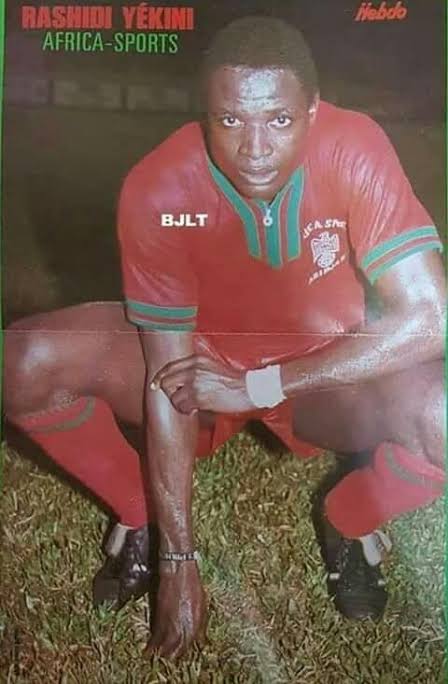
He joined UNTL Kaduna, a local club that gave him his first taste of organized football. There, the raw striker began sharpening instincts that would later terrify defenders across continents. At UNTL, and later with Shooting Stars Sports Club (3SC) of Ibadan, Yekini honed the art of positioning, learning to move like a predator stalking space rather than ball.
By the early 1980s, Nigeria’s domestic football league was brimming with talents — Segun Odegbami, Felix Owolabi, Stephen Keshi — yet Yekini’s presence was different. His gait seemed awkward, his touches sometimes heavy, but when the ball reached him in the box, hesitation vanished. He struck not with elegance but with certainty. Each goal was a statement: that poverty and obscurity could be outrun if one had enough stamina, enough fire.
Kaduna had given him scars, but it had also forged his obsession. Yekini carried from those early days a truth he never abandoned: the goal was more than a statistic; it was escape, it was survival, it was voice.
The Relentless Goal Machine in Nigeria
By the time Yekini wore the colors of Shooting Stars SC, he was no longer a boy chasing improvised footballs but a man demanding recognition. Shooting Stars, one of Nigeria’s oldest and most storied clubs, became the crucible of his reputation. In Ibadan, the striker’s gift for goals exploded into numbers that newspapers struggled to keep up with.
He was not the sort of player who mesmerized with dribbles or entertained with flamboyant tricks. Nigeria had produced — and would continue to produce — magicians like Jay-Jay Okocha. But Yekini belonged to a different species of forward: one who measured greatness by the bulge of the net, not the applause of the crowd.
Match after match, he scored. Local defenders whispered about his uncanny ability to appear in the right place. Goalkeepers cursed the speed with which his left foot could uncoil. Fans in Ibadan gave him nicknames that fused admiration with fear. By the mid-1980s, Yekini had become one of the most consistent scorers in the Nigerian league, his reputation crossing state lines and entering the conversations of national selectors.
When Shooting Stars qualified for continental competitions, Yekini carried them on his shoulders. In African club tournaments, he announced himself not just as a local predator but as a continental menace. His goals against teams from Ghana, Ivory Coast, and beyond made scouts take notice.
But beyond the statistics, Yekini was already cultivating something deeper: a relationship with Nigerian fans that felt both intimate and symbolic. In a country battling economic instability, military rule, and daily uncertainty, watching Yekini score was a temporary cure. Each goal was a collective exhale. Each raised arm, a reminder that Nigeria could produce brilliance even in dark times.
He was, by the late 1980s, Nigeria’s most feared striker at home. Yet destiny had already drawn his path beyond Ibadan’s stadium walls.
Crossing Borders: Yekini’s African Odyssey
The first migration was not to Europe but to Ivory Coast, where Yekini signed for Africa Sports d’Abidjan. This move, though less glamorous than a direct European transfer, became crucial in sharpening his reputation.
In Abidjan, Yekini’s relentlessness found a new audience. African defenders, hardened by physical football, tried to contain him. Yet his style — a mix of raw strength and predatory instinct — made him almost impossible to stop. He scored freely, and soon, the Ivorian league realized what Nigeria already knew: this was not just another striker passing through.
At Africa Sports, Yekini helped the club win league titles and continental respect. The fans adored him, newspapers chronicled his goal tallies, and whispers began to travel across Europe: there was a Nigerian in Abidjan who scored as though nets owed him money.
His time in Ivory Coast marked a bridge. It gave him visibility, stability, and the platform to leap further. By the late 1980s, Portuguese scouts, always alert to African talent, took notice. Vitória Setúbal, a modest but ambitious club in Portugal’s Primeira Liga, decided to gamble. And so Yekini, once the boy from Kaduna, boarded a plane to Europe — carrying with him the fire of Africa’s footballing grounds and the burden of a nation’s quiet hopes.
Portugal and the European Dream
Europe has always been the ultimate proving ground for African footballers, a place where reputations are either confirmed or quietly erased. For Rashidi Yekini, the door opened in 1990, when Vitória de Setúbal, a club with a proud but modest history in Portuguese football, took the risk of signing a striker from Africa who carried whispers of greatness but little international fame.

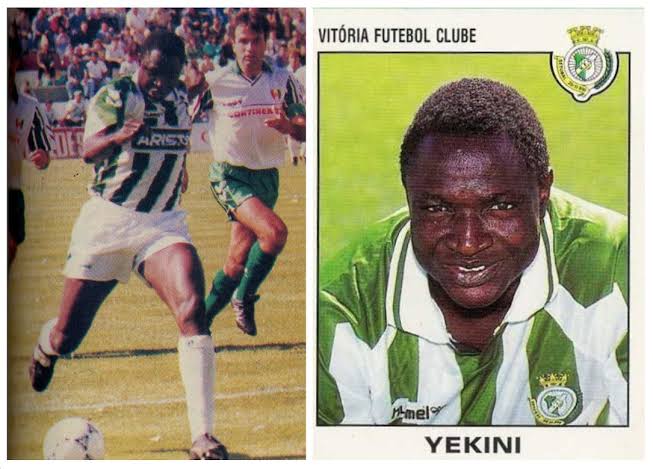
From the very first training sessions, Setúbal’s coaches realized they had not bought a hopeful striker — they had imported a machine. Yekini was taller than most defenders, stronger than many midfielders, and faster than most forwards. His touch could sometimes be heavy, but his finishing was devastating. Give him a half-chance, and the ball would be in the net before the goalkeeper even set his stance.
Portugal in the early 1990s was not the footballing powerhouse it would later become, but its league was competitive, a mix of domestic grit and Brazilian flair. For Yekini, this was both a challenge and an opportunity: if he could dominate here, bigger stages would come.
And dominate he did. Between 1990 and 1994, Yekini scored goals at a rate that startled the Portuguese press. He became the league’s top scorer in the 1993–94 season, an extraordinary achievement for a foreigner in an era when African strikers were still seen as gambles. His record at Setúbal remains legendary: 91 goals in 114 appearances.
Portuguese fans began calling him “The Goals Father.” Nigerian newspapers plastered his exploits across back pages. And European clubs began to circle, wondering how long Setúbal could keep him.
But beyond statistics, Yekini’s success meant something larger: he was the proof that a Nigerian striker could conquer Europe, paving the way for future generations. Before Nwankwo Kanu dazzled at Ajax, before Yakubu terrorized Premier League defenses, before Osimhen became Napoli’s talisman, there was Yekini, quietly rewriting the possibilities of Nigerian football in the small city of Setúbal.
The 1994 World Cup: Nigeria’s Golden Dawn
The summer of 1994 was not just another tournament; it was an awakening. For the first time, Nigeria had qualified for the FIFA World Cup, and the Super Eagles arrived in the United States carrying both flair and fearlessness. This was a team of rare balance: Finidi George’s wing artistry, Jay-Jay Okocha’s improvisation, Daniel Amokachi’s energy, Sunday Oliseh’s bite, and at the heart of it all, Rashidi Yekini, the man who had become Nigeria’s most reliable finisher.
On 21 June 1994, inside the Cotton Bowl Stadium in Dallas, Nigeria faced Bulgaria in their opening match. The world did not yet know what to expect from the debutants in green. By the 21st minute, it did.
Finidi George, sprinting down the right flank, lifted a pass into the Bulgarian box. The ball rolled across, awkwardly bouncing past defenders. And there, like destiny, was Yekini. One touch, two steps, and then the strike — low, hard, final. The net rattled violently. The stadium erupted. And Yekini, instead of running to teammates or turning to fans, did something the world had never seen.

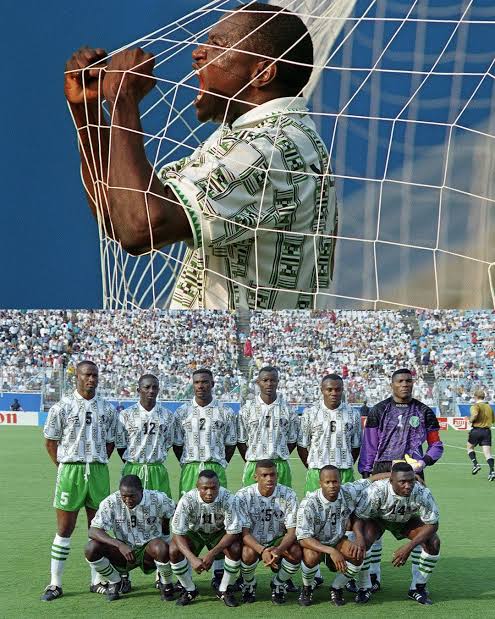
He ran straight into the net, grabbed the white mesh with both hands, and began to scream. His eyes wide, his chest heaving, his face twisted not in joy but in something deeper — relief, anguish, triumph, all at once. It was as though he had carried not just a ball but a country’s burden into that net, and now, clutching it, he was letting history itself know: Nigeria is here.
That moment, captured by cameras, replayed endlessly, became more than a celebration. It became an icon. Across Nigeria, across Africa, across the world, Yekini’s scream into the net came to symbolize the raw power of football as language. It did not need translation.
Nigeria went on to beat Bulgaria 3–0, shocking the football world. They advanced to the Round of 16, where they narrowly lost to Italy in a heartbreaking match. But it didn’t matter. The Eagles had soared, and Yekini’s goal had given Nigeria its first World Cup memory — one that would never fade.
Olympic Dreams and Continental Glory
If the World Cup made Nigeria visible to the globe, the Africa Cup of Nations (AFCON) in 1994 confirmed their supremacy on the continent. In Tunisia, the Super Eagles entered the tournament as favorites, and Yekini entered as the continent’s most feared striker.
He delivered. Yekini finished the tournament as top scorer with five goals, driving Nigeria to victory in the final against Zambia. In that tournament, he was not just a striker; he was a symbol of reliability. Whenever Nigeria needed a goal, he provided it.
That same year, Yekini received the highest individual recognition on the continent: African Footballer of the Year (1993) — the first Nigerian ever to win the award. For a boy who had grown up in Kaduna’s dust, who had once been doubted for his awkward gait, the honor was more than personal. It was national pride crystallized.
The period between 1993 and 1994 was Yekini’s apex — top scorer in Portugal, Africa’s best player, World Cup goal-scorer, and continental champion. He was at once Nigeria’s weapon and Africa’s banner.
But football careers, like life, are rarely straight lines. The climb was steep; the descent, inevitable.
Decline in Europe and Restless Wanderings
Football is cruel to strikers. The same legs that once outran defenders eventually slow. The same instincts that once felt eternal begin to falter. For Rashidi Yekini, the decline came not as a sudden fall, but as a slow erosion.
After his golden years at Vitória de Setúbal, bigger clubs came calling, but the timing was wrong. Transfers to Olympiacos in Greece, Sporting Gijón in Spain, and short stints in Switzerland and Tunisia promised much but delivered little. In Greece, Yekini struggled with injuries and adaptation. In Spain, his style — direct, powerful, single-minded — clashed with the tactical systems of La Liga. Coaches often looked puzzled by him: too effective to ignore, too unconventional to fully trust.
The Yekini who had once terrorized Portuguese defenders now looked restless, sometimes isolated, drifting between clubs without the sense of permanence that had defined his Setúbal years. The goals still came, but less often. His reputation remained intact in Nigeria, but in Europe, whispers grew: was he a one-league wonder?
For Yekini, these years felt like exile. He was not finished — his body still carried strength, his mind still burned with hunger — but he no longer belonged. The European dream had peaked and was now fading. By the late 1990s, he was a football nomad, moving from country to country, league to league, never truly at home.
The National Team Disconnect
If club football was giving way, Yekini still had the Nigerian national team — at least for a while. He remained the Super Eagles’ all-time top scorer, piling up goals in qualifiers and tournaments. But even here, tensions grew.
The Nigerian Football Federation was notoriously chaotic, often mismanaged, riddled with internal politics. Coaches came and went, and with each change, Yekini’s place in the team grew more precarious. Younger strikers like Nwankwo Kanu, Daniel Amokachi, and later Julius Aghahowa began to take center stage. Yekini’s straightforward style looked outdated compared to the trickery and versatility of the new generation.
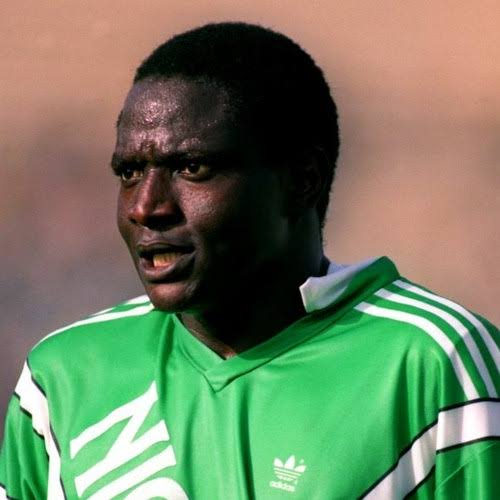
But what pained him most was not the competition — it was the disrespect. Despite all he had given, despite being the first to put Nigeria on the World Cup scoring sheet, Yekini often felt sidelined, forgotten, even humiliated. His relationship with the federation soured.
The 1998 World Cup in France was the final straw. Nigeria, again full of flair, faced internal turmoil and poor preparation. Yekini, already marginalized, played no significant role. He retired from international football not long after, his exit quiet and unceremonious — a stark contrast to the roar with which he had once introduced Nigeria to the world stage.

Isolation, Silence, and the Shadows
Retirement is often hardest for strikers. The adrenaline that once came from goals is impossible to replicate. For Rashidi Yekini, retirement was not just an ending — it was a slow fading into shadows.
He lived quietly, away from the public eye. Unlike some of his contemporaries, he did not become a coach, pundit, or administrator. Instead, he withdrew. Stories began to circulate of his struggles. Some said he had invested poorly and lost money. Others whispered about mental health, depression, and paranoia. The man who had once screamed into the net now lived mostly in silence.
By the late 2000s, rumors about Yekini’s condition grew louder. Reports suggested he roamed his Ibadan neighborhood in solitude, sometimes muttering to himself, sometimes avoiding people altogether. Neighbors described him as gentle but withdrawn. Friends claimed he battled illnesses of the mind, left untreated, perhaps worsened by abandonment.
And abandonment it was. Nigerian football, which had celebrated him in 1994, offered little in return during his decline. No structured support system for retired players existed. No national honor. No meaningful intervention. Yekini’s career had been Nigeria’s pride, but his retirement became Nigeria’s shame.
Death of a Legend: 2012 Tragedy
On 4 May 2012, news broke that Rashidi Yekini had died at the age of 48. The announcement shocked Nigeria, not only because of his age but because of the circumstances surrounding his final days.
Reports conflicted. Some accounts said he had been forcibly taken from his home by family members, allegedly for psychiatric treatment. Others suggested he had been sick for months. Official clarity never truly came. What remained undisputed was this: the man who had once shouted to history died quietly, his life ending with more questions than answers.
His funeral in Ira, Kwara State, was simple. There were tears, but also anger. How could a man who had given Nigeria its most iconic World Cup memory die in such obscurity, with so little dignity? Why had no system been built to protect him, to preserve his place, to ensure he lived his last years in honor rather than neglect?
For many Nigerians, Yekini’s death was not just a personal tragedy — it was a national indictment. A country that had lifted him when he scored had abandoned him when he no longer could. His scream into the net, once a cry of triumph, now felt like a foreshadowing of the silence that would later surround him.
Legacy: The Goal that Never Stopped Echoing
Legacies are rarely about numbers, yet Rashidi Yekini’s statistics remain staggering. 37 goals in 62 appearances for the Super Eagles, still Nigeria’s all-time top scorer more than a decade after his death. Over 200 career goals across Nigeria, Ivory Coast, Portugal, Spain, Greece, and beyond. And yet, what lingers most is not the tally, but the image — that scream into the net in Dallas.
For a new generation of Nigerian footballers, Yekini is both a caution and an inspiration. Players like Nwankwo Kanu and Jay-Jay Okocha followed him, carrying Nigerian flair to global audiences. Later came Yakubu Aiyegbeni, Obafemi Martins, Odion Ighalo, and most recently Victor Osimhen. Each owes something to the door Yekini first kicked open: the proof that a Nigerian striker could not only survive but dominate in Europe.
Osimhen, in particular, is often compared to Yekini — tall, powerful, direct, obsessed with goals. Every time he celebrates, Nigerians recall the ghost of Yekini. And yet, beyond footballing style, what connects them most is symbolic: the sense that Nigeria’s story is best told through its strikers, men who carry the nation’s frustrations and dreams into a single moment of impact.
Beyond Nigeria, Yekini belongs to Africa’s pantheon. Alongside Roger Milla, George Weah, Didier Drogba, and Samuel Eto’o, his name endures as part of the continent’s golden lineage of forwards. FIFA itself continues to replay his 1994 goal as part of World Cup highlights, proof that some moments transcend tournaments.
But Yekini’s legacy is not just celebration; it is also warning. His tragic end reminds Africa of the fragility of its heroes. Without structures to support retired players, without systems to preserve dignity after the final whistle, even the brightest can die in silence. His story has become a reference point in debates about player welfare in Nigeria — a reminder that medals and memories are not enough if men are left abandoned.
In 2019, the Nigerian government named a stadium in Ibadan after him: Rashidi Yekini Stadium. It was a late honor, but a necessary one. Street murals across Lagos and Ibadan still paint his screaming face into the net, keeping his image alive for younger Nigerians who never saw him play.
And so, more than a decade after his passing, Yekini remains not just a memory, but a presence. Every time Nigeria steps onto a World Cup field, his shadow lingers at the edge of the net. Every time a striker scores and runs with uncontainable emotion, the echo of Yekini’s scream.
Because in football, some moments are eternal. Yekini gave Nigeria one of those.
Final Echo: The Net Still Trembles
History is often written in books, but sometimes it is written in the split-second sound of a ball hitting the back of a net. Rashidi Yekini knew this better than anyone. That June afternoon in Dallas, when he clutched the net and shouted with the ferocity of a man releasing decades of hunger, pain, and hope, he was not just celebrating a goal — he was testifying.

His life, like Nigeria itself, was a paradox: glory and neglect, triumph and tragedy, noise and silence. He proved that greatness can come from dust, that a boy from Kaduna can make the world pause. But he also showed how fragile greatness can be when left unsupported, when a nation that demands heroes forgets to protect them.
And yet, Rashidi Yekini does not disappear. His scream remains, reverberating across time. Every time a Nigerian child ties plastic bags together to form a makeshift football, every time the Super Eagles walk out to a World Cup anthem, every time a net ripples with Nigerian power, Yekini’s presence is felt.
When he spoke to the net, history listened. And even now, years after his voice has fallen silent, the net still trembles.