


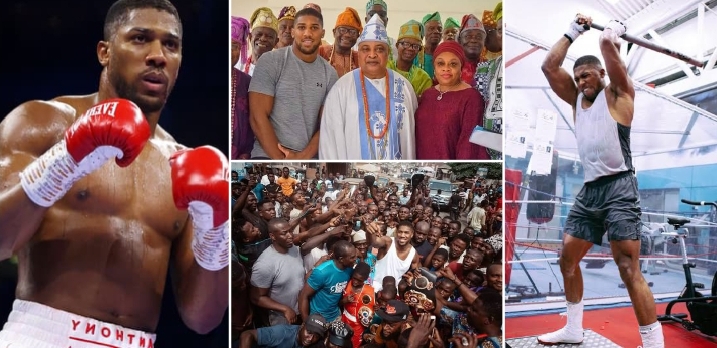
The night air is thick inside a packed arena. Lights cut through the darkness like spears of fire. Anthony Joshua stands in his corner, his body sheened in sweat, his chest rising with a rhythm that is almost ceremonial. He does not speak. He does not look into the crowd.
His fists — wrapped in white tape, sealed inside his gloves — twitch with a tension only he can feel. The bell has not rung yet, but already something older than the night, older than the belts at stake, older than the chants of his name, hums quietly in the air.

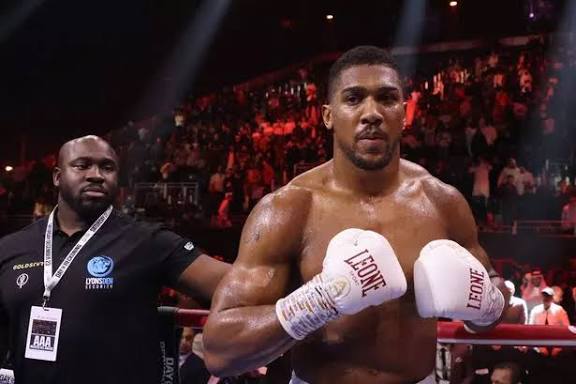
It is not superstition, nor is it a whispered prayer. It is something he does not name, something he has never needed to. The weight in his fists is not only the product of years of sparring, of thousands of rounds drilled in silence. It is the burden of ancestry, the shadow of iron that clings to him. In the split second before the fight begins, the crowd roars — but inside Joshua’s fists, history listens.
The Weight of Heritage
Anthony Oluwafemi Olaseni Joshua was born in Watford, England, but his story never begins or ends there. His Yoruba ancestral hometown is Sagamu, located in Ogun State, stretches across the Atlantic like an invisible cord, tying his story to Nigeria in ways more profound than birthplace alone. To understand Joshua is to understand the weight of history behind him, and the unspoken current of Yoruba iron culture that shapes how his fists move, how his body resists, how his spirit endures.
The Yoruba are not strangers to iron. For centuries, iron was more than a material; it was life itself — the edge of the hoe that broke the soil, the blade of the warrior’s cutlass, the hammer that shaped kingdoms. In Yoruba cosmology, iron represents permanence and resilience, the capacity to cut and to endure. Though Anthony Joshua does not invoke gods, deities, or ancestral powers in interviews, his very identity — carved in the syllables of his name and the discipline of his craft — carries this memory forward.
His middle name, Oluwafemi, translates to “God loves me.” His surname, Joshua, is biblical, a name of conquest and leadership. But in the hidden syllables of his Yoruba heritage is also the weight of iron, the idea that life is a forge and the body a weapon shaped through fire.
Raised in Watford, Joshua lived between two worlds: the ordered suburban rhythms of England and the restless memory of Nigeria, whispered to him by his mother, Yeta, and by relatives who never let him forget his roots. In those early years, he did not yet know what form his destiny would take. But the pulse of heritage was always there, waiting to reveal itself, like an ember glowing beneath ash.
As a boy, Joshua’s strength was evident. Teachers noticed it. Classmates tested it. He was fast, powerful, but untamed. Like iron before it has been smelted, he was raw material — hard, unshaped, restless. His brushes with street fights, his flirtation with lawlessness, were signs not only of youthful rebellion but of a deeper truth: he had too much energy for ordinary containment.
Boxing found him not as a hobby but as a forge. A cousin introduced him to the Finchley Boxing Club, and there, for the first time, Joshua’s fists were given purpose. The bag met his gloves like earth meeting rain, and in that collision, something dormant woke. Discipline became his anvil. Training became his furnace. Each jab and hook was no longer reckless but measured, each movement carved closer to mastery.
To the casual eye, Joshua was simply another young athlete finding direction. But beneath that surface was a pattern as old as Yoruba storytelling itself: the boy of raw energy being reshaped into a man of iron. In Yoruba thought, iron is not only strength but clarity — the tool that cuts away confusion, that forces truth out of chaos. Boxing was Joshua’s forge, the place where his fists became instruments of clarity.
When he first began rising through the amateur ranks, it was not belts or medals that defined him, but the transformation of his body into something unbreakable. Trainers spoke of his power, his discipline, his relentlessness. What they did not name — but what hung silently in his story — was the heritage behind it. The Yoruba do not need to call names to know what they see. The ghost of iron was already alive in Joshua’s fists.
Boxing as Ritual, the Ring as Forge
There is a moment in every fighter’s preparation that feels more like devotion than routine. The wrapping of the hands is meticulous — strips of gauze circling bone and tendon, layer by layer, until the fists are no longer bare flesh but sealed weapons. Trainers lace gloves with deliberate pressure, tugging at knots, tapping tape into place. To outsiders, it is a simple pre-fight necessity. To the fighter, it is ceremony.
For Anthony Joshua, each camp unfolds like a long ritual. Dawn runs, lungs filling with cold air, each stride cutting through fatigue like steel slicing through wood. The skipping rope whips against the gym floor, its rhythm steady as a heartbeat. Punches against the heavy bag resound like drums in a hall — echo upon echo, sweat flinging into the air as leather smashes leather. Conditioning drills break his body down, only for rest and repetition to rebuild it stronger.

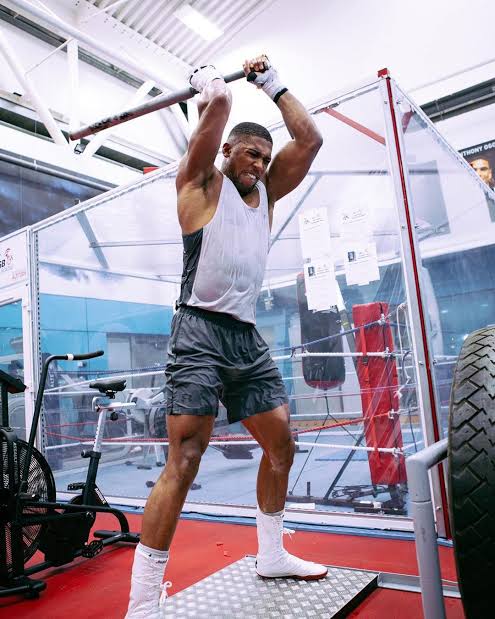
To Joshua, this is training. To the Yoruba imagination, it is forging. A blacksmith in an old village once hammered ore into tools with the same relentless rhythm. Fire, hammer, anvil — repetition until transformation. The boxer’s forge is the gym, the fire is pain, and the anvil is repetition. His fists, like iron, are tempered through blows, shocks, and strain.
The boxing ring itself resembles a shrine of struggle. Ropes are drawn like sacred boundaries; crossing them signals entry into combat. The canvas floor is hard but forgiving, holding sweat, blood, and stories of countless men before him. Every bell that rings is both invitation and command — a summons to prove strength under the harshest conditions.
Joshua never speaks of religion in relation to boxing. He is measured, pragmatic, careful in his interviews. Yet every fight he enters has the feel of an unspoken ritual — one where his body, his discipline, and his fists reenact a story much older than him. His ring walk is not only spectacle; it is a march into an iron space, a place where his fists will speak what words cannot.
Fists of Iron, Roots of Blood
Before he was a global name, before the Olympic medal and the heavyweight belts, Anthony Joshua was simply a young man adrift in Watford, restless and raw. The weight in his fists was already evident, but it had no direction. Street fights called to him. Anger and boredom found release in quick brawls. Trouble followed, and soon, so did the law.
Joshua has never shied away from the truth of those years. He was arrested, tagged, warned. The boy who would later pack stadiums once stood on the edge of wasting himself to the streets. Yet it was there, at his most uncertain, that boxing entered — not as a choice, but as necessity.
The first time he laced up gloves, it was not destiny but desperation. And yet something in that moment felt familiar, as though his body remembered what his mind could not articulate. Each jab landed with a rhythm that steadied him. Each hook was less about hurting an opponent and more about proving he could control himself. Where the streets had offered chaos, boxing demanded structure. Where anger had been scattered, the ring concentrated it into focus.
He rose quickly, not because he was born into privilege, but because his fists carried something heavier than most. Trainers spoke of his natural power, the way even his jabs cracked pads like hammers on iron. Sparring partners respected him, not only for strength but for the way he absorbed lessons with humility, reshaping his rawness into form.
The transformation was not merely athletic. Joshua’s entire life was reforged. Where once he drifted between uncertainty and temptation, he began to move with the precision of a man who had found a forge worthy of his fire. His family saw it. Friends saw it. He was no longer simply Anthony of Watford; he was becoming a vessel of something larger, something tied to the Yoruba notion that every life must be tempered, tested, and made useful.
It is tempting to romanticize this as the moment when he “found his calling.” But boxing is less about callings and more about endurance. For Joshua, it was nights spent aching, lungs burning, muscles torn and stitched back stronger. It was weeks of camp that blurred into years, repetition upon repetition until he could summon power at will.
And yet, beneath all this, his Yoruba bloodline pulsed. He did not need to name Ogun — the spirit of iron, the embodiment of strength and tools — for the resonance to exist. In Yoruba imagination, iron is not distant; it is in the machete that clears farmland, in the nails that hold homes together, in the weapons that guard a village. For Joshua, it was in his fists, two iron instruments that carried both his personal struggle and his ancestral echo.

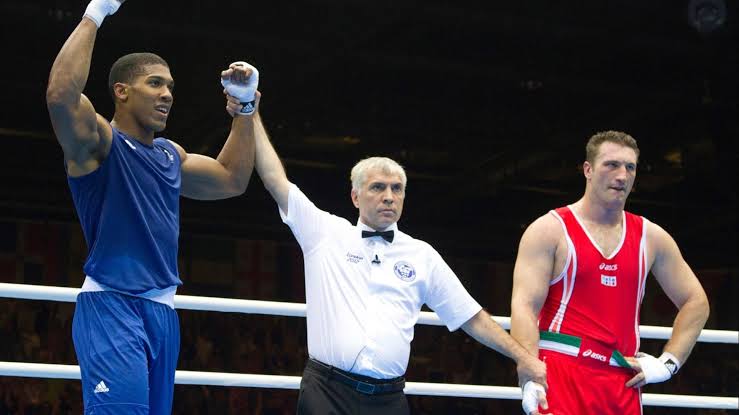
By the time he stepped into the 2012 Olympics in London, he was not merely a young fighter with talent. He was a man who had carried himself out of the fires of adolescence, reshaped into a disciplined force. His gold medal victory was not simply national pride for Britain; it was a moment of ancestral vindication, a Yoruba son proving himself on a global stage.
Those who watched him that night saw a rising champion. Those who looked deeper could sense a shadow in the way his fists landed — the quiet ghost of a heritage that taught iron never lies.
From Watford to Wembley: The Global Stage
The leap from local boxing halls to the grand stage is not sudden. It is built fight by fight, ring by ring, victory by victory. For Anthony Joshua, that climb felt meteoric to those watching, but to him it was years of compounding work. After the Olympics, the transition to professional boxing carried with it expectations heavier than any belt. He was not simply an Olympic gold medalist; he was a beacon of promise, a fighter branded as the future of heavyweight boxing.
From his debut in 2013, every fight bore the weight of spectacle. Joshua’s knockouts were brutal but controlled, precise detonations of power that reminded fans of earlier heavyweight legends. Promoters sold him as the perfect storm — charisma, physique, and a smile that softened his ferocity outside the ring. But for those who knew his story, the true storm lay not in his charm but in the rhythm of his fists.
By the time he faced Wladimir Klitschko in 2017, Joshua had already carried Britain on his shoulders. Wembley Stadium filled with ninety thousand people — a crowd more akin to a football final than a boxing bout. The air was electric, heavy with the kind of anticipation that borders on myth. Klitschko, a veteran of wars, stood across the ring with decades of experience and the aura of a reigning monarch. Joshua, younger, less tested, but burning with a fire no one could quite explain, stood ready to challenge the throne.
That night, the fight played like theatre. Joshua dropped Klitschko, was dropped himself, and then rose again. Each exchange was more than boxing — it was trial by fire. The young challenger battered, bloodied, then resurrected himself, breaking Klitschko in the eleventh round with a storm of punches. Wembley erupted, the roar of thousands shaking the ground.
In that moment, Joshua was no longer a prospect. He was a king crowned not by ceremony but by endurance. What the crowd saw as triumph, Yoruba memory would see as destiny fulfilled — the young warrior tested, felled, but unbroken, rising again to prove that iron may bend but never breaks.

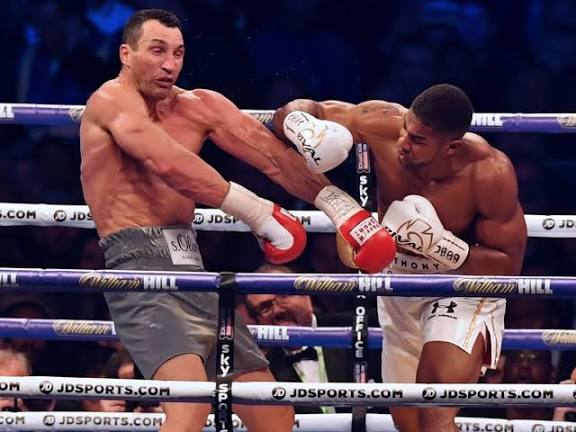
That victory was more than belts. It was a ritual victory, a moment where the roar of the crowd sounded like ancestral drums, echoing across oceans. Joshua’s arms lifted not just the belts of boxing organizations, but the weight of a diaspora watching one of its sons command a global stage.
From Watford to Wembley, Joshua had become something more than a fighter. He was an emblem of possibility, a reminder that heritage does not vanish in migration, and that strength, discipline, and endurance carry across generations. The world called him champion. But in the silence between his punches, his Yoruba roots whispered a deeper name — one he did not need to utter.
The Ghost Without a Name
There is power in silence, in what is never spoken but always felt. Yoruba tradition understands this well. Not every name must be invoked; not every force requires direct acknowledgement. Some presences live in the background, shaping lives without ever stepping forward.
Anthony Joshua never invokes Ogun — the Yoruba god of iron, war, and technology — in interviews or public declarations. He does not speak of spirits, shrines, or ancestral deities. His language is secular, his identity global, his branding polished for an international stage. Yet the resonance of Ogun — the echo of iron, the shadow of strength — hums in the way his career unfolds.
Ogun is not a figure of mysticism alone. In Yoruba culture, iron itself is Ogun’s breath. Every tool, every weapon, every machine carries Ogun’s memory. Ogun is the reason the farmer can till soil, the reason the warrior wields a blade, the reason the blacksmith shapes a world from fire and ore. One does not need to call his name to feel his presence; it is in the iron itself.
Joshua’s fists are wrapped in iron metaphor. His strength, his discipline, his capacity to endure resemble the attributes Yoruba tradition has long tied to Ogun. But rather than naming it, Joshua embodies it in silence. He is the modern athlete who becomes the vessel of ancestral memory without ritual invocation.
To watch Joshua fight is to see this ghost without a name at work. His blows carry the sound of metal striking metal — crisp, sharp, echoing through arenas like hammers in a forge. His body, sculpted and resilient, looks less like flesh and more like iron carved into human form. When he is knocked down, he rises not with mystic words but with the resilience of forged steel, hammered until it will not shatter.
This unspoken connection is not coincidence. It is the reality of diaspora, where heritage moves invisibly across oceans, embedding itself in gestures, in endurance, in the way a man carries his fists. Joshua may not light candles to Ogun, but every jab, every cross, every uppercut carries the ghost of iron forward.
It is why his story resonates beyond sport. For Nigerians watching him in Lagos, for Yoruba communities scattered across continents, Joshua is more than a boxer. He is a reminder of survival, of strength carried in silence, of a cultural echo that does not require open declaration. In Yoruba thought, silence is not absence; it is power contained. Joshua is that silence — a fighter whose fists carry the ghost of Ogun, even when his lips never say the name.
Defeat and Resurrection
Every fighter learns that defeat is not an accident of the ring but an inevitability of the craft. No one who enters the square of ropes, however skilled, however powerful, can avoid the moment when their iron is tested to breaking. For Anthony Joshua, that moment came not against a legend like Klitschko, but against a man no one expected to carry such weight: Andy Ruiz Jr.
June 1, 2019, Madison Square Garden. Joshua’s American debut. He entered the arena gleaming with confidence, carrying multiple heavyweight belts, his reputation as the division’s shining future. Across from him stood Ruiz, short, heavyset, with the physique of a man underestimated before the first punch. The fight was meant to be a coronation in the United States, the expansion of Joshua’s empire. Instead, it became a crucible.
The shock unfolded like a story no scriptwriter could craft. Joshua floored Ruiz in the third round, and for a brief second, the narrative seemed intact. But Ruiz rose, undeterred, and fired back with combinations that crashed against Joshua like waves against steel. Joshua fell. Not once, but four times. By the seventh round, the referee ended it. The belts were gone. The empire cracked. The image of invincibility shattered.
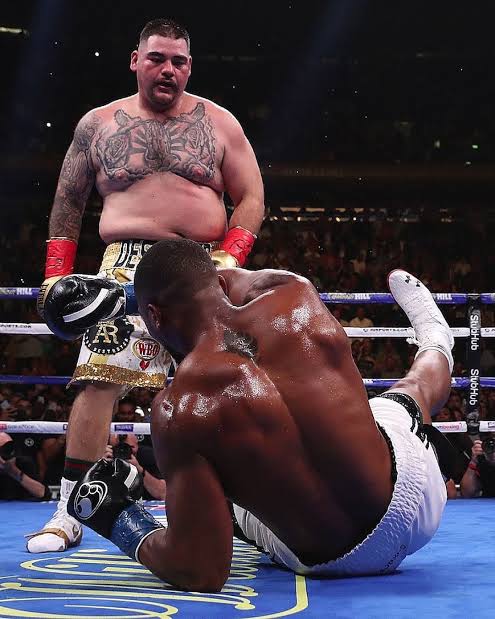
Defeat in boxing is not only physical. It is psychological, cultural, ancestral. For Joshua, who carried both the pride of Britain and the silent weight of Yoruba heritage, the loss was more than a broken record; it was a fracture of identity. For months, questions haunted him: Was the power gone? Was the iron brittle? Had the champion’s spirit rusted?
But Yoruba tradition teaches that iron is not destroyed by fire — it is tempered by it. A blade that breaks is reforged sharper. A hammer that dents is straightened by heat. In the crucible of humiliation, Joshua returned to the forge. Training camps became more severe, focus more precise. He rebuilt his body, refined his approach, and went back to face Ruiz in December that same year.
The rematch in Saudi Arabia was not a display of reckless power but of refined iron. Joshua boxed with discipline, moving, jabbing, refusing to be drawn into brawls. He did not seek to overwhelm Ruiz with fire, but to control him with clarity. Twelve rounds later, his belts were restored. He was champion again, not because of brute force, but because of the resilience of iron re-forged.
The resurrection was more than personal. It was cultural proof of Yoruba endurance: the idea that no fall is final, that the test of greatness is not in never bending but in refusing to break. Joshua’s fists had been humbled, reshaped, and made sharper. His defeat had become his forge.
Beyond Boxing: The Cultural Weight
To see Anthony Joshua only as an athlete is to miss the broader shadow he casts. He is not just a man in gloves; he is a cultural figure, a symbol of what Yoruba heritage means when it migrates across oceans and finds new expression in global arenas.
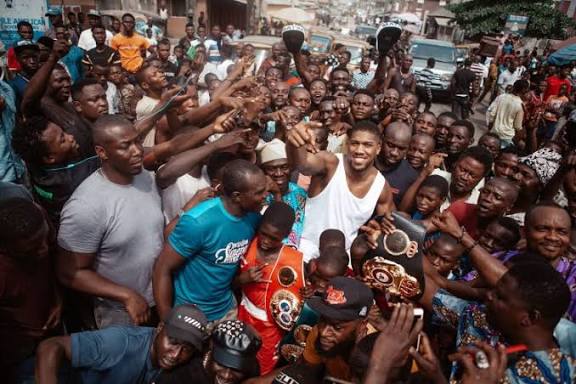
In Nigeria, every Joshua fight is more than sport. Families gather around televisions, bars spill over with shouting voices, neighborhoods erupt when his fists land. He is claimed as a son of the soil, proof that the Yoruba spirit of resilience cannot be erased by geography. His victories are celebrated as collective triumphs, his defeats mourned as shared wounds.
In Britain, Joshua’s identity is more complicated. He is both a national hero and a reminder of immigrant strength. The tabloids often paint him as the smiling face of British boxing, a unifying figure. Yet beneath the polished image lies the tension of being a Black man in Britain, carrying both pride and scrutiny. His Nigerian heritage is sometimes backgrounded, sometimes spotlighted, but never erased.
For the Yoruba diaspora, Joshua is something deeper. He is evidence that cultural memory lives even when unspoken. The Yoruba concept of ase — the life force that flows through action, speech, and presence — manifests in Joshua’s discipline, his endurance, his silent embodiment of iron. He does not need to chant, to invoke, to proclaim. His fists speak enough.

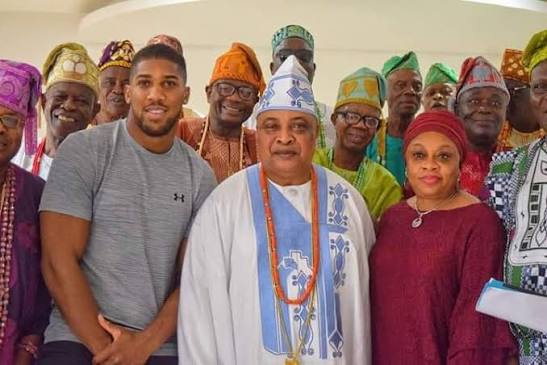
And beyond heritage, Joshua’s cultural weight rests in his role as a figure of redemption. He has become a model for young men who drift toward violence or despair, proof that energy can be redirected, that chaos can be forged into craft. His life is testimony to the Yoruba belief that the raw must be refined, that destiny is not found but hammered into shape.
Joshua also represents the intersection of modern branding and ancient resonance. Corporations sponsor him for his global appeal, plaster his face across billboards, sell his fights as entertainment. But for Yoruba watchers, those images carry layers unseen by marketing teams. They see in his frame the endurance of ancestors who wielded iron, in his victories the vindication of diasporic survival, in his defeats the reminder that even the strongest must be reforged.
In the global conversation, Joshua is often compared to fighters of the past — Ali, Tyson, Lewis. But his story cannot be reduced to a lineage of boxing champions alone. His fists carry a different echo, one tied not just to the ring but to the cultural forge of Yoruba memory. He is not simply a British fighter of Nigerian descent. He is the unspoken embodiment of a heritage that has always understood iron as both weapon and witness.
And so when Joshua steps into the ring, he does not come alone. The crowd may see a man, gloves laced, jaw set, body coiled in readiness. But those who look closer, those who understand Yoruba imagination, see something more: the ghost of iron standing beside him, silent but undeniable, shaping every blow he throws.
Legacy Written in Iron
Legacy in boxing is not measured only in belts. Belts change hands, are lost, are stripped, are unified again. They glitter, but they tarnish. True legacy lives in memory, in the way a fighter is spoken of long after gloves are hung up. For Anthony Joshua, his legacy is already being forged in two languages: the global tongue of boxing history, and the quiet cadence of Yoruba heritage.
In the record books, Joshua will be remembered as an Olympic gold medalist, a two-time heavyweight champion, a man who fought in front of stadium crowds and brought heavyweight boxing back into public obsession. He will be compared to Lennox Lewis, perhaps even to Muhammad Ali and Mike Tyson in terms of cultural presence. He will be remembered for the Wembley night, the Klitschko war, the Ruiz shock and redemption. These are the markers that historians and statisticians will cite.
But in Yoruba memory, his story runs deeper. Joshua is not simply a fighter but a living embodiment of what it means to carry iron without ever invoking its name. Yoruba culture does not require open rituals to recognize endurance, discipline, and strength. The fact that Joshua’s fists resonate with those qualities is enough. His legacy in this sense is spiritual without being religious, ancestral without being ceremonial.
Consider how Yoruba thought interprets iron. Iron is permanence, but also transformation. A blade dulls, but when sharpened becomes more useful. A hammer bends, but in fire and anvil it is restored. Joshua’s career has mirrored this. He has shone, he has bent, he has been broken down, and he has returned sharper. His defeats are not stains on his legacy but essential proofs of iron’s resilience.
His body, his training, his persistence, are all symbols of Yoruba values carried into the modern world. This is not cultural nostalgia — it is living memory. In every fight, he proves a Yoruba truth: that power is not in words but in action, not in invocations but in endurance.
Outside the ring, Joshua’s legacy also lies in what he represents for young men standing where he once stood — restless, reckless, and at risk of being wasted to the streets. His life is testimony that rawness can be refined, that chaos can be directed, that fists meant for destruction can be turned into instruments of purpose. For Nigerian and British youth alike, Joshua’s story is less about the belts and more about the forge of discipline.
He has also become an emblem of diasporic possibility. In him, Yoruba heritage finds global expression without dilution. He does not hide his Nigerian roots, nor does he exploit them for exotic branding. He simply embodies them, allowing his Yoruba name, his Nigerian identity, to exist naturally on the world stage. This is powerful. For a culture often reduced to caricature or myth, Joshua’s presence is reminder that Yoruba heritage does not need dramatization to matter — it lives in everyday resilience, in the way iron lives in every tool, every weapon, every machine.
As Joshua grows older, his fights may dwindle, his physical prime may fade. But legacy is not about how many more belts he collects. It is about what remains when the gloves are gone. And what remains is this: Anthony Joshua’s fists will always carry the ghost of iron. He has already entered Yoruba storytelling not as a deity, not as a ritualist, but as proof that heritage survives in silence, carried across oceans, reborn in new forms.
Closeout: The Ancestral Weight Behind the Gloves
Anthony Joshua’s journey is measured not just in knockouts or championship belts, but in the quiet gravity he carries every time he steps into the ring. Each movement, each strike, each strategic pause is informed by forces unseen—currents of heritage and memory that have traveled across continents, from Yoruba soil to English streets, before converging in his body.
These are not ancestral presences he names or rituals he performs. They are subtler: a rhythm in his punch, a resilience in his stance, a patience forged in silence. They are shadows of a lineage that taught strength is never merely physical, and endurance is never just about surviving the moment. The weight he bears is invisible yet undeniable, a constant reminder that talent alone cannot account for the fullness of his power.

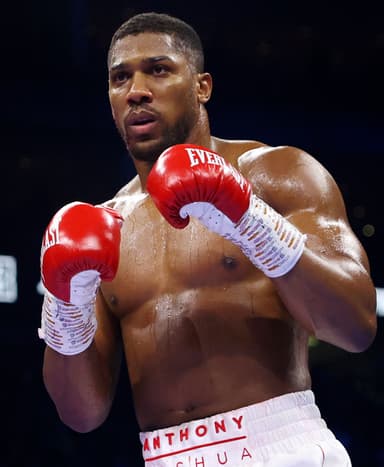
Joshua’s gloves become vessels of this hidden inheritance. They strike not only at opponents but at the distance between past and present, between homeland and diaspora, between the raw potential of youth and the disciplined mastery of adulthood. In this space, boxing transforms into something larger—a meeting ground where ancestry and identity assert themselves through action rather than words.
What makes Joshua’s story remarkable is that the weight he carries remains unseen by most, yet it shapes every outcome. It is a legacy encoded in muscle and motion, in reflexes honed to perfection, and in the silent endurance of a man whose lineage whispers through every blow.
In the end, the spectacle of his fights is only half the story. The other half belongs to history, memory, and culture—the ancestral shadows and unseen weight that live inside Anthony Joshua’s gloves, reminding the world that true power often moves quietly, patiently, and inexorably.