


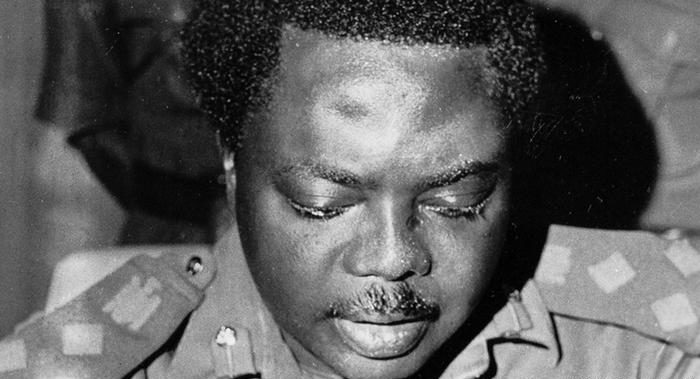
His life was lived in a way that affords one the liberty and opportunity to choose and curate how they want to remember him; as a vainglorious brute savage and depraved murderous cretin who committed war crimes or a fine soldier who turned into a brilliant, resourceful, exceptional and revolutionary head of state who led Nigeria with grit, passion, purpose, vision and fearlessness.
Since last week activities and events have been held to mark the remembrance of General Murtala Mohammad who was assassinated in a failed coup in 1976. He was brutally gunned down in Lagos on his way to work less than eight months after he took power in 1975 in a bloodless coup that ousted General Yakubu Gowon from office. Murtalais is a man of many shades. It is challenging to agree on what truly defines Murtala’s legacy. He is seen by different people through different lenses. The answer you will get for how and what the former head of state should be remembered for will depend on the person or group of people you are asking.
He was born in 1938 in Kano Nigeria Kano and he died 37 years later in 1976. He lived a relatively short life which was and still remains a bundle of extraordinary contradictions. He did everything possible to leave his indelible mark on Nigeria’s treacherous sand and gain an impressionable hold on the mind of those who cross his path whether before or after he died. His life was lived in a way that affords one the liberty and opportunity to choose and curate how they want to remember him; as a vainglorious brute savage and depraved murderous cretin who committed war crimes or a fine soldier who turned into a brilliant, resourceful, exceptional and revolutionary head of state who led Nigeria with grit, passion, purpose, vision and fearlessness.
He is loved by some and loathed by others. He is reviled by some and respected by others. Hero to many, villain to others. While some portray him as an incorruptible public administration and disciplined soldier others see him as a rabid, depraved and sadistic soldier who relished spilling the blood of innocent people and his compatriots for the fun of it. The schism and divergence in feelings towards the man who was nicknamed the ‘Monty of the Midwest’ after Field Marshal Bernard Montgomery, the British World War II hero, was largely influenced by Mohammad’s involvement in both pivotal and dark moments in Nigeria’s history.
The story of Nigeria’s civil war cannot be dispassionately and extensively told without Murtala not featuring prominently. In fact, Nigeria’s checkered history is replete with his unmistakable imprint, strewn with the controversial and contested narrative of his actions and decisions. Whatever credit and praise he received for his performance as head of state, which is also criticised in some quarters as dictatorial and heavy-handed, and the dynamism he brought to Nigeria’s foreign policy, which focuses on the decolonisation of Africa, is often coloured by what many will describe as his reprehensible and abhorrent actions during the civil war. He was at the centre of one of the darkest and most disheartening episodes of the war. Murtala, while leading the second division in the Mid West, was said to have ordered the massacre of unarmed men, women and children during the invasion of Asaba. The incident will later be known as the Asaba massacre.
But these wartime excesses are often overshadowed by audacious policies and radical decisions as the leader of the nation. When he became the head of state, he started by massive and widespread purge which cut across the civil service and military. Over 100,000 troops were demobilised. The infamous cement armada he inherited from Gowon which impedes operation at the Lagos Ports was cleared. He cancelled the divisive 1973 census. He created seven new states in December 1975 to bring the number to 19. He nationalised some of the academic, political and economic institutions formerly owned by regional groupings. He also handed dismissals in the civil service, diplomatic service, judiciary, Police, public corporations, universities and everywhere he perceived ghost workers and “deadwoods.” He began the process of relocating the federal capital territory to Abuja from Lagos as the latter became congested. He began the process of restoring civilian rule by naming a Constitution-drafting Committee led by Rotimi Williams.
On foreign policy, he condemned the intervention of the United States of America in African affairs and viewed that “extra-continental power” as an opponent of the decolonisation of the continent. In a fiery speech that brought many delegates to tears during the Extra-ordinary Summit of the then OAU in Addis Ababa in January, 1976, Murtala denounced Apartheid South Africa’s armed intervention in Angola and mobilised African support for Popular Movement for the Liberation of Angola (MPLA) and other revolutionary groups. This was Nigeria’s finest hour.
Last week, Murtala’s daughter, Aisha, extolled his father’s virtues of prudence, discipline, incorruptibility and altruism. While no one expects Aisha to speak ill of his father or disparage him, not when he has a documented and verifiable slew of remarkable and exceptional achievements as a leader. Be that as it may, there are people who do not see him in the glorious, beautiful and fantastic light. They don’t see him as an exemplary leader who initiated commendable reforms and radical changes, as Aisha spoke about and wanted people to see him as. We cannot discount the feelings of those who do not share the familial sentiments of Aisha about the legacy of her father. These people whose families still carry the deep scars and trauma of Murtala’s unspeakable atrocities during the civil war. While Murtala truly has some redeeming and endearing traits and character that many Nigerians want in a leader, it is hard to overlook his eccentricity and excesses especially in the context of what he did during the civil war.
The legacy of Murtala and the commemoration of his death will continue to be a matter of polemics and controversy in our public discourse. He will remain close to the heart of those who adore and cherish him, those who yearn for the somewhat halcyon days that they believe define his regime. But for those who are the victims of his wartime indiscretion, irascibility and sadistic shenanigans, he will always remain a villainous scoundrel.