


As the PDP continues to flounder, wane in influence and lose general appeal, it becomes a playground for politicians in other parties who recognise its rich history and the sentimental value some electorate still attach to it and want to use it to advance their political interests.
The year 2027 is the most pregnant and portentous one for Nigeria. The questionable endorsement of President Tinubu for a second term in less than two years into office, the fear of Nigeria becoming a one-party state, the dubious wave of defection, the intra and inter-party wrangling, the strident noise of a coalition and the likelihood of its materialisation and the devil-may-care aura of desperados in the political space, all add up to create suspense and drama.
As we gallop worryingly towards a momentous 2027 general election, one of the concerning and, some will say, troubling developments in our political space is the gradual slide of the Peoples Democratic Party (PDP) into irrelevance and infamy. Ten or five years ago, no one would have envisaged that the party that midwifed Nigerian democracy and was in power for the greater part of the fourth republic would become so emasculated and inconsequential to our polity. At the centre of the self-inflicted steep descent of the PDP into insignificance and political oblivion are certain people. Former Vice President Atiku Abubakar has been repeatedly accused of contributing to the PDP’s decline in fortunes. The other person whose antics and shenanigans are believed to have contributed to the painful decline of the PDP is the former Governor of Rivers State, Nyesom Wike.
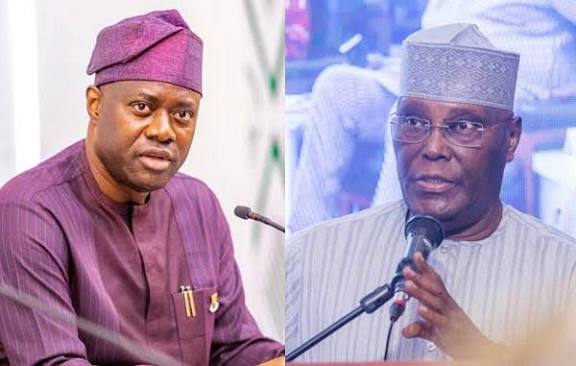
As the PDP is gravely bogged down by perennial internal wranglings, division, exodus of prominent and influential members to another party which has seemingly weakened it and the growing influence of moles and outsiders on it, one personality that is now shouldering the burden of the party’s survival and forestalling its extinction is Oyo state governor, Seyi Makinde. Last week, the governor met with Atiku in Minna, Niger State capital last week. They met at the residence of the former head of state, Ibrahim Babangida. As the PDP continues to flounder, wane in influence and lose general appeal, it becomes a playground for politicians in other parties who recognise its rich history and the sentimental value some electorate still attach to it and want to use it to advance their political interests.
The details of the meeting between Makinde and Atiku were not divulged to the public by both of them, but when a governor of a beleaguered PDP that used to be a powerful and colossal party whose shadow once loomed large on our nation met with a former member of the party who was its presidential candidate on two different occasions but has since ditched it for another party, the African Democratic Congress (ADC), then something is definitely in the offing. Whatever the case may be, the meeting will impact whatever is left of the PDP as a party positively or negatively, shape the trajectory of the ADC ahead of the 2027 presidential election and will definitely introduce a fresh twist, plot and intrigue into the presidential race.
While observers, analysts and politically conscious ordinary Nigerians weave theories, fabricate conjectures and peddle hearsay, a former governor of Ekiti state released a detailed statement disclosing what he believed was certainly the agenda of the Minna meeting. Fayose in his exposé had claimed that the meeting was about how Atiku planned to fund his presidential ambition through Governor Makinde. According to him, Makinde has promised to release N10 billion naira in two tranches for the take-off of the ADC but the governor promised to only join the party if he would be made the running mate of Atiku.
The most important disclosure in Fayose’s account of the meeting is the plan for former Anambra State governor, Peter Obi. He stated that “consideration was given to the fact that Peter Obi will not accept to be Atiku’s running mate and he won’t also be acceptable to the North, as Atiku’s successor” adding that “Atiku is 70% certain of getting the ADC ticket, having ensured the non-zoning of the party’s presidential ticket.”
If Fayose’s account on what transpired at the meeting is anything to go by, if there is grain of truth in any of the information he revealed, especially as it relates to Atiku’s certainty of clinching the ADC presidential ticket hence leaving Obi marooned politically, then we maybe hit by the déjà vu of the circumstances that surrounded the race for the PDP’s 2023 presidential ticket which culminated in the chain of events that led to its implosion. As it was said earlier many have cited Atiku’s decision to contest the 2023 presidential election when the consensus at the time was that it was the turn of the south, as the genesis of the PDP’s misfortune. The sentiment that 2023 to 2031 is for the southern presidency is still held strongly by the majority of Nigerians, especially those from the south.
The question now is why Atiku would be teaming up with Makinde to corner the ADC presidential ticket and contest again in 2027 when the odds are against him now even more than they were in 2023. The defection of Obi undoubtedly gave the ADC the needed impetus, acceptance and appeal among certain demographics, especially the youths, who see Atiku and President Bola Tinubu as two sides of the same coin. One would have thought the party would build on that and the popularity of Obi among Nigerians. As things stand, the chances of Atiku getting the ticket if the ADC opts for a presidential primary election are high because the concept of greater good and delayed gratification are alien to money-seeking delegates who determine the outcome of the primary election and see it as an avenue to make money and fleece corrupt and power-hungry politicians who would aggressively and indiscriminately dole out stolen public funds to realise their political objectives. The delegates are largely and mainly motivated by pecuniary gains, self-interest and imbued with a fleeting sense of authority and power that comes with choosing the standard bearer of the party, traits and conditions that Obi claimed are antithetical to his creeds and disposition.
The ADC must be circumspect and weigh its options very carefully in the process of choosing its presidential candidate if it is going to stand any chance of ousting APC from power. Already, there is this pervasive narrative that the ADC is a contraption cobbled together for the actualisation of Atiku’s presidential ambition, a process of selection that puts Atiku in a pole position to emerge as its presidential candidate will reinforce such a notion and jeopardises it chances at the polls. Also, the path to glory for ADC if it fields Atiku as its candidate will be fraught with difficulties, uncertainty and eventual loss. The ADC has to decide whether it wants to be a party that is willing and ready to make a departure from the old ways of doing things or it wants to double down and continue on the same paths which have only brought pain, misfortune and regression to the people and the nation.
An Obi’s presidential candidature in the ADC gives hope to the majority of the citizens, inspires confidence and gives them the much-needed drive and motivation to rally behind the party and its candidate as seen with the Labour Party in 2023. An Atiku may find it difficult to replicate this especially as he will be contesting on the platform of a party that does not have the financial muscle and national appeal that the PDP had in 2023. For ADC, the situation may look like a conundrum, an entangled road that makes a journey painstaking but all this is because it has not prioritised pragmatism and people’s demands over good old-fashioned money and bigman politics.