A coup, according to Merriam Webster Dictionary, is a rapid and violent seizure of a government or positions of power that frequently involves a small group of people, usually from the military or other high-ranking officials.
A coup necessitates the overthrow of the current leadership or administration and the installation of a new one, sometimes through violent or unlawful means.
A coup occurs when a group of people seize power and control of a government, typically quickly and decisively, without following constitutional or democratic processes.
A FAILED COUP?
Sahara Reporters, an online newspaper, recently published a report that the Armed Forces of Nigeria have detained at least sixteen senior military officers for allegedly planning a coup d’etat to overthrow President Bola Tinubu.
According to Sahara Reporters, a senior official of the Defence Intelligence Agency involved in the arrest disclosed that the officers, led by an army brigadier general, were planning to stage a coup and take over the government from “selfish politicians.”
He said the coup attempt was thwarted after an intelligence gathering by the DIA and sister agencies.
“The 16 officers were planning a coup. The military authorities were just being diplomatic in the statement released by the spokesperson. They have started doing secret meetings on how to overthrow the president and other top government officials,” the source further disclosed.“
They’re all officers within the rank of captain to brigadier-general and are still in detention at DIA as we talk. They were picked recently at their various houses around the country. Their main objective was to overthrow President Tinubu and announce a military government.”
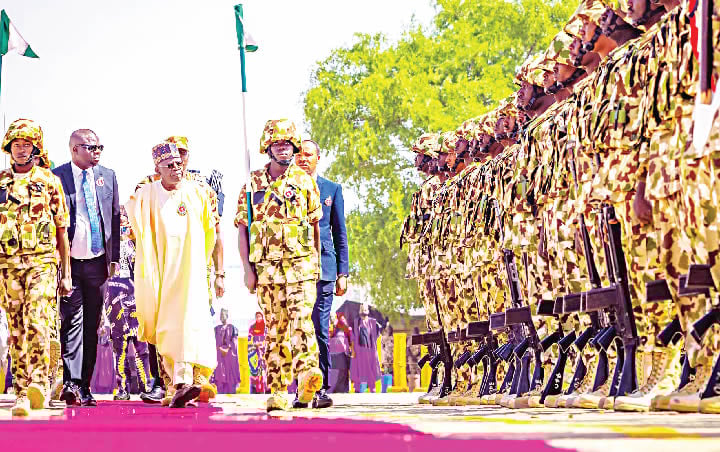
Another source added that the October 1 Independence Day parade was cancelled because of the coup attempt.
He said, “Yes, they were arrested for planning to stage a coup and take over the government. That was the main reason why the Independence Day parade scheduled to be held on Wednesday, October 1, as part of activities marking the country’s 65th Independence Anniversary, was cancelled.“
This was because intelligence reports showed they planned the coup on October 1st during a military parade. So the National Security Adviser and other service chiefs asked the Tinubu-led government to cancel the parade earlier scheduled to mark the day.
“Their plan was to shoot at the president and other top politicians during the event. The move by the military authorities announcing their arrests was to douse tension.”
NO OFFICERS WERE ARRESTED OVER COUP – ARMY CLARIFIES
However, the Director of Defence Information, Brigadier General Tumour Gusau, who confirmed the arrest of army officials, further disclosed that a routine military exercise has resulted in the arrest of sixteen officers over issues of indiscipline and breach of service regulation.
According to Gusau, investigations conducted revealed that their grievances stemmed largely from perceived career stagnation caused by repeated failure in promotion examinations, among other issues.
“Some of the apprehended officers had been under jurisdiction for various offenses, either awaiting or undergoing trial. Their conduct was deemed incompatible with the standards of military service.”
WE SUPPORT THE POSITION OF DHQ WHICH DISMISSED THE REPORT OF COUP – FG
Mohammed Idris, the Minister of Information and National Orientation, has disclosed that the government had faith in the military.
According to Idris, the government had no reason to doubt the position of the Defence Headquarters, which on Saturday dismissed the report of a coup as fake.
Idris, while reacting to the development, stated that it was a military affair.
“The Federal Government believes that the Armed Forces of Nigeria is committed to ensuring the territorial integrity of the country and also strengthening its fight against insecurity.
“The Federal Government commends the military, and it will continue to support them in their task of ensuring the security of Nigeria.”
MILITARY COUP?
A military coup is an overtime attempt by a military group or organization to unseat an incumbent person or leadership.
It often involves a sudden, violent, or unexpected seizure of power, and can be driven by various factors such as corruption, abuse of power, economic instability, gross mismanagement of public funds, ethnic or regional tensions among others.
Nigeria is not new to military coups. The most populous African country has witnessed several military coups from 1966 to 1999. Since the inception of civil rule in 1999, there have been successive governments who were democratically elected by the people to be in charge of the affairs of the country.
A check by WITHIN NIGERIA revealed that Nigeria has witnessed nine military coups – six military coups were successful while three military coups failed.
MILITARY COUPS IN NIGERIA (from 1966 to 1993)
January 1966 Military Coup: The coup was led by Major Chukwuma Kaduna Nzeogwu. It led to the assassination of Prime Minister Abubakar Tafawa Balewa and several other political leaders.
July 1966 Counter-Coup: The coup was led by Northern officers. It led to the overthrown of General Johnson Aguiyi-Ironsi and the appointment of Lieutenant Colonel Yakubu Gowon as head of state.
1975 Coup: The coup was led by a faction of junior Armed Forces officers, with Colonel Joseph Nanven Garba announcing the coup on Radio Nigeria.
General Yakubu Gowon was overthrown in a bloodless coup while attending an OAU summit in Uganda, and Brigadier Murtala Muhammed became the head of state.
February 1976 Coup: A failed coup attempt led by Lieutenant Colonel Buka Suka Dimka led to the assassination of Murtala Mohammed.
Dimka and his co-conspirators ambushed Muhammed’s car in Lagos, killing him and his aide-de-camp, Lieutenant Akintunde Akinsehinwa, and driver, Sergeant Adamu Michika.
The coup attempt was unsuccessful, and Olusegun Obasanjo, Muhammed’s deputy, quickly took charge and put down the uprising. Dimka was later tried, convicted, and executed for treason.
1983 Coup: The coup was led by Major General Muhammadu Buhari and it overthrew the democratically elected government of President Shehu Shagari.
1985 coup: The palace coup was led by General Ibrahim Babangida. It overthrew the Major General Muhammadu Buhari government.
1985 alleged coup: The alleged coup was led by Major General Mamman Vasta. Hundreds of military officers were arrested, tried, convicted, and eventually executed for allegedly conspiring to overthrow the Babangida administration.
1990 Coup Attempt: The coup was led by Major Gideon Orkar against General Ibrahim Babangida’s government but it failed.
1993 Coup: The coup was ledb y General Sani Abacha. It overthrew the interim government of Ernest Shonekan.