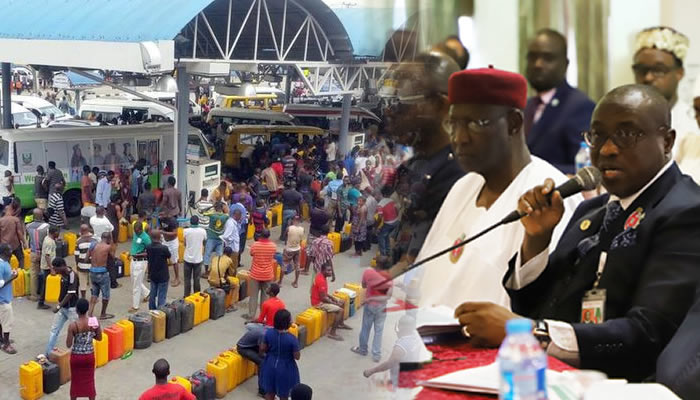
The Academic Staff Union of Universities (ASUU) on Monday, October 13, embarked on a total and comprehensive two-week warning strike across all public universities in Nigeria.
The warning strike action was declared on Sunday during a press conference at the University of Abuja by the National President of the Union, Prof. Chris Piwun.
According to Piwuna, the strike became necessary as a result of the Federal Government’s refusal to address long-standing concerns impacting the country’s universities.
However, the Academic Staff Union of Universities (ASUU) on Wednesday, October 22, announced the suspension of its ongoing two-week warning strike.
This was made known on Wednesday by the National President, Prof. Chris Piwuna, during an ongoing press briefing in Abuja.
Piwuna disclosed that the decision stemmed from the National Executive Council meeting, which was held overnight and ended by 4:00 am on Wednesday.
WITHIN NIGERIA contacted some students of public universities, particularly those affected by the strike action of the Academic Staff Union of Universities (ASUU), and they shared their views about the new development.
Deborah Adegbite, a 300-level student of the Microbiology Department at the Obafemi Awolowo University (OAU), expressed her joy over the suspension of strike action by the Academic Staff Union of Universities (ASUU).
Adegbite, who expressed her eagerness to resume classes, told WITHIN NIGERIA that the suspension of the strike came as a shock, citing the age-long history of terrible ASUU strikes.
“My friends and I thought the strike would last for months. We never envisaged that it could be suspended for barely two weeks. It is really a good and nice development,” she said.
According to Adegbite, most of her coursemates had travelled to their respective homes, while some had started learning digital skills because they thought the strike action would take months.
Blessing Adeyemo, an undergraduate at the University of Ibadan (UI), told WITHIN NIGERIA that he was glad and delighted when he heard about the news of the suspension of strike action.
Adeyemo, a student of psychology, disclosed that his coursemate, simply identified as Segun, informed him about the new development.
‘I maintain a little office at the school mini-mart where I conduct photocopying, scanning, and other administrative tasks for pupils. The strike not only affected me as a project student, but it also had a bad impact on my hustle, he explained.
Adeyemo, while commending the leadership of ASUU for suspending the strike, urged the Federal Government to negotiate in good spirit and fulfill the demands of the union.
Tosin Anjorin told WITHIN NIGERIA that it is selfish for ASUU not to consider students’ plights before embarking on strike action.
The 200-level student of accountancy at the Obafemi Awolowo University (OAU) insisted that the strike was avoidable if the union, ASUU, and the Federal Government adopted negotiation as a credible alternative rather than strike actions.
According to Anjorin, it is unfortunate and condescending that students are still locked out of classrooms for weeks as a result of strike actions embarked upon by academic staff in this digital and global age.
“Students are usually the victims. Lecturers under ASUU will still receive salaries when they resume work. Government will not cease to function, but schools will be under closure. It will cause delay and frustration for students,” Anjorin stated.
He urged the Academic Staff Union of Universities (ASUU) to always consider the plights of students before embarking on strike actions.
He also appealed to the Federal Government to fulfill demands or any agreement made with the union to avert future strike action.
A public analyst and ICT expert, Rahman Adefisoye called on the Federal Government and Academic Staff Union of Universities (ASUU) leadership to respect and consider the mental health of students and possible problems associated with sudden and multiple strike actions.
Rahman, a graduate of Osun State University, stated that negotiation plays an important role in conflict resolution and urged the ASUU leadership and Federal Government to always prioritize it.
“Protests and strikes have never solved any problems. Strike activities always result in negotiation, where concerns are resolved. If opposing parties still need to sit down at a table to discuss their issues, then negotiation is the key, and it must be prioritized,” stated a concerned ICT expert.
According to Rahman, students must not be allowed to bear the brunt of misunderstandings between the Federal Government and the leadership of the Academic Staff Union of Universities (ASUU).