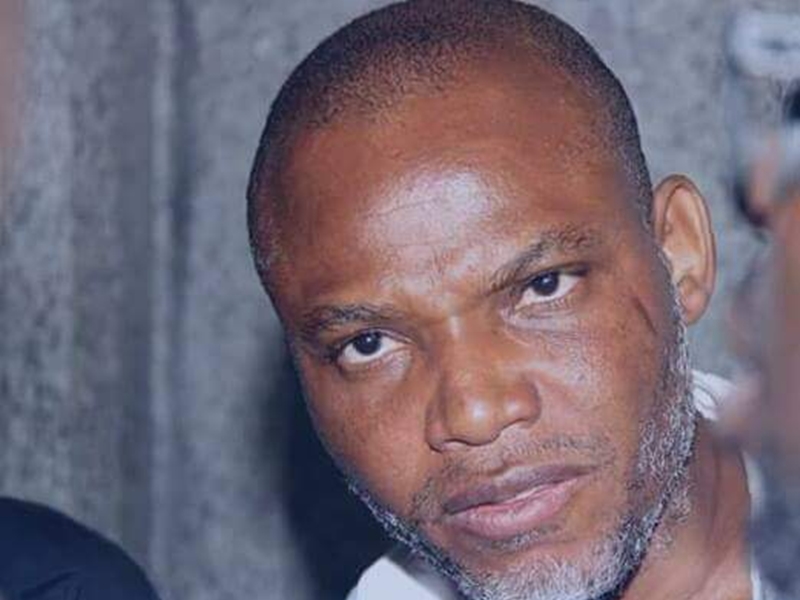
The leader of the proscribed Indigenous People of Biafra (IPOB), Nnamdi Kanu, has been sentenced to life imprisonment.
The sentencing was disclosed on Thursday by Justice James Omotosho of the Federal High Court, Abuja, after Kanu was convicted of terrorism.
It was gathered that Nnamdi Kanu was handed the life imprisonment sentence for Counts 4, 5, and 6 of the seven-count charges, while he was handed a 20-year jail term for Count 3 and a 5-year jail term for Counts 2 and 1.
The tale of Nnamdi Kanu’s arrest has gone global, and it has become a topic of public debate, especially on social media. The importance of Kanu’s trial was required and unavoidable given the extended years spent deciding the case.
The trial, which was marked by numerous unexpected acts that led to the delay, lasted ten years. It began in 2015, after he was arrested by the Nigerian military.
HOW DID IT START?
Nnamdi Kanu crawled into national discussions in 2009 after he launched Radio Biafra—a London-based station used for championing the Biafran cause—and garnered a huge following of Igbo people who believed in his cause.
Following the exposure he received from Radio Biafra, he established the Indigenous People of Biafra (IPOB) organization in 2014. IPOB—a platform via which he promoted his Biafran values and convictions.
Kanu, who began as a critic of the Nigerian government on Radio Biafra, disseminating messages that promoted and enabled Biafran independence, abruptly began campaigning for Igbo independence from Nigeria.
He started broadcasting messages termed as hateful to pit Igbo people against Nigerian people, recognizing that Nigeria is a multi-tribal country.
Kanu was believed to have spoken as a guest speaker at the World Igbo Congress in Los Angeles in 2015, telling his audience that guns and bullets are required for the Biafran cause.
Kanu was arrested in 2015 by Nigerian soldiers for allegedly propagating Biafran separatism through his radio station, Radio Biafra. The Nigerian Army transferred Nnamdi Kanu to the Department of State Security Service, where he was charged with treasonable felony and terrorism-related offenses.
He was also accused by the Nigerian government of criminal conspiracy, intimidation, incitement, and promotion of separatist sentiments, particularly among the Igbo people.
HIS ESCAPE?
Justice Binta Nyako of the Federal High Court, Abuja, on April 28, 2017, released Nnamdi Kanu from DSS detention on bail, citing health grounds.
Barely five months after being granted bail, Kanu escaped Nigeria after the military invaded his residence in Afara-Ukwu near Umuahia, Abia State, during the ‘Operation Python Dance II’ staged to quiet agitation for the Biafra Republic.
The federal authorities had acquired a court ruling designating IPOB as a terrorist group, resulting in the group’s prohibition.
Justice Binta Nyako on March 28, 2019, revoked the bail that was granted to Kanu on health grounds and issued a bench warrant for his arrest after the court had earlier ordered that the IPOB leader be separately tried from the rest of his co-defendants.
Despite Kanu’s absence, a Federal High Court in Abuja on November 26, 2020, commenced his trial, and five prosecution witnesses were reportedly provided to testify against Kanu.
HIS RE-ARREST?
Kanu was re-arrested in Kenya on June 19, 2021, four years after fleeing the nation, and allegedly returned to Nigeria by rendition.
Due to his prior history of disobeying bail conditions, the court remanded Kanu in the custody of the Department of State Services (DSS) facility in Abuja on June 26, 2021, pending the continuation of his trial.
ANOTHER ESCAPE?
On October 13, 2022, the Court of Appeals ordered his immediate release from detention and dismissed the allegations against him. This occurred just six months after eight of the fifteen counts against him were dismissed due to a lack of substance.
However, the Department of State Security Service did not follow the directive. They held Nnamdi Kanu in detention until the Supreme Court of Nigeria reversed the appellate court’s decision and reinstated the remaining seven-count terrorist charge for trial.
A NEW JUDGE?
In continuation of the trial, Justice James Omotosho in March 2025 took over the matter and ordered the “accelerated hearing” of the case.
DRAMAS OR TWISTS?
The trial was filled with drama and twists after a new judge took over. From the defense’s no-case submission to the defendant’s quitting his defense counsel and attempting to represent himself, it was a season of excuses.
Kanu had claimed that he couldn’t proceed with his defense because his old legal team hadn’t turned over his case file. He also claimed that he evaluated the prosecution’s case and found “no valid charge.”
He just ignored the judge’s instruction to file a written statement outlining his stance and returned to court with a new application seeking the denial of the terrorism-related charges, claiming that there is no statute against which his case is being tried.
Despite Justice Omotosho’s offer for Kanu to launch his defense on November 5 or risk being deemed to have waived his right to do so, he refused and argued that no legal legislation supported the charges filed against him.
He further claimed that the allegations against him were unjustified, saying that the relevant law (the Terrorism Prevention and Prohibition Act) had been repealed.
Justice Omotosho declared on November 7, 2025, that Kanu waived his opportunity to open his defense after the six-day deadline had ended. The court then schedules his terrorism case for decision on November 20, 2025.