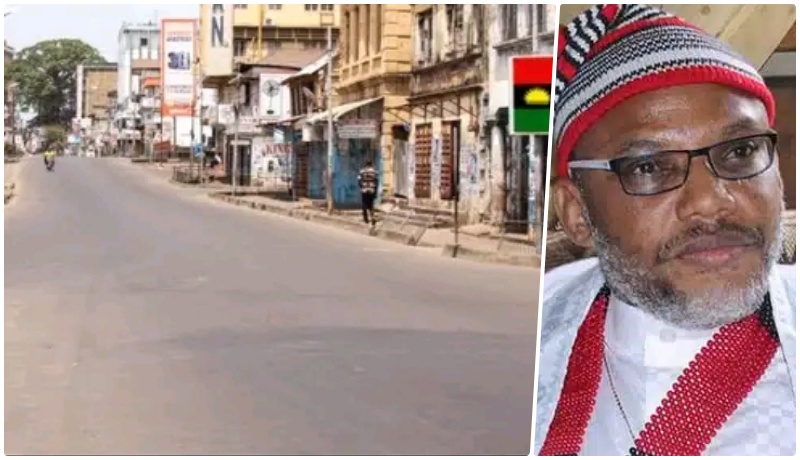
On November 21, 2025, the Federal High court sitting in the Federal Capital Territory, Abuja handed down life jail for the leader of Indigenous People of Biafra, IPOB.
Trial judge James Omotosho, who convicted Mr Nnamdi Kanu on all seven charges, said Kanu would have received death sentence due to the weight of his offences, but for scriptural persuasion to be merciful.
Mr Omotosho said he drew on chapter 22, verse 23 of the book of Matthew in the Bible to commute Mr Kanu’s punishment to life imprisonment instead of death penalty. He therefore sentenced the convict to life imprisonment for counts 1, 4, 5 and 6, “instead of death sentence”.


He added, “With respect to count 3, he is sentenced to 20 years’ imprisonment without fine. He is sentenced to five years’ imprisonment for count 7.”
Reading the judgement, he said that “He turned himself into a tyrant who can kill at will. The defendant cannot be allowed to remain in a sane human society,” the judge said.
However, with this development, Kanu was sent to prison to spend the rest of his life.
Nevertheless, it was thought that with the sentencing of the IPOB leader, the long-standing sit-at-home in the southeast zone would come to an end.
In any case, findings by our reporter showed that the opposite was indeed the case in the first Monday following the judgment.
At Ogige main market Nsukka, Enugu state, many traders stayed away from their shop for fear of being attacked.
It was even gathered that even some traders who usually came on Mondays to open their shops told their colleagues that they would not be coming on Monday, November 24, 2025, because of fear of unknown gun men who may avenge the life sentence of Nnamdi Kanu.
According to some traders who spoke under anonymity, “we were just here with eyes and ears wide open. We are equally afraid that the hoodlums may use the opportunity of sentencing Nnamdi Kanu to life imprisonment to wreak havoc on some shops.”
WITHIN NIGERIA gathered shops, banks and some filling stations remained shut down despite the fact that the case of the IPOB leader has been decided at Federal High Court, Abuja.


At Onitsha, the popular Onitsha-Owerri road was deserted even as so many streets looked like ghost town.
Our reporter gathered that many of the residents were either sitting at home for civil disobedience against the judgment handed down to the IPOB leader or for fear of attacks by supporters of the secessionists group.
According to one resident who spoke to our reporter on phone “sit-at-home in Igbo land has gone beyond the control of IPOB. Everybody is now angry with the federal government over the treatment of the IPOB leader who was later sent to life imprisonment. So, many people are now sitting at home in solidarity with IPOB members.”