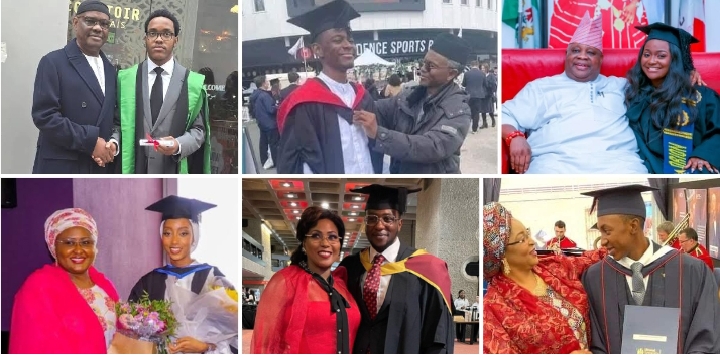
In a world where access to knowledge is both a privilege and a compass, a silent migration unfolds. It is not measured by passports or visas alone but by the corridors of power and opportunity that follow. Joaquin Wike moves through the storied halls of Queen Mary University in London carrying a name that resonates through Rivers State politics. Fatima Ajimobi walks beside him in her own academic ascent at King’s College London, a daughter whose father, Abdullahi Umar Ganduje, shaped the political skyline of Kano State. These journeys are about more than degrees; they are about preparation, influence, and a subtle reshaping of Nigeria’s elite educational landscape.
While local universities grapple with strikes, underfunding, and infrastructural gaps, the children of governors and top political figures traverse global campuses, earning master’s degrees and positioning themselves for influence. Their presence abroad underscores the contrast between privilege and the daily struggles of Nigerian students. Each lecture and seminar abroad becomes a tool of soft power, a quiet lesson in global exposure that cannot be replicated on a campus constrained by resources and unrest.
This feature traces the lives, choices, and implications of these students, weaving their stories into the broader narrative of Nigerian politics, education, and society. The accounts of Joaquin Wike, Fatima Ajimobi, Ahmad El-Rufai, Mohammed Sani Badaru, Titilola Adeleke, Mayo Daniel, and Zahra Buhari reveal a trend that is both celebrated and scrutinized. Their academic paths illuminate not just individual ambition but also the dynamics of elite preparation, public perception, and the silent expectations carried by political children.
As the nation watches, debates emerge. Some praise the pursuit of excellence, framing international education as an investment in national leadership. Others question fairness and equity, emphasizing the contrast between the resources available to political families and the struggles of the average Nigerian student. The journeys of these children are at once personal and emblematic, telling a story of opportunity, privilege, and the quiet flight of influence across borders.
Joaquin Wike and the Rise of Rivers State’s Academic Heirs
Joaquin Wike, son of Nyesom Wike, who served as governor of Rivers State and now oversees the Federal Capital Territory as Minister, represents a new chapter in elite education. His recent pursuit of a Master of Laws degree from Queen Mary University London is a strategic move, combining legal expertise with global exposure. In doing so, Joaquin navigates a world where education is not just about knowledge but about networks, influence, and preparation for roles that straddle governance and business.
Admission into such universities is rarely spontaneous. It requires foresight, planning, and, in many cases, strategic influence. Joaquin’s path exemplifies the careful orchestration behind elite education, from application to funding and relocation. It is a journey that underscores how political privilege can shape access to global academic opportunities. His story is emblematic of a growing trend among Nigerian governors’ children seeking master’s degrees abroad, a trend increasingly observed across the country.
The academic experience itself carries advantages beyond a diploma. Exposure to diverse legal systems, interaction with international peers, and immersion in advanced study equip Joaquin with tools that extend beyond Nigerian borders. Each seminar and lecture becomes a stage for cultivating global competence, a subtle preparation for leadership roles back home. Observers note that these educational experiences function as extensions of the political landscape, molding students to navigate both local and international arenas.
Public reaction is mixed. Some applaud the pursuit of knowledge, framing Joaquin’s journey as an investment in future leadership. Others highlight inequity, questioning whether the concentration of opportunity among political families diminishes the prospects for ordinary students. The narrative around Joaquin Wike’s degree is therefore more than academic achievement; it is a lens through which Nigerians examine privilege, governance, and the contours of opportunity.
Fatima Ajimobi and the Making of Kano State’s Scholarly Lineage
Fatima Ajimobi, daughter of former Kano State governor Abdullahi Umar Ganduje, follows a similar path, earning a master’s degree from King’s College London. Her choice mirrors Joaquin Wike’s in both destination and ambition, reflecting a broader pattern among the children of Nigeria’s elite. Fatima’s academic journey is less a solitary achievement and more a continuation of family tradition, linking political influence with global education.
The significance of her degree extends beyond personal fulfillment. For Fatima, the UK experience offers exposure to international policy perspectives, research methodologies, and professional networks that complement her father’s political legacy. The curriculum, coupled with the prestige of King’s College, provides both credibility and preparation for potential future roles in governance, diplomacy, or corporate leadership. Her education is a form of soft power, equipping her to operate effectively in spaces where local training might fall short.
In media coverage, Fatima’s graduation becomes a focal point for discussion about privilege, merit, and opportunity. Analysts note the contrast between her overseas education and the realities of Nigerian public universities, where students face strikes and limited resources. The story raises questions about equity, societal expectations, and the role of family influence in accessing global academic opportunities.
Fatima’s path, like Joaquin’s, illustrates a broader societal pattern. These elite children are not just accumulating knowledge; they are cultivating networks and skills that reinforce their family legacies. Their presence abroad signals an intentional shaping of a generation of leaders who combine domestic political lineage with international educational credentials, an evolution of Nigeria’s leadership pipeline.
Ahmad El-Rufai, Mohammed Sani Badaru, and the Expanding Network of Political Children Abroad
Ahmad El-Rufai, son of former Kaduna State governor Nasir El-Rufai, joins this cohort, earning a degree from a UK university, while Mohammed Sani Badaru, son of Jigawa State governor Badaru Abubakar, graduated from Brunel University London. These examples broaden the trend, showing that foreign education is not confined to a few families but spans multiple states and political lineages.
The decisions to pursue degrees abroad reflect both ambition and strategic planning. These students gain international exposure, develop global competencies, and secure credentials that can enhance their influence upon returning to Nigeria. Their academic journeys are meticulously structured, often supported by family networks, financial resources, and mentorship, ensuring that the benefits of their studies extend beyond the classroom.
Public attention on these figures often emphasizes the contrast with local educational struggles. Nigerian universities continue to face interruptions due to strikes, underfunding, and infrastructural challenges. Meanwhile, political children enjoy uninterrupted, world-class education, fueling debates about fairness and societal expectations. Critics argue that such concentration of opportunity among elite families perpetuates inequality, while supporters highlight the potential national benefits of globally trained leaders.
The presence of multiple political children in UK institutions also creates a network effect. These students, often studying contemporaneously, interact with peers from other influential families, establishing connections that may influence future collaboration in governance, business, and diplomacy. Their education is therefore both academic and relational, preparing them to navigate complex networks of power.
Josephine Adeleke, Mayo Daniel, and Zahra Buhari: Expanding the Pattern
Josephine Adeleke, daughter of Osun State governor Ademola Adeleke, graduated from a UK university in 2023, while Mayo Daniel, son of former Ogun State governor Gbenga Daniel, earned a degree from the University of London. Zahra Buhari, daughter of former President Muhammadu Buhari, completed her studies at the University of Surrey. Collectively, these examples illustrate the breadth of the trend, demonstrating that foreign degrees among political children are becoming a standard expectation rather than an exception.
The advantages of this educational trajectory are multifaceted. Students gain access to high-quality instruction, diverse professional networks, and international exposure. These experiences are designed not only to cultivate academic excellence but also to enhance social capital, giving these students credibility in both domestic and international arenas. Each institution offers unique strengths, and collectively, they serve as incubators for leadership preparation.
Media coverage often highlights the contrast with local students who navigate disrupted academic calendars, overcrowded lecture halls, and limited resources. This juxtaposition amplifies the perception of privilege and raises questions about equitable access to quality education. Public discourse frequently emphasizes the implications for societal cohesion, leadership development, and national capacity building.
The pattern also demonstrates intentional planning by political families. Selecting top universities, identifying fields of study with strategic relevance, and supporting their children through logistical and financial hurdles are all part of a broader framework. These efforts reflect an understanding of how global education can amplify influence and secure positions of authority in the future.
The Public Debate: Privilege, Equity, and National Implications
The recurrent stories of governors’ children graduating abroad provoke strong reactions. Some Nigerians celebrate the pursuit of global knowledge, framing it as an investment in the nation’s future. Others focus on equity, criticizing a system where children of the elite gain access to opportunities unavailable to ordinary students. This tension underscores a larger societal discourse on privilege, merit, and national development.
Key points of discussion include:
- The contrast between foreign education and local university challenges
- The potential impact of globally educated political children on leadership and policy
- Public perceptions of fairness and social mobility
- The ethical considerations of leveraging political influence for educational opportunities
Analysts suggest that while these degrees confer individual advantages, they also have broader implications for governance and leadership. A generation of political children trained in global institutions may introduce new ideas, approaches, and networks into Nigerian politics, potentially reshaping governance structures and policy priorities.
At the same time, the visibility of these educational choices heightens awareness of disparities in access to quality education. Students in public universities observe a parallel system in which the children of leaders benefit from uninterrupted, world-class instruction, raising questions about inclusivity and national cohesion.
Long-Term Impact on Leadership and Governance
The migration of Nigeria’s elite children to global universities is not a fleeting trend but a subtle reshaping of the country’s future leadership. When Joaquin Wike returns with a Master of Laws from Queen Mary University, or Fatima Ajimobi completes her studies at King’s College London, the education they carry is more than academic. It is a preparation for influence, a toolkit designed to navigate the intersections of law, politics, and business.
These graduates arrive with perspectives shaped by international standards, global networks, and exposure to systems that differ markedly from those in Nigeria.
Over time, these experiences are likely to redefine expectations of governance. Politicians’ children who have studied abroad are positioned to approach policy-making with a breadth of knowledge and a familiarity with global practices. This could result in more sophisticated approaches to administration, budgetary planning, and legal reform. The presence of internationally educated leaders may also encourage collaboration with foreign institutions, attract investment, and improve institutional frameworks. The potential ripple effects extend beyond governance; they influence the economy, education, and the conduct of public affairs.
At the same time, this pattern raises important questions. When leadership pipelines are increasingly populated by globally educated elites, the gap between ordinary citizens and political families widens. Public perception may oscillate between admiration for competence and frustration over inequity. The tension between opportunity and privilege becomes a defining feature of leadership narratives, challenging policymakers to balance excellence with accessibility.
Closing Reflection on Privilege, Opportunity, and National Equity
The pattern of foreign education among Nigeria’s political children underscores a delicate balance between opportunity and privilege. While these graduates gain skills, exposure, and networks that position them to contribute to national development, their access to such opportunities remains largely restricted to families of means and influence. For the average Nigerian student, local universities continue to face strikes, funding shortfalls, and infrastructural challenges, creating a stark contrast in access to quality education.
This disparity invites reflection on broader societal questions. What does it mean for equity when leadership pipelines are populated by those with uninterrupted global education? How can Nigeria ensure that the benefits of advanced education are accessible to a wider population while preserving merit and excellence? The experiences of Joaquin Wike, Fatima Ajimobi, and their peers serve as both an inspiration and a critique, highlighting the potential of education abroad while reminding the nation of persistent domestic inequities.