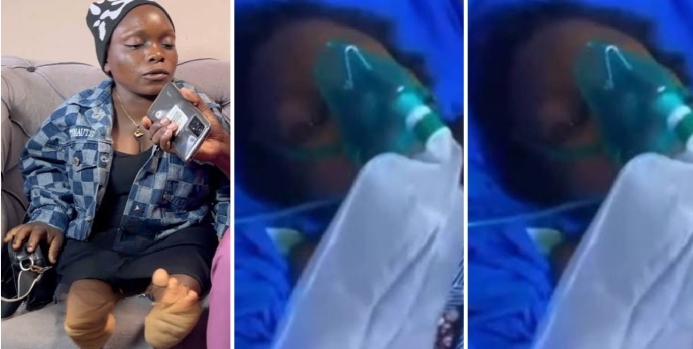
For years she has appeared on screen as a burst of laughter, a familiar presence whose size never limited her impact, whose voice carried warmth into living rooms across Nigeria. Now the images circulating are quieter and harder to process. A hospital bed, Oxygen support, Voices asking for help.
The story of Aunty Ajara has shifted suddenly, and the silence around key details has only deepened public unease. What is confirmed is sobering, what remains unknown is unsettling, and between both lies a fragile human life that Nollywood is urgently trying to protect.
The Moment the Industry Realised Something Was Wrong
The first signs did not come through official statements or press releases but through concern that spilled quietly onto social media. Colleagues who had worked with Aunty Ajara began sharing short videos and messages that carried a different tone from the usual industry chatter. In the footage, she lay on a hospital bed, visibly weak, receiving oxygen, her strength reduced to shallow movements that alarmed viewers instantly.
What struck many was not only her condition but the urgency in the voices of those posting. These were not vague calls for prayer alone. They were appeals rooted in immediate medical need. The language used by fellow actors suggested that the situation had escalated quickly, moving from manageable concern to something far more serious within a short time.
As the videos spread, confirmation followed from multiple Nollywood figures. Aunty Ajara was hospitalised. She was seriously ill. Treatment was ongoing. These were facts repeated consistently across posts, interviews, and shared messages. There were no contradictions about the gravity of the moment, only a shared insistence that time mattered.
This was the point at which the industry stopped speculating and started mobilising. What had been private became public not for attention but out of necessity, and in that shift the reality of her condition became impossible to ignore.
Hospitalisation and the Visible Signs of a Medical Emergency
The hospital setting offered the clearest confirmation that this was not a minor health issue. Aunty Ajara was shown receiving oxygen, an intervention typically reserved for patients whose breathing or oxygen levels require support. This single detail did more to communicate severity than any caption could.
Observers noted her reduced responsiveness and the absence of the energy that had defined her public persona. While no medical charts or doctor statements were shared, the visuals alone communicated distress. The presence of medical equipment and the tone of those around her indicated sustained treatment rather than routine observation.
Importantly, there was no attempt to dramatise her state. The videos were brief, restrained, and focused. That restraint strengthened their credibility. They were shared by respected actors and industry figures whose reputations rest on public trust, adding weight to what viewers were seeing.
The consistency of these images across different sources reinforced a single truth. Aunty Ajara was facing a serious health crisis that required continued medical attention and financial support.
The Absence of a Public Diagnosis and Why It Matters
One of the most striking aspects of this situation is what has not been said. Despite widespread concern, no official diagnosis has been disclosed. No illness has been named. No condition has been confirmed. This silence has been deliberate rather than evasive.
Colleagues who have spoken publicly have maintained a careful boundary. They describe her condition as serious and worsening, but stop short of attaching a medical label. Nigerian media reports have mirrored this caution, reporting only what has been verified without speculation.
This absence matters because it shapes public understanding. Without a diagnosis, narratives cannot settle into familiar explanations. The focus remains on care rather than curiosity, on support rather than conclusions. It also protects the actress’s medical privacy at a moment when vulnerability is at its peak.
At the same time, the lack of specifics has heightened anxiety. People struggle to process uncertainty, especially when confronted with visible suffering. The balance between transparency and dignity is delicate, and in Aunty Ajara’s case, those closest to her have chosen restraint.
The Financial Reality Behind the Appeals for Help
As concern grew, so did the clarity around another difficult truth. Medical care is expensive, and prolonged treatment compounds that cost rapidly. Several actors publicly confirmed that significant sums had already been spent on Aunty Ajara’s care, yet her condition continued to deteriorate.
This detail shifted the narrative from sympathy to urgency. It explained why public fundraising became necessary and why the appeals carried such emotional weight. The message was not abstract. It was practical and immediate. Funds were needed to sustain treatment.
Notably, these appeals came from multiple figures rather than a single spokesperson. Kemi Apesin, Adeniyi Johnson, Wumi Toriola, Dayo Amusa, and others echoed the same message. This consistency suggested coordination and shared understanding rather than individual panic.
The willingness to speak openly about money underscored the seriousness of the situation. It revealed the strain placed on individuals when healthcare becomes prolonged and unpredictable, even within a high visibility industry.
Nollywood’s Collective Response to a Personal Crisis
What followed was a rare moment of unity. Nollywood, often fragmented by competition and politics, responded to Aunty Ajara’s illness with a shared voice. Actors, producers, and fans rallied around a single goal. Keep her alive. Support her recovery.
This response was not performative. It involved repeated updates, coordinated fundraising efforts, and sustained attention rather than a brief wave of concern. The industry treated her condition as a collective responsibility rather than a private misfortune.
Such moments reveal the informal safety nets that exist within creative communities. When institutional support is limited, people rely on one another. In Aunty Ajara’s case, that reliance became visible and urgent.
The outpouring of support also reflected her standing within the industry. She was not a peripheral figure. She was someone whose presence had touched many careers and audiences, and that history translated into action when it mattered most.
Public Reaction and the Weight of Shared Concern
Beyond the industry, the public response was immediate and emotional. Fans shared prayers, donation links, and messages of encouragement across platforms. The tone was one of collective hope tempered by visible fear.
Many expressed shock at seeing a familiar face in such a vulnerable state. For audiences accustomed to seeing her bring joy and humour, the contrast was jarring. It humanised the distance between performer and viewer, collapsing it into a shared moment of concern.
Importantly, the public largely respected the boundaries set by those closest to her. While curiosity was natural, speculation about her illness was limited compared to other high profile health crises. This restraint suggested a growing awareness of the harm that unchecked rumours can cause.
Hope remained a constant thread. Even amid uncertainty, messages focused on recovery, strength, and survival rather than despair.
What Past Stories Do Not Explain
As attention intensified, some older interviews resurfaced. In these, Aunty Ajara had spoken openly about past personal trauma, including a painful pregnancy related experience. These stories were real, documented, and part of her public history.
However, colleagues and media outlets were clear on one point. These past experiences are not connected to her current illness. There is no evidence linking them, and drawing such connections would be misleading.
This distinction is crucial. In moments of crisis, narratives can blur, and unrelated hardships can be woven into false explanations. By separating past struggles from present facts, those reporting on her condition have helped maintain clarity.
The focus remains where it belongs. On her current medical state and the immediate need for support.
The Emotional Toll on Colleagues and Loved Ones
Behind every public appeal lies private exhaustion. Those closest to Aunty Ajara are not only managing logistics and finances but also emotional strain. Watching someone you know struggle for health while resources run thin is a heavy burden.
Several colleagues have spoken with visible emotion, their voices carrying fatigue alongside determination. These are not distant observers. They are people who have shared sets, rehearsals, and years of professional history with her.
This emotional toll often goes unacknowledged in public discourse. Yet it shapes every decision made, every appeal shared, every update posted. It is the quiet cost of caring in a crisis.
Their persistence despite this strain speaks to the depth of their commitment and the seriousness of the situation they are confronting.
Why This Story Has Resonated So Widely
Aunty Ajara’s illness has struck a nerve because it intersects with broader realities. It highlights the fragility of health, the limits of fame, and the financial precarity that can exist even within visible industries.
Many see in her situation a reflection of systemic challenges. The absence of comprehensive healthcare support for creative professionals. The reliance on public goodwill during emergencies. The thin line between stability and crisis.
These themes give her story weight beyond individual tragedy. They transform it into a mirror held up to the industry and society at large, prompting uncomfortable questions about preparedness and protection.
Resonance, in this case, is born from recognition.
What Is Known and What Remains Unclear
At this point, the verified facts are straightforward. Aunty Ajara is seriously ill. She is hospitalised, she is receiving oxygen, medical costs are high. Her condition has worsened despite treatment. Public support is being sought.
What remains unclear is the nature of the illness itself. There is no confirmed diagnosis. No timeline for recovery has been shared. No medical prognosis has been made public.
This balance of knowledge and uncertainty defines the current moment. It demands careful reporting and measured response. It also calls for empathy rather than assumptions.
Until more information emerges, restraint remains the most responsible stance.
Waiting, Watching, and Hoping for Recovery
As days pass, updates continue to arrive slowly. Each one is scrutinised for signs of improvement or decline. In the absence of clear milestones, hope becomes both fragile and necessary.
Those supporting Aunty Ajara understand that recovery is not always linear. They speak in cautious terms, neither promising improvement nor surrendering to fear. This realism grounds expectations.
For the public, waiting has become an act of solidarity. Sharing her story, donating when possible, and respecting her privacy are ways of participating in that wait.
It is a pause filled with concern, patience, and collective breath holding.
A Life Beyond the Headlines
It is easy for a health crisis to reduce a person to their illness. Yet Aunty Ajara’s life extends beyond this moment. She is an actress, a colleague, a woman whose work has contributed to Nigerian cinema in tangible ways.
Those who know her emphasise her resilience and spirit, qualities that do not vanish because of illness. They speak of her as someone fighting, even when strength appears limited.
Remembering this fuller picture matters. It frames her not as a passive subject of tragedy but as an active participant in her own struggle for recovery.
Her story is still unfolding.
Conclusion
The illness of Aunty Ajara has exposed both vulnerability and solidarity. It has revealed the stark realities of medical emergencies and the power of collective response. Verified facts paint a serious picture, while unanswered questions remind us of the limits of public knowledge.
What remains constant is concern grounded in truth rather than speculation. As support continues and treatment progresses, the focus stays on what matters most. Her life. Her recovery. Her dignity.
For now, the story is not about conclusions. It is about attention, care, and hope sustained through uncertainty.