It lasted only seconds, barely long enough to interrupt the choreography of state power, yet it lingered far beyond the ceremony itself. Cameras were already rolling, flags were already raised, and history was already being recorded when the moment happened.
A stumble in a foreign capital, witnessed by another head of state, captured in clean wide angles, and immediately released into a digital world that never forgets. Long before officials spoke, the footage had begun to speak for itself, quietly and loudly at the same time.
The Ankara Moment That Sparked a Global Pause
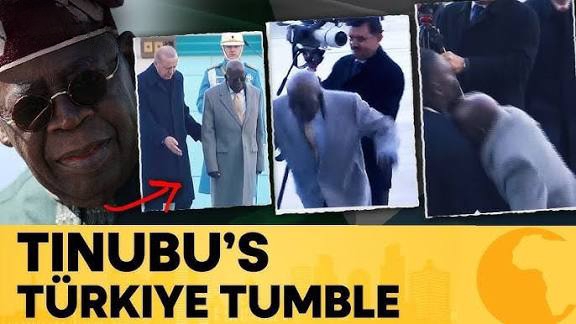
The incident occurred in Ankara, the capital city of Turkey, during an official welcome ceremony hosted by Turkish President Recep Tayyip Erdogan. President Bola Ahmed Tinubu was participating in a formal walk past that formed part of the ceremonial reception marking his state visit. As the two leaders moved along the designated path, Tinubu briefly lost his footing and fell, aides and protocol officers immediately stepping in to assist him back to his feet.
The event took place in a controlled diplomatic environment, with uniformed guards, dignitaries, and international media present. The surface appeared layered with ceremonial carpeting and metal fittings typical of state receptions, elements designed more for symbolism than traction. Within moments, the programme resumed, the Nigerian president continuing with the ceremony without visible interruption.
Video clips of the fall spread rapidly across social media platforms, amplified by the presence of foreign leaders and the formality of the setting. The imagery carried weight not because of the physical impact but because of where it happened and who was involved. In global diplomacy, optics matter, and every movement is interpreted beyond its physical meaning.
What made the moment resonate was not the fall itself but the silence between frames, the brief uncertainty before the official narrative arrived. In that space, public memory filled in gaps with history, speculation, and political context.
The Presidency’s Immediate Response and Narrative Control
Within hours, the Nigerian Presidency released statements aimed at containing interpretation and calming speculation. Officials confirmed that President Tinubu was in good health and that the incident did not disrupt his official schedule in Turkey. According to the statement, the stumble occurred after he stepped on a metal object or uneven surface, resulting in a temporary loss of balance.
The Presidency emphasized that the fall was not related to any medical condition and should be viewed as a minor incident rather than a health episode. It noted that Tinubu proceeded to attend bilateral meetings and continued his diplomatic engagements without adjustment, reinforcing the message of continuity and stability.
This framing was deliberate and precise. In international politics, health narratives around leaders often become proxies for broader questions of capacity and authority. By focusing on environmental factors rather than physical ones, the Presidency redirected attention away from the body and toward circumstance.
The speed of the response also reflected lessons learned from past episodes, where delayed clarification allowed speculation to harden into belief. In this case, the goal was not to deny the video but to contextualize it before alternative interpretations could dominate.
Public Memory and Tinubu’s History With Physical Stumbles
For many Nigerians, the Ankara footage did not exist in isolation. It immediately summoned memories of previous public moments involving President Tinubu’s physical balance. Most notably, during his inauguration at Eagle Square in Abuja in May 2023, Tinubu stumbled while ascending the steps to take the oath of office. At the time, he famously waved off concerns, later joking about missing a step rather than missing the moment.
That earlier incident occurred in the Federal Capital Territory during one of the most symbolically charged events of Nigeria’s democratic life. Like the Ankara fall, it was brief, non injurious, and quickly followed by normal proceedings. Yet it embedded itself in public consciousness because it happened at a moment of maximum visibility.
There have also been longstanding public discussions about Tinubu’s physical health, fueled by his age, his gait, and reports of medical travel abroad during his political career. These discussions intensified during the 2023 election campaign, when opponents raised questions about his fitness for office, often without concrete medical disclosures.
It is important to note that no officially confirmed chronic illness has been publicly disclosed by the Presidency. What exists instead is a pattern of visible moments that invite interpretation, especially in a political culture where transparency around leaders’ health has historically been limited.
The Body as a Political Text in Nigerian Leadership
In Nigeria, the physical body of a president carries symbolic meaning beyond biology. It represents endurance, authority, and continuity in a country shaped by memories of incapacitated leaders and opaque successions. From past administrations, Nigerians have learned to read between the lines, watching movement, posture, and presence as clues to deeper truths.
President Tinubu inherits this context. His public appearances are scanned not just for policy signals but for physical cues. A stumble therefore becomes more than a stumble, it becomes a text that citizens interpret using historical experience rather than medical evidence.
The Ankara incident fits into this tradition of bodily scrutiny. It triggered analysis not because of injury but because of association, with earlier moments, with age debates, and with Nigeria’s unresolved anxiety about leadership health disclosure.
This does not mean the interpretations are accurate, but it explains why they are persistent. In societies where official silence once masked serious illness, even transparency is often met with skepticism.
Media Amplification and the Speed of Interpretation
The speed at which the Ankara footage circulated illustrates how modern media collapses distance and context. Within minutes, the fall moved from a ceremonial ground in Turkey to timelines in Lagos, London, and Washington. Cropped clips, slowed footage, and speculative captions reshaped the moment before official explanations could anchor it.
Some reactions were sympathetic, others mocking, and many overtly political. Supporters emphasized the normalcy of accidental falls, especially on unfamiliar surfaces. Critics framed it as evidence of deeper issues, often linking it to governance debates unrelated to the event itself.
Traditional media outlets were more restrained, largely reporting the incident alongside the Presidency’s explanation. However, the initial viral momentum had already shaped public perception, demonstrating how first impressions often outpace corrections.
The episode underscores a reality of contemporary leadership, where every unscripted second is subject to endless replay and reinterpretation, regardless of intent or outcome.
Health, Age, and the Burden of Visibility
President Tinubu is in his seventies, an age where occasional balance issues are not uncommon even among individuals in good health. Globally, leaders of similar age have experienced public slips without these incidents defining their tenure. Yet context matters, and Nigeria’s political memory sharpens scrutiny.
There is no publicly available evidence that the Ankara fall resulted from a medical episode. No emergency intervention was required, no schedule was altered, and no follow up treatment was announced. These facts support the official position that the incident was minor.
Still, age amplifies perception. In political leadership, especially in Africa, age is often read through the lens of stamina and longevity, rather than experience alone. Every visible sign becomes a data point in an ongoing public assessment.
This places leaders like Tinubu in a paradox, where transparency is demanded but privacy remains necessary, and where ordinary human moments are elevated into political symbols.
Diplomatic Continuity After the Fall
Despite the brief disruption, the Nigerian Turkish engagement proceeded as planned. President Tinubu participated in bilateral discussions, diplomatic meetings, and state functions following the ceremony. There were no reports of shortened appearances or visible distress during subsequent engagements.
This continuity mattered. Diplomacy thrives on reassurance, and the absence of disruption sent a signal to both domestic and international observers that governance remained steady. Turkish officials treated the incident as inconsequential, maintaining protocol and schedule without adjustment.
By the end of the visit, attention had already begun to shift back to policy outcomes and diplomatic statements, though the video continued to circulate online. In practical terms, the fall altered nothing about the visit’s objectives or execution.
What lingered instead was the conversation it reignited, about leadership, health, and the stories societies tell themselves when power briefly loses its balance.
What the Ankara Video Ultimately Reveals
The Ankara fall reveals less about President Tinubu’s medical condition and more about the environment in which modern leaders operate. It exposes a world where symbolism outruns substance, where seconds outweigh hours, and where physical vulnerability is instantly politicized.
It also reveals a public still shaped by historical opacity, trained to watch closely because it once had to. In that sense, the reaction says as much about collective memory as it does about the man at the center of the frame.
For President Tinubu, the moment becomes another entry in a long public record, not defining on its own, but cumulative in perception. For observers, it serves as a reminder that leadership is lived in the open, where even the smallest misstep becomes part of the story.
And in the end, the ceremony continued, the visit concluded, and power remained intact, standing again after a brief, human interruption.