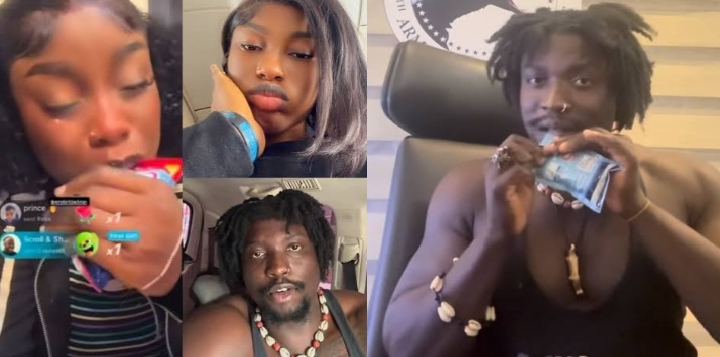
In early 2026, social media in Nigeria became a storm center due to a dramatic online feud involving VeryDarkMan (Martins Vincent Otse), a controversial social commentator, and King Mitchy (Mitchell Mukoro), a content creator and philanthropist. The conflict began as a dispute over a public school renovation in Delta State, which King Mitchy completed in six days and showcased online to highlight the impact of her charitable work. VeryDarkMan challenged the project’s transparency, alleging mismanagement of donations and suggesting that political motives might be involved.
The situation escalated further when Seyi Tinubu, son of President Bola Tinubu, was dragged into the conversation by VeryDarkMan, who claimed that Seyi had indirectly funded Mitchy’s project and posed a threat to his safety.
These allegations prompted many members of the public to question whether legal consequences, including arrest, could arise for either influencer. The question has gained urgency in Nigerian media circles, fueled by viral videos, social media speculation, and public commentary on both sides of the feud.
VeryDarkMan and the Allegation of Defamation
On February 27, 2026, VeryDarkMan posted videos publicly claiming that Seyi Tinubu was involved in King Mitchy’s activities beyond legitimate philanthropy. He suggested that Seyi’s involvement was politically motivated and implied that he faced personal danger due to these associations. Seyi Tinubu responded the next day, February 28, 2026, explicitly denying the allegations, calling them false, malicious, and defamatory.
He clarified that his only contact with King Mitchy was a public donation at a charitable event and insisted that he had never threatened VeryDarkMan in any way. In Nigerian law, public statements such as those made by VeryDarkMan, if proven untrue and damaging to reputation, can constitute civil defamation, which may lead to lawsuits, fines, or other legal remedies. However, accusation of defamation by itself does not automatically trigger arrest.
Legal processes must follow, including filing a formal complaint, court evaluation, and issuance of a warrant if the court finds sufficient merit. As of now, there is no credible report that Seyi Tinubu has formally filed such a suit against VeryDarkMan, meaning the risk of immediate arrest is purely speculative.
Legal Process Required for Arrest in Defamation Cases
In Nigeria, arrest for defamation is not automatic. The legal system requires several procedural steps before law enforcement can act. First, the aggrieved party must submit a formal complaint in court, outlining the statements alleged to be false and harmful.
Second, the court examines the evidence, including videos, social media posts, and witness statements, to determine whether the claims meet the threshold for actionable defamation.
Third, if the court finds that the case has merit, a charge may be issued, and a warrant could be directed to the relevant enforcement agencies. Importantly, these steps have not occurred in the VeryDarkMan and Seyi Tinubu scenario. Until formal legal procedures are initiated and validated by the courts, VeryDarkMan remains at no immediate legal risk of arrest, despite public speculation fueled by viral content and media discussion.
King Mitchy and Self‑Harm: Legal and Mental Health Context
Amid the feud, King Mitchy posted content that raised concern among followers, including the apparent consumption of harmful substances in livestream videos. Some commentators including Nollywood comic Actor, Ijebu believes that this could warrant legal action. However, under Nigerian law, self-harm or attempted suicide is not classified as a criminal offense. Individuals who engage in such behavior are typically referred to mental health professionals for intervention rather than criminal prosecution.
Public authorities and legal advisors in Nigeria have repeatedly clarified that arresting someone for self-harm is both legally unfounded and ethically inappropriate. The only exceptions could involve situations where self-harm causes harm to others, which is not the case here. Therefore, despite viral social media reactions calling for punishment, there is no legal basis to arrest King Mitchy for these actions. The emphasis in such situations is on providing psychological support, medical care, and intervention from professionals trained to handle mental health crises.
Viral Misinformation and Public Perception
Between February 25 and February 28, 2026, the feud took on an extraordinary viral dimension. King Mitchy’s management pronounced her death after ingesting harmful substances, and other content implied that VeryDarkMan himself had been threatened with or had staged his own death. Hospitals, including a private facility in Abuja, categorically denied admitting King Mitchy, clarifying that reports of her death were entirely false.
These episodes illustrate how rapidly misinformation spreads in online spaces, creating confusion about legal responsibilities, social obligations, and actual risk. For many viewers, the dramatic presentation of content blurs the line between reality and performance, making speculation about arrests or threats appear plausible even when officially there is no evidence. Public perception often lags behind verified facts, which reinforces the importance of careful fact-checking before forming conclusions about legal consequences.
Emotions Behind the Headlines
While much of the discourse centers on legality, the underlying human elements of fear, reputational concern, and social anxiety are significant. VeryDarkMan’s videos reveal genuine apprehension for personal safety, while King Mitchy’s content suggests distress and the pressure of public scrutiny. Seyi Tinubu’s measured and firm denial illustrates the difficulty faced by public figures who are unwillingly drawn into conflicts online. Observers must understand that social media amplifies not only messages but also the emotional stakes.
Misperception, misinterpretation, and rapid viral spread of information can heighten feelings of threat or urgency even when legal consequences are absent. These human dimensions underscore why professional guidance, clear communication, and responsible online engagement are critical in high-profile conflicts.
Conclusion: Arrest Risk Remains Hypothetical
Despite speculation, the legal reality is clear: VeryDarkMan faces no immediate risk of arrest due to Seyi Tinubu’s accusations, as no formal lawsuit or police complaint has been filed. King Mitchy similarly cannot be arrested for self-harm, which is treated as a mental health issue rather than a criminal act. Viral content and public outcry, while sensational, do not equate to enforceable legal action.
At this moment, the so-called arrest risk is entirely hypothetical and arises from misunderstanding, social media amplification, and public curiosity rather than verified law enforcement activity. The feud remains a cautionary example of how rapidly digital conflicts can grow, the gap between perception and legal reality, and the importance of careful interpretation of both verified facts and unverified social media narratives.