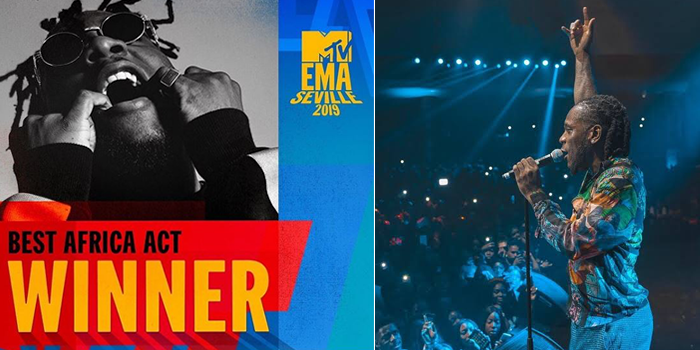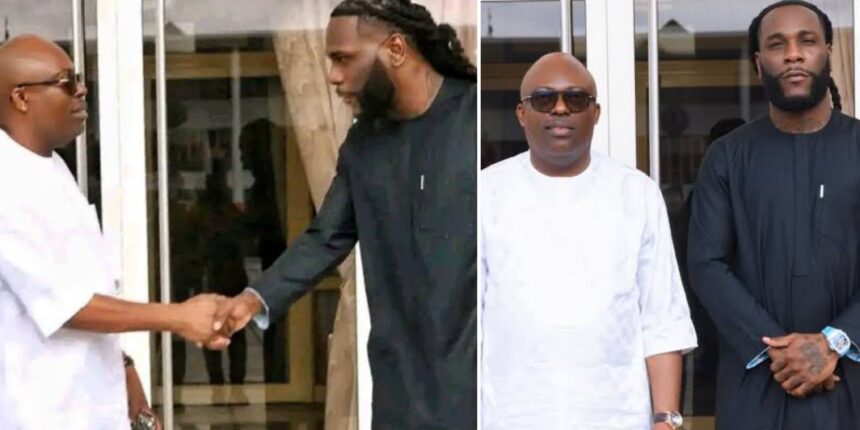
Port Harcourt witnessed a meeting of significance on March 17 and 18 2026 when Grammy-winning Nigerian singer Damini Ogulu, popularly known as Burna Boy, met with Governor Siminalayi Fubara at the Rivers State Government House. The encounter was not a casual visit nor a symbolic handshake for media optics, but a carefully coordinated discussion centered on community development in Burna Boy’s ancestral region of Ahoada West Local Government Area.
Accompanying the artist were his father, Samuel Ogulu, and music executive Soso Soberekon, highlighting that the visit was both professionally managed and personally invested. The timing of the meeting followed a series of viral social media posts that drew national attention to the state of public infrastructure in Ahoada West, particularly concerning dilapidated school buildings.
THE PURPOSE BEHIND THE VISIT
The meeting between Burna Boy and Governor Fubara was not merely ceremonial but focused on substantive interventions in education and healthcare infrastructure in Ahoada West. A viral video earlier in March 2026 highlighted a public school in the region with collapsing ceilings, crumbling walls, and unsafe conditions for students. The footage drew national attention and criticism, putting pressure on local authorities and sparking discussions about neglected educational facilities. Burna Boy’s intervention is framed as an effort to provide tangible improvements, including funding a full reconstruction of the school to create a safe and functional environment for children.
Beyond education, Burna Boy reportedly intends to extend his support to healthcare facilities in the community, addressing urgent needs for medical infrastructure and services. The discussions with Governor Fubara were structured to ensure alignment between private contributions and state oversight, reflecting a commitment to collaboration rather than unilateral action. The purpose of the visit highlights a broader understanding that community development in Nigeria requires partnerships between private actors, celebrities, and governmental agencies, ensuring that projects are not only funded but also implemented sustainably within existing regulatory frameworks.
KEY ISSUES DISCUSSED DURING THE MEETING
Several practical issues formed the core of the dialogue between Burna Boy’s team and the governor’s office. A primary concern was road access to construction sites in Ahoada West, including critical areas like Ogbogolo. Poor road infrastructure has historically limited the delivery of materials and hindered progress on development projects. Burna Boy’s representatives reportedly sought commitments that the state government would mandate relevant road authorities to repair and maintain access routes, facilitating the school reconstruction and any additional infrastructure initiatives. This discussion underscores the interconnected nature of local infrastructure, where roads, public buildings, and service delivery operate as an ecosystem requiring coordinated planning.
Another focal point was ensuring state support and collaboration for the projects. While specific commitments from Governor Fubara’s office have not been officially disclosed, the very act of dialogue signals a willingness to cooperate, provide logistical guidance, and navigate regulatory requirements together. The meeting likely addressed permits, coordination with local councils, and strategies for minimizing bureaucratic delays. Observers suggest that this interaction is indicative of a model in which celebrity-backed initiatives complement rather than circumvent governmental processes, demonstrating the potential for public-private partnerships to address systemic gaps in infrastructure and service delivery.
THE SYMBOLIC AND PUBLIC IMPACT
The meeting received extensive coverage in local and national media outlets, with commentary emphasizing the symbolic importance of a world-renowned Nigerian artist actively engaging with governmental authorities on community concerns. Social media discourse reflected a mixture of praise and critique. Many applauded Burna Boy’s decision to leverage his resources and visibility for tangible social impact, framing the intervention as a response to viral advocacy highlighting the educational and infrastructural neglect of Ahoada West. Others focused on the structural governance questions exposed by the viral videos, questioning why local officials had allowed the school to deteriorate to the point of public outrage.
The interaction also demonstrates the broader societal expectation that high-profile individuals carry a degree of social responsibility, particularly when their influence can drive attention to neglected areas. In Nigeria, where celebrity engagement often intersects with governance and public policy, Burna Boy’s initiative is illustrative of a growing trend where musicians, actors, and athletes engage directly in community development, using visibility to catalyze change while navigating complex political landscapes.
THE WIDER POLITICAL AND SOCIAL CONTEXT
Rivers State has been under scrutiny due to ongoing political tensions involving Governor Fubara, local councils, and historical administrative challenges. Within this environment, Burna Boy’s visit is noteworthy for its focus on infrastructure rather than direct political alliance. By framing the discussion around education, healthcare, and roads, both parties emphasized public service and community well-being. The meeting suggests that even in politically charged contexts, celebrity-led interventions can operate within governance frameworks to produce socially valuable outcomes without immediate political implications.
Furthermore, the meeting draws attention to the broader systemic issues affecting local governance, including inadequate infrastructure, limited resource allocation, and the challenges of ensuring accountability at the local council level. By directly engaging with the governor, Burna Boy both highlights these issues and positions himself as a proactive agent for change, reinforcing the concept that high-profile advocacy can influence public priorities while complementing governmental planning.
POTENTIAL LONG-TERM OUTCOMES
The outcomes of the meeting, though not fully disclosed in terms of concrete commitments, may shape several aspects of community development in Ahoada West. Improved road access could facilitate not only the reconstruction of the school but also broader economic activity and service delivery in the region. Rebuilt educational infrastructure may provide safe learning environments for students, potentially improving educational outcomes and community morale. Similarly, investment in healthcare facilities could address urgent medical needs, enhancing the overall quality of life for residents.
The collaboration also serves as a potential model for other celebrity-led interventions in Nigeria, demonstrating how engagement with state governments can produce measurable social impact while respecting regulatory frameworks and governance processes. The symbolic resonance of a Grammy-winning artist taking actionable steps to address local challenges reinforces expectations for public figures to contribute meaningfully to national development beyond entertainment and cultural influence.
RECEPTION AND MEDIA NARRATIVE
Local and national media have highlighted the meeting as a constructive intersection of celebrity influence, governmental responsibility, and community advocacy. News outlets noted that Burna Boy’s engagement was informed, purposeful, and aligned with the broader needs of Ahoada West, emphasizing social impact over political alignment. Online platforms captured public sentiment ranging from praise for proactive intervention to critique of systemic failures that necessitated such high-profile involvement.
Social media commentary emphasized the dual narratives of accountability and celebrity responsibility, sparking discussions on how Nigerian society can better integrate private initiative and public governance to address longstanding infrastructural deficits. The media framing underscores both the practical outcomes and symbolic significance of the meeting, demonstrating the potential for cultural influence to drive social change.
INSIDE THE COLLABORATION: CHALLENGES AND STRATEGIC CONSIDERATIONS
Implementing development projects in Ahoada West will require careful coordination between Burna Boy’s team, the state government, local authorities, and contractors. Challenges include navigating bureaucratic processes, ensuring timely material delivery, and maintaining oversight to prevent project delays or mismanagement. Road access remains a priority, as the transport of construction materials and personnel depends on functional infrastructure.
Another consideration is sustainability. Rebuilding a school or improving healthcare facilities is only meaningful if ongoing maintenance, staffing, and community engagement are ensured. Burna Boy’s approach appears to recognize this necessity, as discussions with Governor Fubara likely included strategies for long-term oversight, collaboration with local councils, and alignment with existing state development plans. This demonstrates an understanding that high-profile interventions must be coupled with practical governance considerations to produce lasting impact.
CONCLUSION: A MODEL OF ENGAGED SOCIAL RESPONSIBILITY
The March 2026 meeting between Burna Boy and Governor Siminalayi Fubara represents a convergence of celebrity influence, governmental oversight, and grassroots advocacy. Focused on education, healthcare, and infrastructure development in Ahoada West, the encounter highlights how high-profile Nigerians can engage meaningfully with government authorities to address pressing social needs. While the full extent of commitments and actions remains to be publicly confirmed, the dialogue signals a proactive collaboration and the potential for tangible community impact.
This initiative also underscores a broader societal trend in Nigeria where celebrities increasingly take responsibility for community development, complementing governmental efforts while drawing national attention to neglected areas. By leveraging influence responsibly and engaging with governance structures, Burna Boy’s actions offer a model for socially conscious interventions that prioritize sustainable impact, public accountability, and long-term community benefit. As the projects unfold, the outcomes will be closely monitored by both the public and media, setting a precedent for future engagements between cultural figures and government actors in the pursuit of social development.