In March 2026, Pete Edochie, the veteran Nollywood actor whose career spans decades and whose influence touches millions across Nigeria and the African continent, made a statement that immediately captured the attention of the public and political observers.
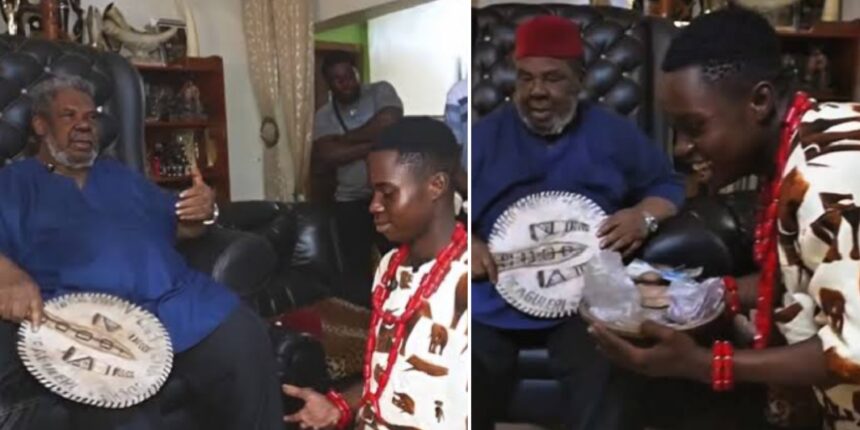
During a courtesy visit from popular social media personality and streamer Peller at his residence in Enugu State, Edochie shared a narrative that took place during the 2023 general elections. He recounted how six politicians visited his home ahead of the elections, seeking his prayers and spiritual guidance,
This revelation sparked a wave of public intrigue, debate, and discussions about the intersection of spirituality, celebrity influence, and political success in Nigeria.
The Visit
The story, as Edochie told it, began with the arrival of the six politicians at his home in Enugu. He described the atmosphere as solemn yet respectful, with each individual presenting themselves formally and acknowledging his standing as a cultural and spiritual elder. The presence of the ram and kola nuts served as both a cultural and spiritual gesture, signifying their request for his blessing. While the specific identities of the politicians were not disclosed, the sequence of their visit followed a recognizable pattern of seeking spiritual endorsement common in Nigerian political culture. During these visits, Edochie offered prayers for guidance, success, and protection, framing his role as one of spiritual intercession rather than political manipulation.
The meeting lasted several hours, as he explained, with conversation flowing naturally around values, ethics, leadership, and the responsibilities that come with public service. This extended exchange allowed him to understand each politician’s intent and aspirations while reinforcing the importance of moral and spiritual grounding before pursuing positions of influence.
The Prayer
Edochie described the act of praying for the politicians as a deeply personal and spiritual experience. He emphasized that his prayers were heartfelt, guided by his Christian faith, and infused with a desire for the leaders to succeed in a manner that would benefit their communities. He detailed that he prayed for wisdom in decision-making, courage to act ethically under pressure, and favor in the eyes of their constituents. According to him, the prayers also included a request for protection against political sabotage and guidance to remain steadfast in the face of challenges inherent in public office.
Edochie framed this practice not as a guarantee of victory but as a moral and spiritual foundation that, if acknowledged by the recipients, could influence the way they approached their campaigns and governance. He recalled moments during the prayers where the sincerity of the politicians was evident, their gestures and words reflecting respect and anticipation of a favorable outcome that transcended mere electoral success.
The Outcome
Following the visits and prayers, the 2023 elections proceeded across Nigeria with heightened public engagement and national interest. The presidential elections took place on February 25, 2023, accompanied by legislative and gubernatorial contests in various states. Enugu State, where Edochie resides, held its gubernatorial elections on March 18, 2023, creating a local backdrop that made the timing of the politicians’ visits particularly significant. Edochie recounted that, after the votes were counted and winners declared, all six politicians who had sought his prayers emerged victorious in their respective races.
He expressed this not as a boast of personal influence but as an acknowledgment of what he believes to be divine intervention. In his reflection, he highlighted the power of faith and spiritual practice in shaping outcomes that, while not deterministically causal, align with human desires for moral support, guidance, and reassurance in moments of uncertainty.
Cultural Context
To fully understand the significance of Edochie’s account, it is necessary to situate it within Nigerian cultural norms. Across the country, it is a long-standing practice for individuals in positions of influence, including politicians, to seek the blessings of elders, spiritual leaders, and culturally respected figures before embarking on important endeavors. These gestures are symbolic acts that reflect humility, reverence, and recognition of spiritual and communal values.
The offerings of kola nuts and livestock, as seen in Edochie’s account, are deeply embedded in the social fabric, serving as tangible expressions of respect and requests for divine favor. These practices are not merely ceremonial but are understood as meaningful exchanges that can shape personal conduct and the perception of constituents, thus influencing both the internal and external dynamics of leadership.
Spiritual Interpretation
Edochie framed the outcome of the politicians’ victories as evidence of divine responsiveness to prayer. He stated that “each time I make a request from Him, He grants it,” highlighting a personal conviction that spiritual intercession can produce tangible results. While he did not claim that his prayers were the sole factor in their electoral success, he emphasized the moral and spiritual dimension as an important precursor to leadership outcomes.
This interpretation aligns with broader Nigerian sensibilities, where faith and spirituality are integrated into daily life and national processes. By sharing his experience, Edochie provided insight into how individual belief systems intersect with public and political life, illustrating the ways personal actions guided by faith can coexist with secular democratic processes.
Public Reaction
Public reaction to Edochie’s revelation has been diverse, reflecting the complex interplay of faith, skepticism, and political awareness in Nigerian society. Supporters and admirers of Edochie celebrated his testimony as a demonstration of the enduring value of prayer and tradition in guiding human actions. Social media platforms were abuzz with discussions about the role of spirituality in electoral success and the symbolic significance of cultural practices.
Conversely, critics and secular observers questioned the logical link between prayer and electoral outcomes, emphasizing that elections are influenced by myriad factors, including voter engagement, party strategy, and sociopolitical dynamics. This debate has fostered a broader conversation about the limits of celebrity influence in political processes and the extent to which personal belief intersects with empirical outcomes.
Legacy and Influence
Edochie’s narrative also touches upon his enduring role as a cultural and spiritual touchstone in Nigeria. His decades-long career in Nollywood, combined with his public persona as a respected elder, positions him uniquely to offer perspectives that resonate across generations. The disclosure of the six politicians’ visits serves not only as a reflection on specific events but also as a broader commentary on the influence of respected figures in shaping societal norms, behaviors, and expectations.
By framing his involvement as a spiritual rather than political act, Edochie reinforces his legacy as someone who supports ethical leadership and moral grounding, highlighting the subtle yet meaningful ways cultural icons can influence public life without formal authority.
Edochie’s account encourages reflection on the ways personal belief systems inform leadership behavior, electoral participation, and community engagement. It also serves as a reminder that in societies where spirituality and tradition are valued, the line between personal conviction and public action is often nuanced and deeply interwoven.
Closing Thoughts
Pete Edochie’s conversation with Peller about the six politicians who visited him before the 2023 elections offers a window into how influence, respect, and culture quietly intersect in Nigerian public life. By sharing this story, he revealed the importance he places on guidance, prayer, and moral reflection, showing that leadership and success are not shaped by strategy alone but also by relationships and ethical support. The visit itself, with gifts and prayers exchanged, reflects humility on the part of the politicians and illustrates the ongoing relevance of tradition in contemporary society.
In relaying the experience to Peller, Edochie also highlighted the human side of politics—the moments of uncertainty, the search for reassurance, and the value of turning to trusted elders for perspective. While the identities of the politicians remain undisclosed, the narrative emphasizes the broader lessons about preparation, reflection, and integrity. It shows that unseen influences, such as guidance, mentorship, and moral grounding, can play as much a role in outcomes as visible efforts and ambition.