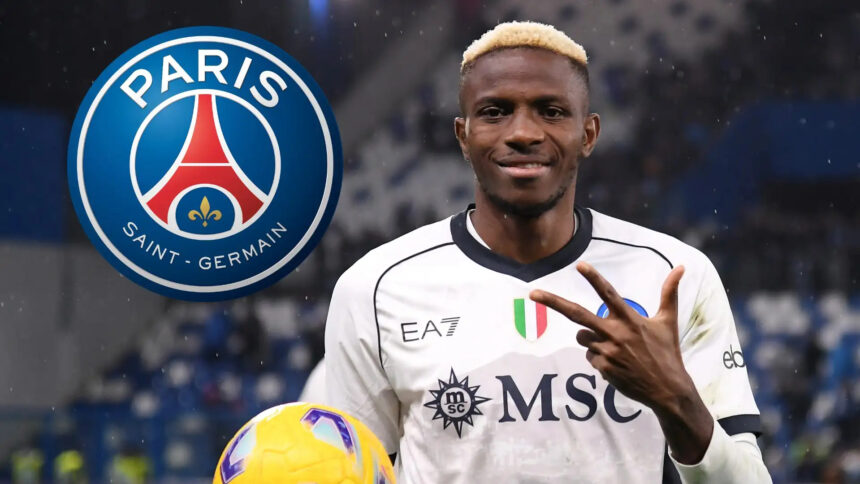
Paris Saint-Germain have a striker problem. It is not a new one, and it is not a secret. Since Kylian Mbappe left for Real Madrid in the summer of 2024, the French champions have fielded a rotating cast of options through the centre-forward position, none of whom has truly owned the role. Gonçalo Ramos, Randal Kolo Muani, Bradley Barcola, Ousmane Dembele deployed as a false nine, Luis Enrique has tried them all. And yet, when the most logical solution appeared to be available, a Nigerian striker who had just scored 37 goals in 41 games in his first season in Istanbul, PSG walked away.
- The Transfer That Never Was: How the PSG-Osimhen Saga Unfolded
- Luis Enrique’s Tactical Vision and Why Osimhen Did Not Fit It
- The Financial Reality: What a €150m Fee and €20m Salary Mean for PSG in 2026
- The Internal Power Struggle That Quietly Shaped the Outcome
- Dembele as False Nine: The Tactical Proof PSG Did Not Need Osimhen
- PSG’s New Transfer Philosophy and the End of the Galactico Era
- What Osimhen’s Galatasaray Numbers Say About the Rejection
- Conclusion: A Rejection That Says More About PSG Than It Does About Osimhen
Victor Osimhen is currently one of the most productive forwards in European football. That is not a matter of opinion. The numbers from his time at Galatasaray speak loudly and without ambiguity. He led the Turkish club to a domestic double in his loan season, then made the move permanent in July 2025 for €75 million. In the current 2025-26 campaign, he has already scored 17 goals in 25 appearances across all competitions, including seven in eight UEFA Champions League matches. By almost any conventional metric, he is the kind of striker PSG have been missing.
And still, PSG passed. According to reports from Foot Mercato confirmed in early March 2026, the Parisian club has officially turned down the opportunity to sign him, despite Galatasaray’s current asking price standing north of €150 million and Osimhen’s wage demands sitting at around €20 million net per season. The decision is layered, part tactical, part financial, part philosophical, and understanding it properly requires looking at what PSG have become, who controls their transfer strategy, and why the club that once spent €222 million on a single player now considers a €150 million bid an unacceptable risk.
Why PSG Rejected Victor Osimhen Despite His €150m Valuation
The full story of why PSG rejected Victor Osimhen despite his €150m valuation runs deeper than a single number or a single season. It starts with the manager’s philosophical preferences, runs through a deliberate shift in the club’s financial outlook, and ends with a tactical experiment that has paid off in ways that made pursuing Osimhen feel redundant. This is not a story about a striker who was not good enough. It is a story about a club that decided it no longer needed him.
The Transfer That Never Was: How the PSG-Osimhen Saga Unfolded
To understand the March 2026 rejection, it helps to trace the years of near-misses that preceded it. PSG’s interest in Victor Osimhen is not a recent thing. The club began circling the Nigerian as far back as the summer of 2023, when he was at the height of his powers at Napoli and fresh off a Serie A title. At that point, multiple reports linked PSG with a serious push to sign him as a long-term replacement for Mbappe.
By the summer of 2024, with Mbappe finally out the door and the striker position genuinely vacant, the interest intensified. Sporting director Luis Campos was, by all accounts, an enthusiastic advocate for the signing. According to Sky Sport’s Sacha Tavolieri, Campos believed strongly in Osimhen’s profile and pushed internally for the club to move. That summer also saw Napoli president Aurelio De Laurentiis claim he had rejected a combined offer of over €200 million from PSG for both Osimhen and Khvicha Kvaratskhelia, though separate reports from the same period suggested PSG were actually unwilling to match Napoli’s €120 million asking price for Osimhen alone.
What is clear is that a deal never materialised. Osimhen, unable to secure a permanent move anywhere in that transfer window, ended up joining Galatasaray on loan on deadline day of the 2024-25 season. By January 2025, PSG made contact again, and Osimhen himself reportedly turned down the possibility of joining them in the winter. He committed to staying in Istanbul for the remainder of the season, which he then finished with 37 goals and eight assists across 41 appearances, form that helped Galatasaray win the Super Lig and Turkish Cup double.
Galatasaray triggered the €75 million release clause in Osimhen’s Napoli contract in July 2025, completing a permanent deal that made him the most expensive African footballer ever at the time of purchase. The clause also included an ‘anti-Serie A’ provision requiring Galatasaray to pay double the transfer fee should they sell him to an Italian club before September 2027. When the 2025-26 season began, Osimhen was a Galatasaray player in the fullest sense, under contract until 2029, but with interest from Bayern Munich, Chelsea, Manchester United and others, his future remained a topic of constant speculation. PSG, according to Foot Mercato, had been considered a potential destination again heading into the summer of 2026. Their decision in March of that year to formally walk away closed the chapter.
Luis Enrique’s Tactical Vision and Why Osimhen Did Not Fit It
The single most important factor in PSG’s rejection is this: Luis Enrique does not want a traditional number nine. He never really has, at least not in the way PSG’s Qatari-era history would imply. The manager’s football is built around fluidity, pressing, positional interchangeability and collective movement. A physically dominant, box-based centre-forward who needs service and clear-cut chances is the antithesis of what his system demands.
Enrique’s PSG operates in a 4-3-3 structure on paper, but the reality is considerably more fluid. Wingers Dembele, Barcola and Desire Doue rotate and invert constantly. The midfield of Vitinha, João Neves and Warren Zaire-Emery is designed to overflow into attacking spaces. The ‘striker’ in this system is asked to drop deep, link play, create space with movement off the ball and contribute to the press. According to Foot Mercato, Enrique was not convinced by Osimhen’s profile, believing he does not fit the style of play he wants to implement. Reports from Legit.ng further noted that the PSG manager explicitly prefers versatile forwards over traditional number nines.
That preference is not just theoretical. The way Gonçalo Ramos was used when fit, dropping into midfield pockets, working as a link player, illustrates the kind of striker Enrique values. Even Randal Kolo Muani, whose time in Paris has been largely frustrating, was picked precisely because of his ability to press and move with the team rather than stand at the apex of an attack. Osimhen is a spectacular footballer, but his game is built around a different set of principles. He is a central, physical, instinctive finisher whose greatest strength, the combination of pace, aerial ability, hold-up play and clinical finishing, works best when an attack is designed around him, not around collective rotation.
That kind of forward-centric structure is almost the opposite of what Enrique has built in Paris. Asking Osimhen to operate as a Dembele-style false nine would be wasting his specific excellence in pursuit of a fit that has never been natural to his game. Enrique appears to understand this better than anyone, and his reluctance has been consistent and clear across two transfer windows of serious interest.
The Financial Reality: What a €150m Fee and €20m Salary Mean for PSG in 2026
Even setting aside the tactical mismatch, the economics of signing Victor Osimhen in 2026 are extremely difficult to justify when you lay them out plainly. Galatasaray’s asking price, according to multiple sources including Foot Mercato, sits above €150 million. Osimhen’s own wage demands are reported at €20 million net per season, a figure that would make him the club’s highest earner by a substantial margin, surpassing even Dembele’s gross salary of approximately €18 million per year.
The context matters enormously here. PSG three seasons ago had a wage bill that peaked at around €729 million per year. That figure was directly tied to having Mbappe, Messi and Neymar all on the books simultaneously. The deliberate dismantling of that structure has been one of the defining features of the Enrique era. By the 2025-26 season, PSG’s total estimated annual payroll had dropped to approximately €175 million, a dramatic reduction that reflects the club’s conscious move away from galactico economics.
Into that leaner structure, inserting a player who would cost north of €150 million in fees and demand €20 million per season in wages represents a radical reversal of the financial philosophy PSG have spent three years building. The fee alone would instantly make Osimhen one of the most expensive transfers in the history of the sport. The wages would disrupt a dressing room that has been constructed around the principle of collective merit rather than individual star power.
There is also the matter of UEFA’s Financial Sustainability Regulations, which replaced the old Financial Fair Play framework and impose stricter squad cost controls on elite clubs. A combined outlay of this scale, transfer fee amortised over a contract, plus wages, would have significant implications for PSG’s regulatory compliance. For a club that has already been sanctioned in the past over financial irregularities and is now navigating a more austere self-imposed model, such a deal sits awkwardly regardless of the player’s quality.
The Internal Power Struggle That Quietly Shaped the Outcome
One element of the PSG-Osimhen story that has not received enough attention is the internal dynamic at the club that influenced the decision at key moments. In the earlier rounds of this saga, particularly in the summer of 2024, sporting director Luis Campos was reportedly the primary advocate for signing Osimhen. His enthusiasm for the Nigerian was genuine and well-documented. The problem was that Luis Enrique was not on board, and between a sporting director and a head coach whose authority over squad composition has grown steadily since his arrival, Enrique’s position consistently prevailed.
That dynamic has only become more entrenched over time. Far from the narrative of Campos’s contract expiring and his influence waning, a story that circulated in early-to-mid 2025, the sporting director ultimately extended his deal at PSG until 2030, doing so in May 2025. Enrique too has been in discussions over a long-term extension to his own contract, with reports from Le Parisien and Sport in early 2026 indicating talks over a deal potentially running until 2030. PSG president Nasser Al-Khelaifi has repeatedly described Enrique’s appointment as the best decision of his tenure.
What has emerged from all of this is a clear hierarchy: at PSG, the manager’s footballing vision takes precedence in transfer decisions to a degree that was not always the case in the Qatari era’s earlier incarnations. When Enrique says no, the club ultimately listens. And on Osimhen, he has said no consistently, on technical grounds, across multiple windows. That consistency, combined with the financial realities, made the March 2026 rejection feel less like a surprise and more like the inevitable conclusion of a long-running internal assessment.
Dembele as False Nine: The Tactical Proof PSG Did Not Need Osimhen
Perhaps the most compelling evidence that PSG made the right call for their specific context is what Ousmane Dembele did when deployed as a false nine in the 2024-25 season. The former Barcelona winger, operating centrally under Enrique’s direction, produced one of the most extraordinary individual campaigns in PSG’s history, finishing with 33 goals and 15 assists across all competitions. He won the Ligue 1 Golden Boot with 21 league goals, claimed UEFA’s Player of the Season award, and played a central role in PSG’s historic sextuple, a clean sweep of six trophies across the calendar year 2025.
Dembele’s false nine displays were not just productive, they were structurally perfect for what Enrique wanted. His ability to drop deep and receive, his pressing intensity, his link play and his willingness to allow midfielders to run beyond him created exactly the kind of fluid, unpinnable attack that Enrique’s system requires. In the Champions League final against Inter Milan in Munich, where PSG won 5-0, Dembele contributed two assists and was central to a third goal. Enrique’s post-match assessment was unambiguous, he credited Dembele’s defensive contribution as much as his attacking output.
In the current 2025-26 season, Dembele has continued that productive form. FootyStats data shows him averaging 1.05 goals per 90 minutes in Ligue 1 through 14 matches, with 8 goals and 4 assists, a goal involvement of 1.57 per 90 minutes that places him among the elite forwards in Europe’s top leagues. The club has essentially answered its own number nine question with a player already on their books, one who costs nothing additional and whose wages are already factored into the squad’s financial architecture.
Signing Osimhen in this context would not be solving a problem. It would be disrupting a solution. The Nigerian’s game demands a specific type of service and a specific structural role that PSG have deliberately moved away from. Bringing him in would either mean changing the system that won them six trophies, which makes no managerial sense, or misusing one of the world’s best strikers as a kind of expensive rotational option. Neither outcome is attractive.
PSG’s New Transfer Philosophy and the End of the Galactico Era
The Osimhen rejection is not an isolated decision. It is consistent with a fundamental shift in how PSG approach the transfer market, a shift that has been one of the defining narratives of the Enrique era and which explains why the club that once spent €222 million on Neymar would now baulk at a €150 million package for a striker in peak form.
The new PSG buys young, technically developed players who can be shaped into the system. The investment in Warren Zaire-Emery from the academy, the acquisition of João Neves from Benfica, the signing of Desire Doue, the purchase of Khvicha Kvaratskhelia, these are all moves that prioritise profile fit and long-term development over short-term star-power. Even the Kvaratskhelia deal, at €70 million plus bonuses, made sense within this framework because the Georgian winger is precisely the kind of technical, pressing, position-fluid forward that Enrique’s system accommodates naturally.
According to Wikipedia’s detailed financial overview of the club, PSG’s total wage bill was dramatically reduced following Mbappe’s departure, dropping by approximately €80 million annually in a single season. The club sold Gianluigi Donnarumma to Manchester City for €30 million in September 2025 specifically because his contract renewal demands were incompatible with PSG’s new salary structure. Sporting director Campos was explicit about this: starting positions and contracts at PSG are now determined by merit and performance rather than reputation or past achievements.
In that philosophical environment, Osimhen presents a contradiction. He is a player whose enormous market value and wage demands are a product of a specific kind of individual excellence that PSG’s system does not prize above collective contribution. The club are not dismissing his quality, they are simply saying that his quality does not map onto what they are building.
What Osimhen’s Galatasaray Numbers Say About the Rejection
There is a certain irony in all of this. The very performances that have driven Osimhen’s valuation past €150 million, the 37 goals and eight assists in his loan season, the 53 goals in 65 Galatasaray appearances as confirmed by the club, the seven Champions League goals in eight games this season, are performances built in a system that is tailored around him rather than one that asks him to function peripherally.
Galatasaray play for Osimhen. Their attacking structure, their width, their service from midfield, it is organised to feed a dominant centre-forward who finishes with power, pace and clinical precision. That is a very different proposition from PSG’s collective machine. In Istanbul, Osimhen is the sun at the centre of the system. At PSG under Enrique, no individual player occupies that position. The system is the sun.
His Champions League form this season has been exceptional, seven goals in eight appearances gives him a rate of 0.88 per match, one of the highest in the competition. UEFA’s official data confirms that across those eight matches he has generated 34 total attempts and logged an average of 88 minutes per game, numbers that speak to both his volume and his endurance. This is a player at the peak of his career, producing elite output in elite competition. Bayern Munich, according to Foot Mercato, are now the most interested party for a summer move, with Vincent Kompany having approved of a transfer as the Bundesliga giants prepare for life after Harry Kane.
PSG knows all of this. The decision to step aside is not based on any doubt about his ability. It is based on a clear-eyed assessment that paying over €150 million in fees and €20 million per year in wages for a striker who does not fit the tactical template is a risk that the current club structure does not need to take. When you have already won six trophies in a calendar year without a traditional number nine, the argument for spending that kind of money to get one becomes very difficult to make.
Conclusion: A Rejection That Says More About PSG Than It Does About Osimhen
Victor Osimhen is not the problem. PSG rejecting him is not a verdict on his talent or his potential or the 53 goals he has scored for Galatasaray in under two seasons. It is a verdict on a very specific question: does he fit what PSG are building in 2026? And the answer, from Luis Enrique’s perspective, is clearly no.
The reasons are stacked in layers. The tactical mismatch is real and significant, Enrique’s system has no obvious place for a traditional box striker of Osimhen’s profile, and the manager’s consistent objection across multiple windows makes that position unmistakable. The financial burden of a deal costing over €150 million in fees and €20 million per year in wages runs directly against a club philosophy that spent three years deliberately moving away from superstar economics. The internal alignment between Enrique and Campos, now both locked in for the long term, means there is no longer a champion within the PSG hierarchy making the case for the signing.
What makes this story particularly instructive is that PSG’s position is defensible precisely because their alternative is working. Dembele as a false nine, supported by Barcola, Doue, Kvaratskhelia and an elite midfield, produced a sextuple and a first Champions League title. You do not dismantle a winning machine to accommodate a different kind of excellence, however spectacular that excellence might be.
For Osimhen, the destination in summer 2026 may well be Bayern Munich, where Kompany’s approval and the post-Kane rebuilding need make the fit feel considerably more natural. He will arrive wherever he lands as one of the most productive strikers in European football, with numbers that demand attention and a transfer fee that reflects a player in the absolute prime of his career. Paris simply was not the right canvas for that talent. The club has moved on, quietly and without drama, and so now must Osimhen.