The idea of creating a new state within Nigeria has always been a topic that ignites debate, passion, and, at times, controversy. Over the decades, state creation has not only been a political tool but also a means to preserve cultural identity, improve governance, and provide communities with greater access to resources. The latest proposal to create an “Anioma State” from the Delta North Senatorial District has drawn national attention and has once again brought to the fore questions about ethnicity, governance, political influence, and grassroots participation.
The initiative is particularly significant because it revolves around the Anioma people, a distinct subgroup of the Igbo ethnic group that resides in northeastern Delta State. Known for their rich history, linguistic uniqueness, and cultural pride, the Anioma have long expressed a desire to have a state that reflects their identity while enabling better management of their local affairs.
In 2026, the idea received a high-profile boost when Senate President Godswill Akpabio publicly announced the intent to create Anioma State, signaling a major political development that could reshape the geopolitical and cultural map of Nigeria.
Understanding the Anioma State Proposal – Roots and Political Drivers
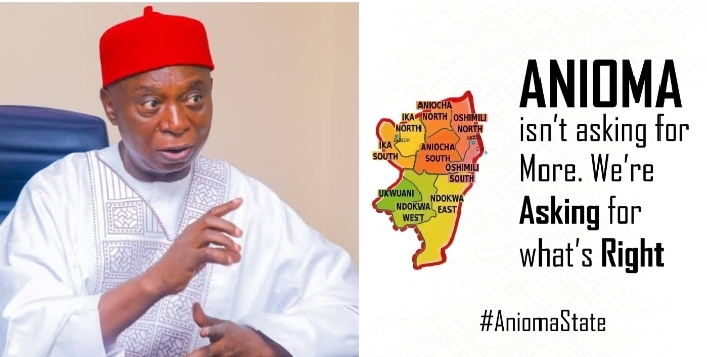
The “Anioma State” proposal refers to the formal plan to carve out a new federating state from nine local government areas currently within Delta North, all of which lie in Delta State. The name “Anioma” was coined in 1951 and represents a unifying identity for the Aniocha, Ika, Ndokwa, and Oshimili peoples, capturing centuries of shared cultural and historical experiences. For decades, these communities have expressed the desire for a more autonomous administrative framework, citing the need for improved infrastructure, representation, and economic development.
In 2026, Senator Ned Nwoko, representing Delta North at the National Assembly, emerged as a key sponsor of the state creation bill, advocating for a state that would consolidate Anioma communities under a singular governance structure. Political backing appears robust, with Senate President Godswill Akpabio publicly supporting the proposal and reports suggesting that as many as ninety-seven senators are in favour, indicating a high level of legislative interest. President Bola Tinubu is also reportedly supportive, lending weight to the initiative. While these endorsements are significant, the proposal must navigate a rigorous constitutional framework, demonstrating that political enthusiasm alone is insufficient to translate the dream into reality.
Proposed Composition – Nine Local Government Areas That Would Form Anioma State
According to the bill under discussion, Anioma State would comprise nine local government areas, all presently part of Delta State. These areas include Aniocha North, Aniocha South, Ika North-East, Ika South, Ndokwa East, Ndokwa West, Oshimili North, Oshimili South, and Ukwuani. These LGAs collectively represent the heartland of the Anioma people, forming a contiguous region with shared historical ties, cultural practices, and linguistic similarities. Discussions have also highlighted Asaba as the most likely choice for the state capital, a city that already functions as the capital of Delta State and serves as a commercial and administrative hub for the region.
By consolidating these LGAs under one state, advocates argue that governance could be more focused, resource allocation more equitable, and development projects more locally tailored. The proposal is not merely administrative; it is symbolic, reflecting the pride and identity of the Anioma people while seeking to empower them politically and economically in a federation where smaller communities often feel marginalized.
The Path to Legal Recognition of a New State
Creating a state in Nigeria is a rigorous process governed by the 1999 Constitution, and the Anioma proposal is no exception. The constitutional steps are deliberately complex, designed to ensure that state creation is not pursued lightly or without substantial consensus. First, a formal bill must be submitted to the National Assembly, typically accompanied by signatures from at least two-thirds of elected representatives from the affected area. This step ensures local legitimacy and demonstrates grassroots support. Second, the bill must secure approval in both chambers of the National Assembly – the Senate and the House of Representatives – with a two-thirds majority in each. Third, endorsements from the State Houses of Assembly and the local government councils in the proposed territory are required, again with at least two-thirds backing, ensuring that local governance structures formally support the initiative.
A referendum conducted by the Independent National Electoral Commission follows, with two-thirds of voters in the proposed state required to approve the creation. Finally, the results of the referendum must be ratified by a majority of all state assemblies across Nigeria, and the President must sign the bill into law. Historically, most Nigerian states were created under military regimes, where constitutional procedures were often bypassed. In contrast, Anioma State, if created under the current democratic framework, would need to successfully navigate this detailed and challenging process.
Areas of Debate – Geopolitics, Ethnicity, and Local Support
Several contentious issues have emerged around the proposed state. One key debate concerns its geopolitical classification. Delta State is currently part of the South-South geopolitical zone, but some leaders argue that Anioma State should be included in the South-East, reflecting the Igbo ethnic affinity of the region. This issue is more than administrative; it touches on representation in federal structures, allocation of resources, and political alliances. Local support is another matter. While some communities, like Igbanke in neighboring Edo State, have expressed interest in joining Anioma State, others have raised concerns over the proper process for inclusion and the legitimacy of endorsements purportedly representing their LGAs.
Some local government chairmen have explicitly distanced themselves from documents circulated online claiming to reflect support, insisting that formal procedures must be followed. The debates highlight the complexities inherent in state creation, where identity, politics, and local governance intersect.
Cultural and Historical Roots: Why Anioma Matters
The push for Anioma State is deeply rooted in history and cultural identity. The Anioma people have historically referred to themselves collectively as a distinct subgroup within the larger Igbo ethnicity, maintaining unique dialects, traditions, and social structures. During colonial and post-colonial Nigeria, the area was often referred to as the Mid-West Igbo, reflecting its position within a larger ethnic context while also asserting its distinctiveness.
Advocates argue that the creation of Anioma State is not simply a political move but a cultural imperative, a way to preserve heritage, provide appropriate administrative focus, and enable the Anioma people to chart their own developmental path. Over the decades, various movements and civic organizations have consistently championed the idea of state creation, emphasizing that local governance and resource control could be significantly enhanced by establishing a state that represents their collective identity.
National Attention and Controversy
The announcement of the Anioma State initiative has sparked discussions across Nigeria, both online and in traditional media. Supporters see it as long overdue recognition of the Anioma people, while skeptics question the feasibility of achieving all constitutional requirements and warn about potential political and ethnic tensions. Senate President Godswill Akpabio’s public backing has given the proposal credibility, while Senator Ned Nwoko’s sponsorship of the bill ensures a legislative pathway exists for debate and approval. The involvement of President Bola Tinubu, as reported, adds another layer of political weight, signaling potential alignment between executive support and legislative action.
However, the process remains delicate. Any misstep in garnering local support, referendum approval, or inter-state ratification could derail the initiative, leaving proponents frustrated. For the Anioma people, the issue represents both hope and uncertainty – hope that their cultural and administrative autonomy might finally be recognized, and uncertainty given the historical difficulty of state creation under a democratic system.
Challenges and Next Steps – From Proposal to Reality
While political support is significant, the legal and procedural hurdles cannot be underestimated. The bill must navigate multiple layers of approval, from local government and state assemblies to a nationwide referendum. Each stage requires careful negotiation, community engagement, and legal compliance. Historical precedent shows that very few state creation efforts under civilian governance succeed without broad consensus and meticulous planning.
Should the Anioma State proposal pass through all stages, the benefits could include improved local governance, enhanced development planning, and recognition of cultural identity. On the other hand, failure at any stage could prolong the status quo, reinforcing perceptions of marginalization and unfulfilled promises. The road ahead for Anioma State is thus both promising and complex, demanding political skill, social cohesion, and unwavering advocacy.
Conclusion – The Promise and Challenge of Anioma State
The Anioma State initiative encapsulates a complex mix of identity, governance, and political ambition. For the Anioma people, the proposal represents a long-sought opportunity to assert cultural identity, control local resources, and enhance development in northeastern Delta State. Politically, it showcases the influence of key figures like Senate President Godswill Akpabio, Senator Ned Nwoko, and, reportedly, President Bola Tinubu. Constitutionally, the effort illustrates the formidable challenge of translating political momentum into legal reality, requiring approvals across multiple levels and a successful referendum.
Socially, the proposal underscores the ongoing tension in Nigeria between ethnic identity, regional equity, and national governance. If realized, Anioma State would not only redraw political maps but also serve as a symbol of self-determination for a historically marginalized but culturally proud community. The coming months and years will determine whether Anioma transitions from a vision to reality, reshaping Delta North and Nigeria’s federal landscape.