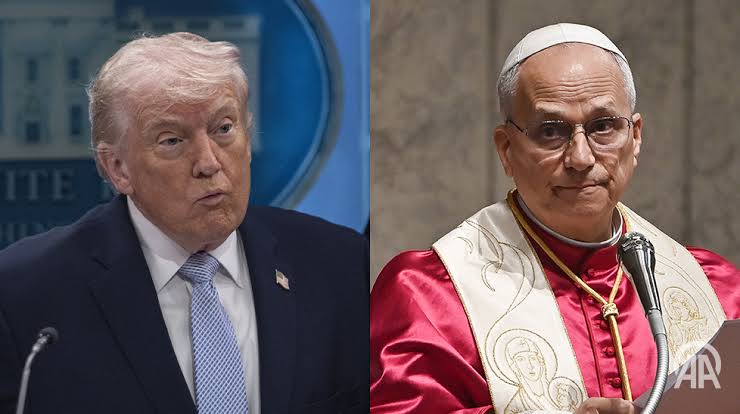
The ongoing tension between Donald Trump and Pope Leo XIV has become one of the most unusual public confrontations between a political leader and a religious authority in recent memory, not because disagreement between church and state is new, but because of how directly, publicly, and rapidly this exchange has unfolded during the 2026 global climate of conflict surrounding the Iran crisis. What makes the situation stand out is not only the clash of opinions but the collision of two different forms of influence, one rooted in state power and political strategy, the other rooted in moral authority and religious doctrine, both speaking into the same fast moving global crisis at almost the same time.
The events that followed between early April 2026 and mid April 2026 created a layered sequence of statements, reactions, and symbolic controversies that moved beyond traditional diplomacy into global media discourse almost instantly. The conflict became widely discussed not just for what was said but for how it was communicated, including public criticism, social media responses, and the introduction of artificial intelligence generated religious imagery into an already sensitive geopolitical moment. This combination of factors is what makes the situation historically unusual when compared to earlier interactions between United States political leaders and the Vatican.
Origins of Moral Political Divide
The earliest phase of tension began forming during late March 2026 as international concern increased over military escalation linked to the Iran conflict, with debates intensifying across global institutions regarding the legitimacy, scale, and consequences of intervention. Donald Trump positioned himself in favor of a strong military posture, arguing that decisive action and pressure were necessary to maintain stability and deter further escalation in the region.
Pope Leo XIV began addressing the same crisis through moral and ethical language, emphasizing restraint and warning against the normalization of war as a political tool. On April 3 2026, during a Vatican diplomatic address, he referred to the dangers of what he described as a delusion of omnipotence among global leaders, a phrase that quickly gained international attention because it appeared to challenge the moral foundation of military escalation strategies.
Rather than addressing any individual leader directly, the pope framed his message as a universal warning about the ethical limits of political power during conflict. However, the timing and tone of the statement led political observers and media outlets to interpret it as a clear counter position to leaders advocating for stronger military engagement, including Donald Trump. This interpretation set the stage for a public confrontation even before any direct exchange occurred.
The significance of this stage lies in how quickly moral commentary entered a fast moving geopolitical debate, removing the traditional distance between religious reflection and political decision making. The Vatican statement circulated globally within hours, becoming part of the same media environment that was covering military developments, which intensified its perceived political weight.
Public Confrontation Through Digital Platforms
The second phase of the conflict began on April 6 2026 when Donald Trump responded publicly through digital platforms, marking the shift from indirect interpretation to direct confrontation. His statements criticized Pope Leo XIV in strong terms, describing his position as weak on crime and overly liberal in approach to global security issues, while also accusing him of aligning with political movements opposed to Trump’s worldview.
Trump further argued that the pope should remain outside geopolitical decision making, asserting that religious leadership should not interfere in matters of national security or military strategy. His supporters reinforced this position, framing the pope’s comments as an overreach into political territory rather than a moral observation.
Pope Leo XIV did not immediately respond to these remarks, maintaining his established position that moral responsibility requires speaking even when it leads to disagreement with political leaders. Vatican representatives reiterated that the pope’s message was not intended as a personal criticism but as a broader ethical reflection on global conflict and human responsibility.
This phase became historically notable because of the platform through which it unfolded. Instead of formal diplomatic communication or structured institutional dialogue, the exchange occurred in a public digital space where statements were immediately visible to global audiences, reshared within minutes, and interpreted without mediation. This removed the traditional boundaries that once separated political disagreement from global public discourse.
The rapid visibility of both statements contributed to an environment where reaction and counter reaction developed almost simultaneously, creating a continuous loop of commentary that expanded the conflict beyond its original context.
Symbolic Escalation Through Artificial Imagery
A significant turning point occurred on April 8 2026 when Donald Trump shared an artificial intelligence generated image depicting himself in a Christ like visual style, characterized by symbolic lighting, elevated posture, and religious aesthetic elements associated with traditional depictions of healing figures. The image circulated widely across social platforms within hours, generating immediate debate about its meaning and appropriateness.
Religious scholars, cultural commentators, and political analysts responded with concern over the blending of sacred symbolism with political identity, particularly in the context of ongoing global conflict. Some interpretations viewed the image as metaphorical messaging about leadership strength and restoration, while others considered it a misuse of religious imagery during a sensitive geopolitical moment.
Reactions from religious communities were especially strong, with several leaders describing the image as inappropriate due to its association with sacred representation. International political figures also commented, including statements from global leaders who viewed the imagery as contributing to unnecessary tension during an already unstable period.
Donald Trump later defended the image, stating that it was intended to represent leadership and healing rather than religious substitution or theological commentary. Despite this explanation, the image was eventually removed from public platforms, but by that point it had already become a central point of global discussion.
This moment is historically unusual because it represents one of the earliest large scale political controversies involving artificial intelligence generated religious symbolism linked directly to an active geopolitical dispute involving a major political figure.
Vatican’s Response Through Moral Clarity
Following the escalation, Pope Leo XIV responded on April 10 2026 during a public address that maintained a calm but firm tone. He stated that moral responsibility requires speaking clearly about the consequences of war while avoiding participation in political hostility. He emphasized that the role of religious leadership is not to compete with political authority but to provide ethical guidance when human life and dignity are at risk.
The pope reaffirmed opposition to continued military escalation in the Iran conflict and warned that sustained violence could deepen global instability and humanitarian suffering. He also addressed the broader issue of religious symbolism, cautioning against its use as a tool for political identity or conflict justification.
Notably, Pope Leo XIV avoided direct personal references to Donald Trump during this response, maintaining a consistent approach of addressing issues rather than individuals. This distinction reinforced the Vatican’s effort to preserve institutional tone despite increasing public attention and political pressure.
The restraint shown in this phase contributed to global discussions about leadership communication styles, particularly the contrast between emotionally direct political messaging and structured moral discourse rooted in institutional tradition.
Global Political Reaction Patterns
By April 11 2026, reactions from international actors had intensified significantly. Several European political figures expressed concern over the tone of the exchange, warning that direct public criticism between high profile leaders of state and religion could complicate diplomatic relations during an ongoing conflict environment.
Within Iran, official responses expressed support for the pope’s calls for restraint, framing his position as aligned with broader appeals for de escalation in the region. This alignment created an unusual geopolitical overlap where a religious authority based in the Vatican found rhetorical convergence with a government involved in the conflict under discussion.
Within the United States, analysts focused on the potential domestic implications of the exchange, particularly among Catholic voters who represent a significant demographic group. Discussions centered on whether the public disagreement could influence perceptions of moral leadership or political judgment among moderate religious communities.
Religious organizations across multiple denominations also responded, emphasizing the importance of maintaining clear boundaries between spiritual authority and political governance while acknowledging the historical role of religious voices in advocating for peace during times of war.
Structural Difference From Historical Precedent
Comparing this situation with earlier interactions between United States political leaders and the Vatican reveals significant structural differences. Past disagreements typically occurred through formal diplomatic communication, carefully worded public statements, or indirect messaging that preserved institutional distance between the two authorities.
Earlier historical moments involving disagreement over war policy or social issues rarely involved direct personal criticism between a sitting pope and a United States political leader in a public digital environment. Communication was usually filtered through diplomatic channels, reducing the likelihood of rapid escalation.
The current situation differs in three major ways. First, communication is instantaneous and globally visible, allowing statements to circulate without institutional moderation. Second, artificial intelligence generated imagery introduces new symbolic dimensions that were not present in earlier historical periods. Third, public interpretation now occurs in real time across global audiences, creating immediate feedback loops that amplify tension.
These differences combine to create a form of interaction that is structurally new rather than simply politically contentious.
Philosophical Divide Between Authority Models
At the core of the conflict lies a fundamental disagreement about the nature of leadership and authority. Donald Trump’s approach emphasizes national strength, strategic control, and the belief that political decisions should be guided primarily by state interest and security considerations. Within this framework, external moral critique is often viewed as secondary to sovereign decision making.
Pope Leo XIV represents a different model in which moral accountability is inseparable from leadership responsibility. From this perspective, religious authority is not positioned as political power but as a conscience based voice that must speak when human dignity and ethical boundaries are at risk.
These two perspectives create a structural tension that extends beyond individual disagreement. One prioritizes autonomy of state action, while the other emphasizes universal moral obligation that transcends political boundaries. When both are expressed publicly during an active global crisis, the result is a visible ideological collision that gains international attention.
Why This Moment Stands Out Historically
The combination of factors present in this situation makes it historically unusual when compared to previous political and religious interactions. The directness of communication between a major United States political figure and a sitting pope, the involvement of artificial intelligence generated religious imagery, and the rapid global amplification of every statement together create a unique convergence of political, technological, and moral dimensions.
Rather than unfolding through slow diplomatic processes, the entire exchange developed in a compressed timeline between April 3 2026 and April 11 2026, with each phase escalating through public visibility rather than private negotiation. This speed contributes significantly to its uniqueness in modern political history.
The situation also reflects a broader transformation in global communication, where authority is constantly negotiated in public view and where symbolic actions can carry immediate international consequences.
Closing Reflection
The tension between Donald Trump and Pope Leo XIV is not defined by a single disagreement but by a sequence of interactions that reveal deeper questions about authority, morality, and global responsibility during crisis. The historical significance lies not only in what was said but in how quickly and widely it was experienced across the world.
As events continue to develop, the situation remains a clear example of how modern political leadership and religious authority can collide in a digital environment that amplifies every word, image, and reaction into global discourse within moments.